
My Mom Mails Me Five-Kernel Mooncakes Every Year. The Rest of China Eats Something Else.
From Henan’s giant taro-mochi pastry to Chaoshan’s fermented bean curd cakes, here’s how one holiday tastes completely different across China.
I
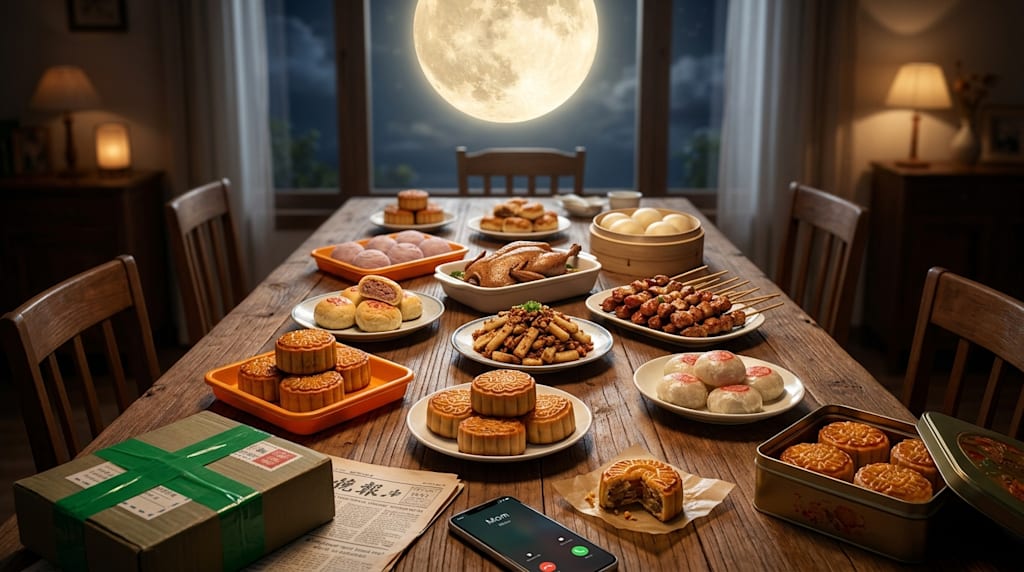
When my mother’s package arrived, Mid-Autumn had already passed by three days.
The box was from China Post, wrapped in three layers of green tape. I cut it open. Inside was old newspaper. Inside the newspaper was a tin box. The box said “Five-Kernel Mooncake” in gold characters on a red background. One corner had chipped, exposing bare metal. I opened it. Ten cakes, each wrapped in oil paper. The paper was soaked through with oil, translucent. Through it I could see bits of green and red candied strips.
I picked one up and took a bite. The crust was hard. The filling was loose. The rock sugar gritted against my teeth. The melon seeds carried a stale edge. I chewed twice, swallowed, then put the remaining half on the table and went to the kitchen for water. When I came back, the half-mooncake was lying beside the tin box, its oil paper spread open like an upturned palm.
My mother sends one every year. Every year I can’t finish them. Every year she asks: Was it good? I say yes. She says: Then eat more. I say okay.
II
If you ask a Chinese person what to eat for Mid-Autumn, nine times out of ten the answer is mooncake. If you ask what kind, the answers scatter. The same full moon shines on a hundred different tables. Each table has its own version.
Mooncakes are the most visible marker of Mid-Autumn. They have shaped the holiday’s image across China: worshiping the moon, reunion, gifts, longing. Under that shared image, mooncakes were never one thing. The national standard lists nine regional styles. Folk counts say there are nearly a hundred. Beijing style, Cantonese style, Suzhou style, Teochew style, Yunnan style, Shanxi style, Hong Kong style. All are called mooncakes. Each has its own temper.
III
Northern mooncakes often carry the plainness of wheat.
Beijing-style zilaihong and zilaibai have dense, dry crusts and low sweetness. Bite in, and you taste nuts, rock sugar, and the aroma of green and red candied strips. When I was a child, I broke open a zilaihong first, dug out the chunks of rock sugar, and held them in my mouth until they melted. I didn’t eat the green and red strips. I picked them out one by one and left them on the table. My grandmother saw me and said: Don’t waste food. She gathered the strips into her palm, tossed them into her mouth, chewed, and said: Sweet.
In Shanxi and Inner Mongolia, mooncakes are often made with oil and flour. They are rustic in shape and filled with red dates, walnuts, beans, even flaxseed oil and brown sugar. Fengzhen mooncakes from Inner Mongolia are known for their flaxseed-oil fragrance and flaky crunch. I had a college classmate from Fengzhen. He said his family didn’t cook dishes for Mid-Autumn. They ate mooncakes, one per person, with a pot of brick tea. He said this in September, with osmanthus outside the dorm window. He stared out and said: Is the moon in the south smaller than ours?
IV
In Henan these past few years, the mooncake that has broken out is not the traditional five-kernel one. It is the giant mooncake from Pangdonglai.
Its official name is “pastry.” It is about fifteen centimeters in diameter and two centimeters thick, the size of a six-inch pizza. It is golden and round, set in an orange square tray. The taro-mochi flavor has a soft, milky crust, smooth taro paste, stretchy mochi, and salty meat floss with egg yolk. The red bean-egg yolk flavor has grainy red bean paste and oily salted duck egg yolk. Its biggest feature is its short shelf life: only seven days. Made the same day, taken off the shelf the next. No stockpiling, no warehouse pressure.
I have a friend from Xuchang. Last Mid-Autumn, he queued for forty minutes and bought two boxes. He sent me a photo: the mooncake on his office desk, next to a cup of Americano. He said: Guess what? In front of me in line was an old man who bought six boxes. He said he was mailing them to his son in Shenzhen. His son hadn’t come home for Mid-Autumn in ten years. Every year he asked his father to mail them. The old man said: He doesn’t come back, so I send them. He eats them, and it’s like he came back.
V
In Jiangsu, Zhejiang, and Shanghai, the mooncake’s temper changes.
Most mooncakes are eaten cold. Here, fresh pork mooncakes are eaten hot, straight from the oven. They belong to the Suzhou-style branch. The crust is made by repeatedly rolling and folding water-oil dough and oil dough. The flakiness must come from lard. The baked crust falls apart at a touch. You have to cup one hand under your chin to catch the flakes.
I have a friend in Hangzhou, surnamed Chen, who designs gardens. Every year a week before Mid-Autumn, he queues at an old shop on Pinghai Road. He says: You don’t understand. A cold fresh pork mooncake has a soft crust and congealed fat. Bite in and it’s like chewing a wet towel. It must be hot. You stand at the window, take a bite, the juice burns your upper palate, you hiss, then breathe out, and that breath is white.
He said one year, while queuing, an old woman stood in front of him. She bought two boxes, held them to her chest, and didn’t leave. She just stood by the road, watching. He came out after buying his, and she was still there. He asked: Auntie, are you waiting for someone? She said: No. I bought these for my husband. He passed away three years ago. He used to eat them every year. I buy them, put them in front of his photo, and I eat one myself.
Chen said: After that, every year I queue, and I don’t find the line long anymore.
Hangzhou people add diced zhacai pickled mustard tuber to the meat filling. The crisp saltiness of the pickle meets the juice of the fresh pork. It cuts the richness and lifts the flavor. I ate one once on Hefang Street, after queuing half an hour. I bit down. Juice splashed onto my sleeve. The diced pickle crunched between my teeth. I stood by the street, watching tourists come and go. Suddenly I felt that this city had turned Mid-Autumn into everyday life.
Nanjing people must eat osmanthus duck. The ducks are fat and tender then, carrying the scent of osmanthus. In the Jiangnan region, people also eat lotus root sandwiches, symbolizing reunion, and taro, hoping for a good “surplus.” Ningbo, by the sea, has seaweed mooncakes. They mix the salty freshness of seaweed into nuts. The result is a unique sweet-savory flavor.
A mooncake in Jiangnan can be a hot dish. It can also taste like the sea.
VI
Cantonese-style mooncakes are the “Mandarin” of mooncakes. Thin crust, thick filling, rich and soft. Lotus seed paste with egg yolk is the eternal classic. Five-kernel with Jinhua ham is also beloved. Its influence is the widest. You can find it almost anywhere in China.
But the mooncake culture of the Chaoshan region is unique in the entire country.
Chaoshan has la bing. La means lard in the Teochew dialect. La bing is a pastry made with lard mixed into flour for the crust, wrapped around sweet filling and baked. It is the representative of Teochew-style mooncakes. Both crust and filling depend on lard. The crust is made with lard for flakiness. The filling is blended with lard as well. The crust is folded and rolled countless times, then fried in warm oil. Layers open like a peony. It flakes at a touch and melts in the mouth. The filling is mainly mung bean paste or black bean paste, with white sugar and lard. It is sweet, crisp, soft, rich but not cloying.
There is also fermented bean curd pastry. Legend says that in old Chaozhou, there was a pastry shop. The head baker overheard the owner planning to replace him. In a rage, he dumped a jar of red fermented bean curd, half a basket of garlic, and a bottle of aged wine into the mung bean filling and stirred it all together. Unexpectedly, when this angry batch was baked, it had a strange fragrance and sold out immediately.
I have a colleague from Chaoshan, surnamed Lin, a product manager in Shenzhen. Every Mid-Autumn he goes home and comes back with a box of fermented bean curd pastries. He leaves it at his desk and offers one to anyone who passes. I tried one. The first bite brought the salty fragrance of fermented bean curd, then garlic, white liquor, and the sweetness of candied pork, and finally sesame and crushed peanuts. I said: This doesn’t taste like mooncake. He said: Nobody there treats it as mooncake. It’s called bing. We eat it at Mid-Autumn, but also normally, with tea.
He said: Did you know? In Teochew, fermented bean curd sounds like fortune and prosperity. So we give it at weddings, offer it to ancestors. On Mid-Autumn night, my whole family sits in the courtyard, a pot of gongfu tea, a few fermented bean curd pastries. The moon is in the sky, the tea is in the cup, the pastry is in our hands, and no one speaks.
VII
Yunnan’s ham mooncake carries the aroma of high mountains and cured ham.
It uses Xuanwei ham fermented for more than a year. The ham is washed, deboned, steamed, and cut into dice the size of soybeans. Then it is mixed with honey, white sugar, and cooked flour in a specific ratio. The saltiness of Xuanwei ham, the sweetness of honey, and the richness of lard fuse. The crust is made with lard and local wheat or buckwheat flour. It is baked at high heat until it forms a hard shell that is flaky but not scattered, slightly chewy, golden or reddish-brown. The texture is crisp, fragrant, sweet with salt, rich but not greasy. Best eaten hot, with a cup of pu-erh tea to cut the richness. This is the classic Yunnan way.
I have a Yunnan friend, surnamed Yang, who sells tea in Kunming. He said when he was a child, a week before Mid-Autumn, his father would start steaming ham. The ham had been cured the year before. It hung above the stove, smoked for a year, blackened. His father would take it down, scrape the surface with a knife, scraping off a layer of golden fat. Then debone, cut, steam. The steamed ham cubes: he’d sneak a bite, and it was so salty he’d jump.
He said: Now my dad doesn’t make it anymore. He buys ready-made. But every Mid-Autumn, he still cuts a plate of ham, steams it, and eats it with mooncakes. He says: Mooncake is sweet, ham is salty. One sweet bite, one salty bite. That’s Mid-Autumn.
In Sichuan, besides mooncakes, people pound ciba glutinous rice cakes, eat sesame cakes and honey cakes, and have the custom of killing ducks at Mid-Autumn. Smoked duck is a must in western Sichuan. Ciba is soft and sticky, rolled in soybean flour and brown sugar. One bite, and it’s the sweetness of the autumn harvest.
Shaanxi has crystal cakes, said to be the “ancestor” of mooncakes. Thin flaky crust, filling of rock sugar, walnut, and osmanthus. Crystalline and sweet when bitten. Xi’an people also make a large steamed bun called tuanyuan mo, eaten by the whole family, symbolizing reunion.
A bun, a cake. Both are the northwest’s plain answer to the full moon.
VIII
In Fujian, people eat betel nut taro braised duck at Mid-Autumn. The ducks are fattest then. The taro is dense and fragrant, soaking up the duck fat. I have a Fujian friend, surnamed Huang, a teacher in Xiamen. She says her grandmother’s betel nut taro braised duck had taro better than the duck. Her grandmother cut the taro into chunks, fried them once, then braised them with the duck. The taro absorbed the duck fat. It was crisp outside, powdery inside. She said: When I was little, I only ate the taro, not the duck. Grandma said: You’re silly, the duck is the essence. She said: Now I think Grandma was right, but Grandma is gone.
Taiwan developed its own unique “Mid-Autumn barbecue” culture. In the 1980s, a soy sauce commercial sparked the trend. Now it’s a national event. Every Mid-Autumn, families set up grills at their doors, on balconies, along riverbanks. The smell of meat, charcoal, and laughter mixes with the full moon. Mooncakes become a supporting actor. Barbecue is the star.
I have a Taipei friend, surnamed Wu, who makes documentaries. He said when he was a child, on Mid-Autumn day, his father started the fire in the afternoon. The charcoal was longan wood charcoal. The fire was red. The smoke was white. His father grilled sausages, pork slices, corn. He squatted nearby, waiting for the first sausage. He said: Mooncakes? We bought them, but nobody ate them. My mom said, Barbecue is Mid-Autumn. My dad said, Right, barbecue is Mid-Autumn. I said, Then what about mooncakes? My dad said, Mooncakes are for giving away.
IX
Shandong’s Mid-Autumn food customs are especially rich.
Old Weixian has a rare custom called “steaming the moon” and “reciting the moon.” People use new wheat flour and red dates to steam a large food item called a “moon.” On Mid-Autumn night, children hold it up and chant to the moon. Jimo, in Qingdao, eats something called maijian. It is made by rolling fillings in white flour pancakes and steaming them. In the Zhucheng area, there is also the Mid-Autumn custom of “tasting the fresh,” beginning to eat new taro, sweet potatoes, peanuts, and other newly harvested crops.
I have a Shandong colleague, surnamed Wang, who grew up in Weifang. He said when he was little, three days before Mid-Autumn, his grandmother started leavening dough. The flour was new, from wheat just harvested that year. His grandmother kneaded the dough into a ball, shaped it like the moon, and pressed in red dates, peanuts, chestnuts. When steamed, it was huge, enough for the whole family. He said: When my grandmother steamed the moon, she wouldn’t let me talk. She said, If you talk, it won’t be round.
He said: After my grandmother passed, my family never steamed a moon again. Every Mid-Autumn, my mother buys a box of mooncakes, cuts them into small pieces, one for each person. My dad says, As long as the meaning is there.
X
In recent years, the boundaries of mooncakes have been broken by young people.
Hunan’s Spicy Prince launched a spicy strip mooncake. A Henan hulatang shop launched a hulatang lava mooncake. Somewhere else came out with a pickled cabbage mooncake. For young people, mooncakes are festival food and a creative vehicle. Traditional five-kernel and lotus seed paste with egg yolk still have their fans. Spicy strips, lava, and pickled cabbage can also come to the table.
A few days ago, I saw a stall selling spicy strip pastries on the street and bought one. I bit in. The spicy strip oil seeped out and mixed with the flaky crust. Salty, spicy, sweet, crisp. I finished it standing by the road, wiped my hands, and thought it was pretty good. Then I thought, if my grandmother were still here, she definitely wouldn’t eat it. She’d say: What kind of thing is this?
XI
So, is mooncake the signature food of Mid-Autumn everywhere?
As a symbol of Mid-Autumn, mooncake is nationwide. The taste, shape, and way of eating mooncakes are not. Neither are the other foods on the Mid-Autumn table. The north has zilaihong and Fengzhen mooncakes. Jiangnan has fresh pork mooncakes and zhacai mooncakes. Lingnan has Cantonese-style, la bing, and fermented bean curd pastries. The southwest has Yunnan ham mooncakes and ciba. Fujian has betel nut taro braised duck. Taiwan has barbecue. Shandong has steamed moon and maijian. Shaanxi has crystal cakes and tuanyuan mo.
They all point to the same festival. Each carries the soil and wind of its own hometown.
Each mooncake carries a place’s taste memory. Mid-Autumn is about the hometown, childhood, and homesickness behind the mooncake.
I put the remaining nine five-kernel mooncakes my mother sent into the refrigerator. The next morning, I took one out and microwaved it for ten seconds. The crust softened. The filling warmed. The rock sugar melted. I took a bite. Sweet. Then I called my mother and said: Mom, I got the mooncakes. They’re good. She said: If they’re good, eat more. I said: Okay.
After hanging up, I finished the other half. I still picked out the green and red candied strips and left them on the table. I looked at them for a while, then threw them in the trash.
Outside was September in Shenzhen. No osmanthus. The moon was very bright. I thought of my grandmother gathering the green and red strips into her palm, tossing them into her mouth. She chewed and said: Sweet.
About the Creator
Jin
Writer of reamstories
https://reamstories.com/jin
Enjoyed the story? Support the Creator.
Subscribe for free to receive all their stories in your feed. You could also become a paid subscriber, letting them know you appreciate their work.
Comments
There are no comments for this story
Be the first to respond and start the conversation.