
I Broke Down That Viral $25 Takeout Bill. The Restaurant Got $6.08.
The receipt is real. The outrage is missing half the math.
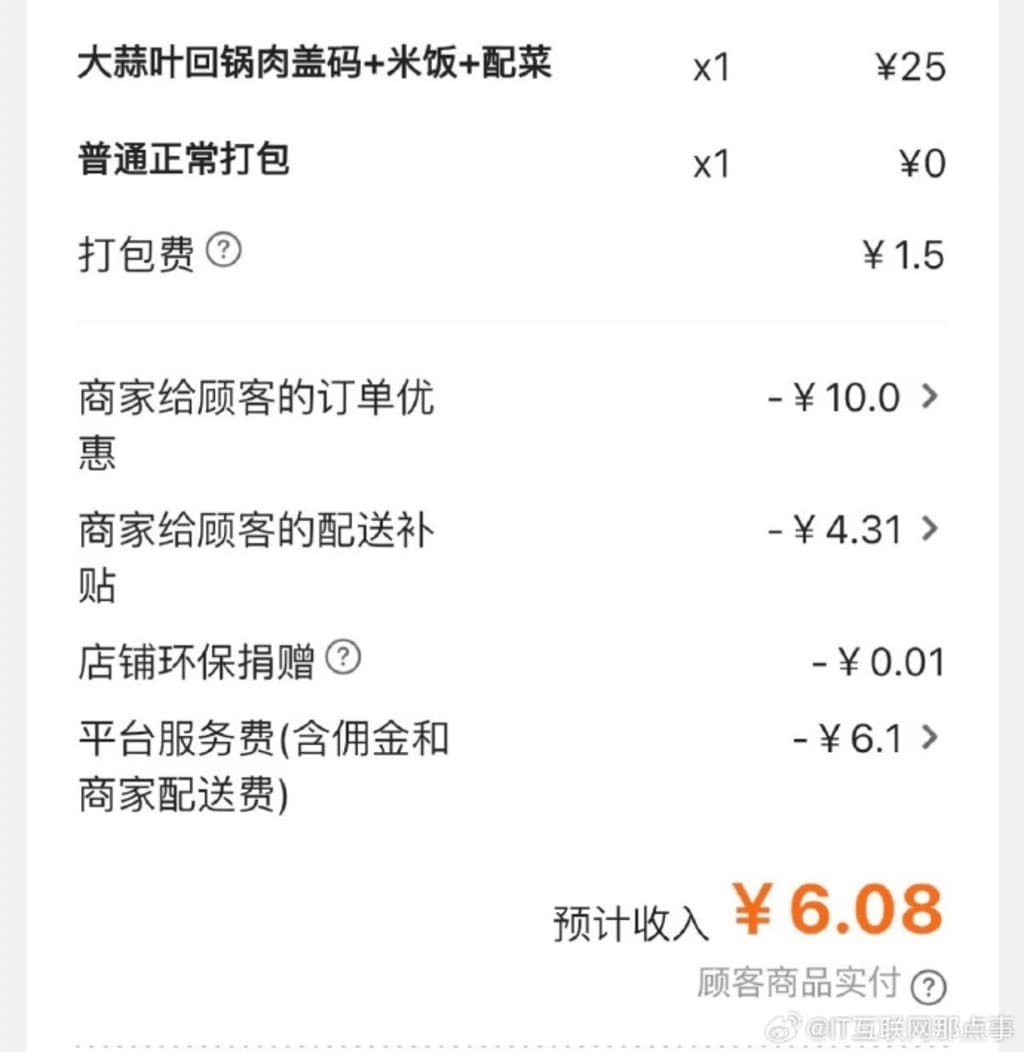
The bill
Customer side: meal 25 yuan, packaging 1.5 yuan, total 26.5 yuan.
Merchant side: promotion subsidy 10 yuan, delivery subsidy 4.31 yuan, platform service fee 6.1 yuan, merchant gets 6.08 yuan.
26.5 minus 10 minus 4.31 minus 6.1 equals about 6.09. The bill says 6.08. Rounding.
The numbers match. The bill is not fake.
When people post this bill online, the caption usually says “Meituan’s commission is too high” or “How can a restaurant survive?” Emotion gets there before the math. Most people see 25 yuan turn into 6 yuan and assume the platform took 19 yuan. That reaction makes sense. It is also wrong.
Of that 19 yuan, only 6.1 yuan is the platform service fee. The other 14.31 yuan comes out of the merchant’s own pocket.
Where the 19 yuan goes
10 yuan is promotion subsidy.
Full-reduction offers, discounts, coupons, first-order deals. When a customer checks out, most of the “You saved XX yuan” is paid by the merchant. The platform controls campaign slots, ranking rules, and traffic entrances. A merchant that does not join gets no exposure. A merchant that joins gives up profit. The 10 yuan is not taken by the platform. It is carved out of the merchant’s margin to win the order.
4.31 yuan is delivery subsidy.
Delivery costs more than the customer pays. The customer may pay 3 or 5 yuan. The rider’s pay, station operations, dispatch, and insurance add up to more. The platform covers part of the gap. The merchant covers part. This 4.31 yuan is the merchant’s share of delivery cost.
6.1 yuan is the platform service fee.
That 6.1 yuan splits into two parts. One is the technical service fee, the platform commission itself. It averages 6% to 8% across the industry. The other is the fulfillment service fee, charged for delivery help. It changes with distance, time, and order price. It averages close to 7 yuan per order.
The platform service fee is not platform profit. It is a bundle: rider wages, dispatch systems, payment channels, customer service, and research costs. The net profit the platform keeps from 6.1 yuan is much smaller than outsiders assume.
26.5 minus 10, minus 4.31, minus 6.1, leaves 6.08. The merchant gets 6.08.
What this meal is worth
The bill says 25 yuan. The meal’s economic value is not 25 yuan. That number is a marketing sticker.
The economic value is the merchant’s expected income plus the platform service fee: 6.08 plus 6.1, about 12 yuan. In the local market, this meal is worth about 12 yuan. The 25 yuan exists for full-reduction offers, for comparison, and to make customers feel they saved money.
This does not defend the platform. Nominal price and market price are different things. Takeout makes that difference easy to see. The customer sees 25. The merchant sees 6. The platform sees 6.1. The market sees 12. Four numbers, four views. None is lying.
Is the 6 yuan pure profit
No.
The largest part of the platform service fee is fulfillment. That is delivery cost. When a rider delivers an order, the platform pays the rider, the station, the dispatch system, and insurance. Bad weather, long distance, and late nights raise the cost. Of the 6 yuan charged to the merchant, four or five yuan, sometimes more, goes to delivery.
The remaining technical service fee pays for the transaction system, research, customer service, marketing, and payment channels. After costs, the platform’s net profit is not as large as outsiders imagine. Meituan and Ele.me have run takeout on thin margins or at a loss for years, subsidized by other businesses. That fact is public.
The platform still has problems. High commissions, forced promotions, and opaque traffic rules put heavy pressure on merchants. But treating the platform service fee as pure profit turns a complex chain into a slogan.
Why a merchant does it for 6 yuan
If a meal is worth 12 yuan, the platform takes 6, and the merchant keeps 6, pure takeout shops still survive.
The math depends on marginal cost and fixed-cost allocation.
A dine-in-only restaurant has limited traffic. It serves the surrounding neighborhood. If customer flow cannot rise, fixed costs such as rent, labor, and utilities stay spread across few orders. Prices must be higher. That is why dine-in often costs more than takeout.
A takeout restaurant reaches the whole city. Profit per order is thin. The marginal cost of one more order is low: ingredients, packaging, a little labor. As long as the price covers that marginal cost and leaves a little profit, the merchant will accept the order. Every extra order spreads a bit more rent, equipment, and labor.
The merchant is not doing charity. The merchant is using scale. Low price, high volume. Per-order profit is small. Total volume dilutes fixed costs. The business can still profit. That is why the takeout industry can race to the bottom and still support many pure takeout shops.
Takeout and dine-in pricing
Many people assume takeout should cost more because delivery costs money. In practice, takeout is often cheaper.
The two models follow different logic.
Dine-in has a low traffic ceiling, limited table turnover, and high fixed costs. Prices must cover higher unit fixed costs. Takeout has a high traffic ceiling, reaches customers citywide, and has low marginal costs. It can rely on low prices and volume. If scale is large enough, low prices survive.
This has a cost. Takeout prices are pushed low. Merchant margins are thin. Merchants stay alive by joining promotions, compressing ingredient costs, and speeding up the kitchen. When the platform raises commissions, cuts subsidies, or requires open kitchens and dine-in space, costs rise. Some shops exit. The market price rises.
Anti-involution and who pays
The takeout industry now talks about anti-involution. One push is to require dine-in space and open kitchens. The stated goal is food safety and better operations. The economic effect is higher entry barriers and higher operating costs.
Some noncompliant, low-cost shops disappear. Supply falls. Prices rise. Merchants do not always benefit. Selling prices rise, but fixed costs rise too: compliance, rent, labor. Higher takeout prices reduce value. Order volume may fall. Scale spreads fixed costs less effectively.
The result is usually this: customers pay more, merchants carry more costs, the platform adjusts rules, and the ecosystem finds a new balance. No one gets a free lunch.
Merchants also play the exploited card
Some merchants understand that “exploited by the platform” is a good story.
A bill showing 25 yuan in and 6 yuan out, posted online, triggers sympathy. Customers curse the platform, feel bad for the merchant, and sometimes order to show support. The merchant gains traffic, builds a persona, and uses the story as leverage in talks with the platform. The merchant asks for lower commissions and more concessions.
This is public relations. It is not necessarily false. It is the selected, amplified side of the story. The limit remains consumer tolerance. In the local market, a meal can only sell for 12 yuan. Charge more, and no one buys. No persona changes that ceiling.
The account
A 25-yuan takeout order pays the merchant 6.08 yuan. True.
The rest goes to promotion subsidies, delivery costs, the platform technical service fee, and the fulfillment service fee. The 6-plus yuan the platform takes is not pure profit. Much of it pays riders and the delivery system. The merchant keeps going because takeout has low marginal costs and large traffic scale. Fixed costs get spread through volume.
The meal’s economic value is about 12 yuan. The 25 yuan is the sticker price. The 6.08 yuan is what the merchant gets. The 6.1 yuan is the platform service fee. The remaining 14.31 yuan is the traffic cost and delivery subsidy the merchant pays.
Four numbers, four views. None is lying. None alone tells the whole story.
Calculating this account does not defend anyone. It shows where the money goes. That is the only way to understand why the industry is so competitive, why it is so cheap, and why merchants complain about losses while still taking orders.
About the Creator
Jin
Writer of reamstories
https://reamstories.com/jin
Enjoyed the story? Support the Creator.
Subscribe for free to receive all their stories in your feed. You could also become a paid subscriber, letting them know you appreciate their work.
Comments
There are no comments for this story
Be the first to respond and start the conversation.