Nature
The Sky
The sky has consistently held a significant interest for humankind, charming our creative minds and mixing a profound feeling of marvel and wonder. However huge as it seems to be mysterious, the sky addresses opportunity, probability, and a definitive trial of one's cutoff points. For the people who respond to a call, the sky becomes both a milestone and a prize — a domain where courage, strength, and the longing to accomplish significance are tried against the powers of nature.
By nadia khanom2 years ago in Earth
THE FALL OF AN INFANT
In the far away future, the last star will die, resulting in a dark universe. It is likely that this final star will be a red dwarf, a small type of star. Red dwarfs could serve as humanity's last refuge before the universe becomes uninhabitable. Approximately 70% of the stars in the universe are red dwarfs. These stars are quite small, with a mass ranging from 7% to 50% of our sun's mass. They are not much larger than Jupiter, although they are still substantial in size. Red dwarfs are dim and cannot be seen with the naked eye; thus, you have never observed one in the night sky. Even with advanced technology, we can only clearly observe red dwarfs in our local vicinity. About 20 of the 30 stars nearest to Earth are red dwarfs.
By Myrtle Zephyr 2 years ago in Earth
NO SPACE LEFT IN EARTH ?
Currently, the global population is at an all-time high. We have grown from 1 billion in 1800 to 8.2 billion in 2024. In the last century, the population increased fourfold. This leads to questions about the future. Will there be mass migration? Overcrowding in urban areas? Will diseases and pollution rise? Are we facing chaos over essential resources like energy, water, and food? Will population growth jeopardize our lifestyle, or is this merely unfounded fear?
By Myrtle Zephyr 2 years ago in Earth
AGING OF A BLACKHOLE
Black holes are some of the most peculiar entities in the universe. Their formation and nature raise many questions. Massive stars form from enormous gas clouds and are primarily composed of hydrogen atoms. These stars create energy through nuclear fusion, converting hydrogen into helium in their cores. This process generates radiation that counters gravitational collapse, keeping the star stable.
By Myrtle Zephyr 2 years ago in Earth
ARE METEORS THE TRUE CAUSE OF DINOSAUR EXTINCTION ?
One of life's greatest illusions is continuity. Sixty-six million years ago, dinosaurs had been dominant for about 165 million years. The world was warm and pleasant. Land was covered with lush forests and a vast diversity of flora and fauna. Dinosaurs thrived and diversified into hundreds of species. Massive gentle giants shared habitats with predatory beasts like Tyrannosaurus rex and Edmontosaurus.
By Myrtle Zephyr 2 years ago in Earth
52 HERTZ WHALE
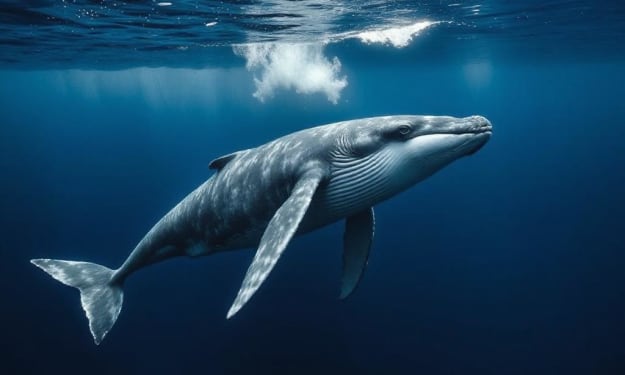
The story of the loneliest whale illustrates profound isolation. Scientists refer to it as the 52 Hertz whale, named for its unique sound pitch. This frequency is similar to that of a blue whale, which ranges between 10 and 39 Hertz. Unlike other whales, this particular whale communicates at a frequency no other whale produces. Consequently, it is often likened to a ghost, as no one has observed it in person or through recorded footage. The only evidence we possess consists of recordings obtained via hydrophones. This whale has been swimming for decades and was first detected in the late 1980s. From August to December, scientists have consistently received its cries in the Pacific Ocean. Between January and February, it moves out of detection range.
By Myrtle Zephyr 2 years ago in Earth
WE ARE NOT ALONE ?
Astronomers have recently identified a new super Earth named TOI 715b. This planet is approximately 1.5 times larger than Earth, which warrants its designation as a super Earth. It is relatively close to our solar system, located about 137 light-years away. In comparison, most exoplanets are typically hundreds of light-years distant.
By Myrtle Zephyr 2 years ago in Earth
European Animals Denmark
The Northern European country of Denmark is a small Nordic country that is part of the Scandinavian countries along with Norway and Sweden. The country borders Germany to the south and the rest of the country is surrounded by the Atlantic Ocean including the North Sea and the Baltic Sea. The northern part of Denmark is comprised of a large peninsula called Jutland that connects to the European mainland and over 400 smaller islands.
By Rasma Raisters2 years ago in Earth