

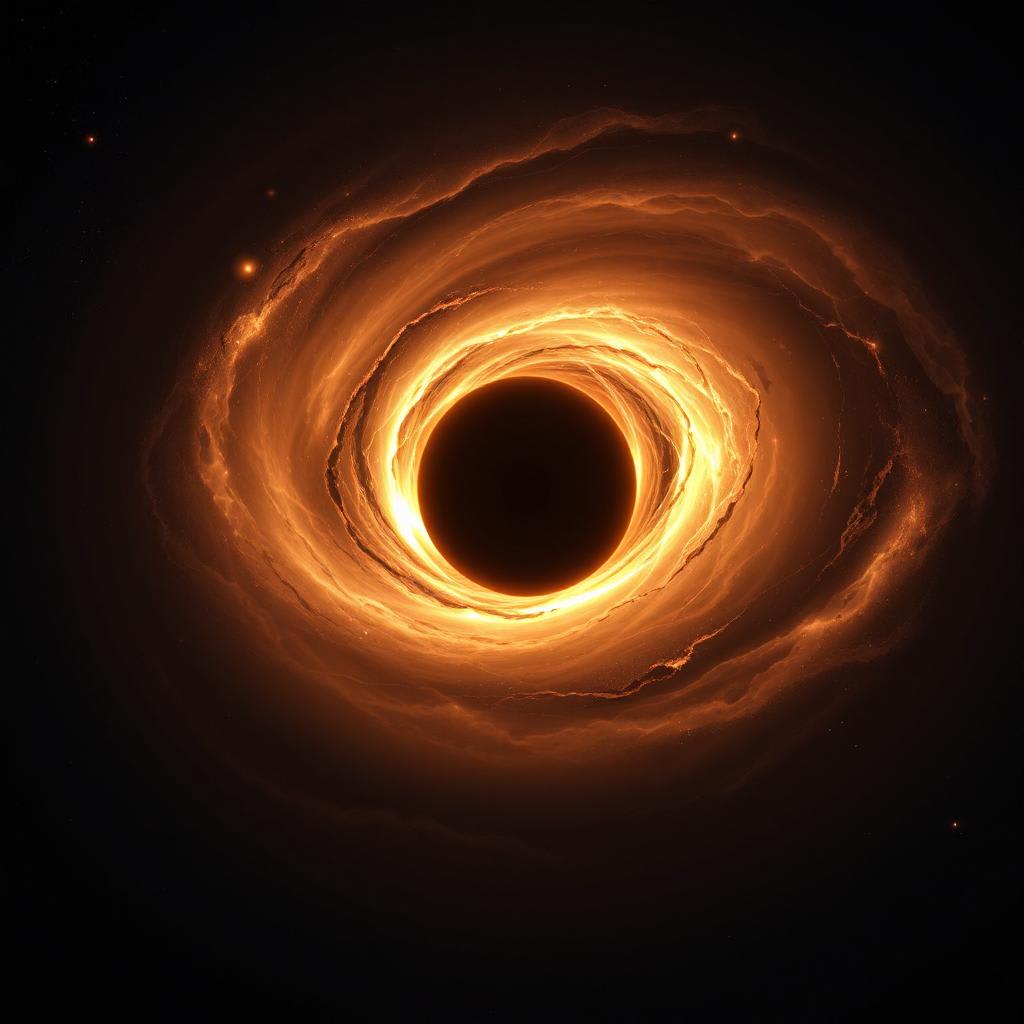
Black holes are some of the most peculiar entities in the universe. Their formation and nature raise many questions. Massive stars form from enormous gas clouds and are primarily composed of hydrogen atoms. These stars create energy through nuclear fusion, converting hydrogen into helium in their cores. This process generates radiation that counters gravitational collapse, keeping the star stable.
When a star has significantly more mass than the sun, it can fuse heavier elements until it produces iron. Fusion of iron does not release energy. As iron accumulates in the core, a critical mass is reached, disrupting the balance between radiation and gravity. Consequently, the core collapses, leading to a rapid implosion of the star.
During the implosion, material moves at approximately a quarter of the speed of light, adding more mass to the core. In its final moments, the star undergoes a supernova explosion, producing either a neutron star or, if massive enough, a black hole. When observing a black hole, one actually sees the event horizon. Anything crossing this boundary must travel faster than light to escape, which is impossible. Thus, we perceive a black sphere that reflects no light.
The "hole" in a black hole refers to the singularity. It is uncertain what a singularity precisely is. It may represent an infinitely dense point in space, concentrated with mass and lacking a surface or volume. The concept is akin to a mathematical "divide by zero" error.
It is important to note that black holes do not act like vacuum cleaners. If the sun were replaced with an equally massive black hole, the effects on Earth would be minimal, aside from a drastic drop in temperature.
If a person were to fall into a black hole, their experience of time would differ from that of an outside observer. As they near the event horizon, they would appear to slow down, seemingly freezing in time. The observer would witness the individual gradually turn red and eventually disappear. In contrast, the person falling into the black hole would perceive the universe speeding by.
The fate awaiting someone who crosses the event horizon may lead to one of two outcomes. Firstly, crossing the event horizon subjects the individual to extreme gravitational forces, resulting in spaghettification, where their body stretches and disintegrates. Secondly, they could encounter a firewall inside the event horizon, resulting in instantaneous termination.
The duration of survival depends on the black hole's mass. Smaller black holes could cause death before crossing the event horizon, while a supermassive black hole may allow for an extended experience. Generally, the distance from the singularity influences longevity.
Black holes exhibit a range of sizes. Stellar mass black holes have a few times the mass of the sun, while supermassive black holes reside at the centers of galaxies, accumulating mass over billions of years. The largest known supermassive black hole, S5 0014+81, has a mass 40 billion times that of the sun, with a diameter of 236.7 billion kilometers.
Despite their immense power, black holes will eventually evaporate through a process known as Hawking radiation. Empty space contains virtual particles that frequently appear and annihilate. Near a black hole, one particle may be drawn in while the other escapes, resulting in energy loss for the black hole. This loss occurs slowly at first, accelerating as the black hole diminishes in size.
When a black hole's size is reduced to that of an asteroid, it radiates at room temperature. When its mass equals that of a mountain, it generates heat comparable to that of the sun. In its final moments, the black hole releases energy akin to billions of nuclear bombs in a massive explosion.
However, the evaporation process is exceedingly slow. The largest known black holes may require many years to completely evaporate. By then, the universe will likely be uninhabitable, and no witnesses will remain to observe the event.
About the Creator
Enjoyed the story? Support the Creator.
Subscribe for free to receive all their stories in your feed.
Comments
There are no comments for this story
Be the first to respond and start the conversation.