

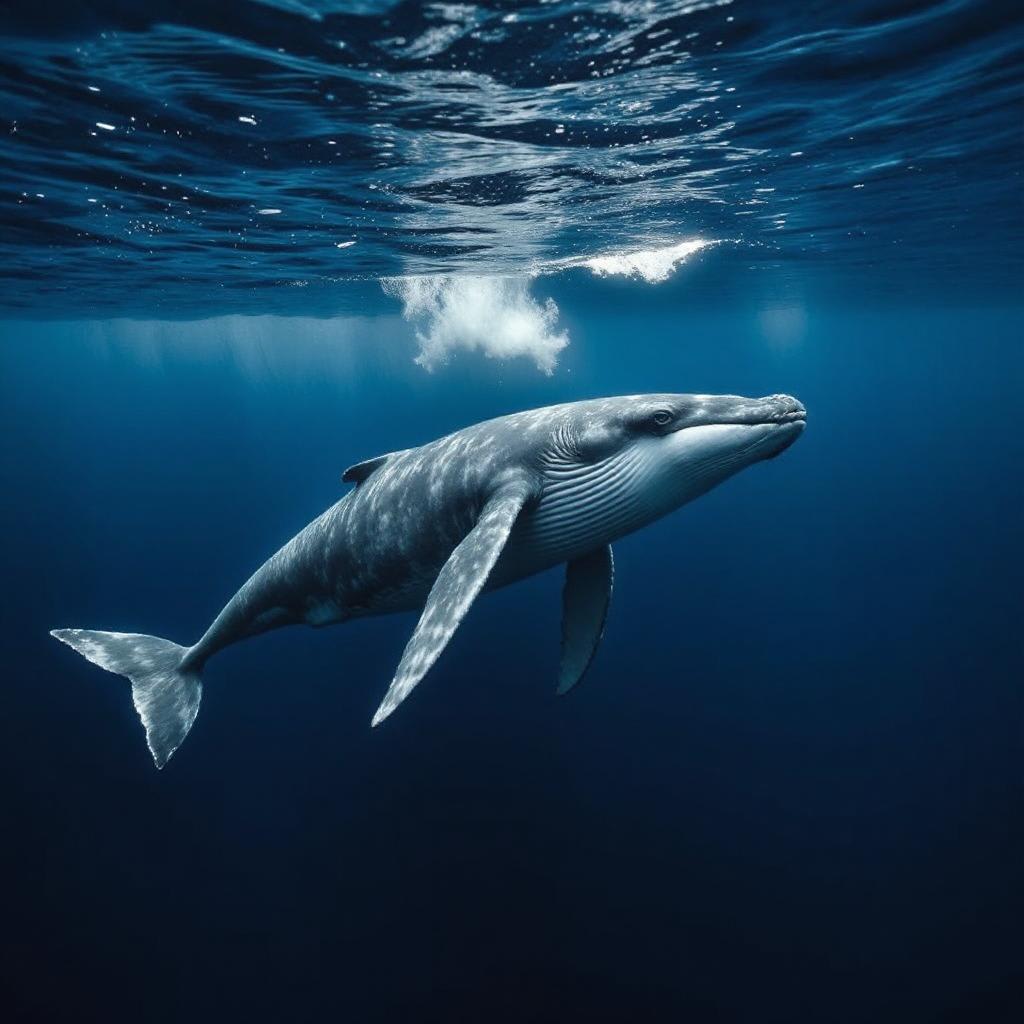
The story of the loneliest whale illustrates profound isolation. Scientists refer to it as the 52 Hertz whale, named for its unique sound pitch. This frequency is similar to that of a blue whale, which ranges between 10 and 39 Hertz. Unlike other whales, this particular whale communicates at a frequency no other whale produces. Consequently, it is often likened to a ghost, as no one has observed it in person or through recorded footage. The only evidence we possess consists of recordings obtained via hydrophones. This whale has been swimming for decades and was first detected in the late 1980s. From August to December, scientists have consistently received its cries in the Pacific Ocean. Between January and February, it moves out of detection range.
Scientists remain puzzled about the whale's nature. Some propose that it might be a hybrid of a blue whale, while others suggest it may be a blue whale with a hearing impairment. Despite its prolonged existence, which indicates good health, the whale has yet to be sighted in the last 30 years. We have focused primarily on collecting its vocal recordings, searching for another whale to respond to its calls.
The discovery of whale frequencies occurred accidentally. The United States deployed hydrophones across the ocean floor to monitor incoming submarine activity. While this strategy achieved its goal, it also captured various oceanic frequencies, producing deep rumbling sounds associated with legendary creatures. Initially perceived as potential signals from mythical beings, these frequencies were later identified as those of blue and fin whales.
In the late 1980s, scientists gained access to the hydrophone network to focus specifically on whale communication. During this research, they discovered the distinctive frequency of the 52 Hertz whale. The attention surrounding this whale led some individuals to create documentaries exploring its story.
Similarly, the case of an albatross named Albert illustrates loneliness. For approximately 50 years, scientists believe Albert has searched along the coast of Scotland for a mate. However, suitable partners are located nearly 8,000 miles away. Albert is not naturally found in Scotland; some theorize that he was displaced during a storm in the South Atlantic during the 1960s. Since then, he has remained in Scotland, where he requires the right winds to return home.
Today, he seeks refuge on a remote rocky outcrop between the Shetland Isles and the Outer Hebrides. Scientists have observed Albert's activities, noting that this species typically has a lifespan of about 70 years. While Albert has attempted to socialize with local birds, he has not succeeded. Albatrosses are native to the Falkland Islands, making his current location atypical.
Lonesome George, a Pinta Island tortoise from the Galapagos, embodies a profound sense of isolation. He was the last member of his species, which thrived in the 19th century until human activity led to their demise. Once thought extinct, George was discovered in 1972, garnering significant media attention. By that time, he was approximately 60 years old. Unfortunately, George spent many years in captivity, where he could not experience the freedom he desired. Scientists hoped he would mate with other species, but his final days came in 2012, marking the end of his species.
Tuffy the Rab's fringe-limbed tree frog, a native of Panama, experienced a similar fate. Captured to protect him from predators and disease, he lived in captivity but passed away in 2016. During his time in a container, Tuffy ceased calling for a mate, possibly indicating he was aware of his isolation.
In 1987, only three Spix’s macaws existed in the wild. By the end of that year, two were captured in Brazil. These birds inhabit tropical dry forests in the Amazon. Despite their striking blue-gray color, they became increasingly rare, and by 1995, they were no longer spotted. Scientists undertook efforts to save the species, locating the last known parrot in northeastern Brazil. After successful breeding in captivity, scientists released 47 healthy parrots into the wild. They implemented measures to ensure the safety of these birds and prevent predation.
In conclusion, these stories of notable individuals—unique whales, solitary albatrosses, endangered tortoises, and rare parrots—underscore the challenges faced by species on the brink of extinction. Each narrative highlights the consequences of environmental disruption and human interference, ultimately amplifying the urgency of conservation efforts.
About the Creator
Enjoyed the story? Support the Creator.
Subscribe for free to receive all their stories in your feed.
Comments
There are no comments for this story
Be the first to respond and start the conversation.