
WE ARE NOT ALONE ?
Did our 'parallel world' become a reality ?

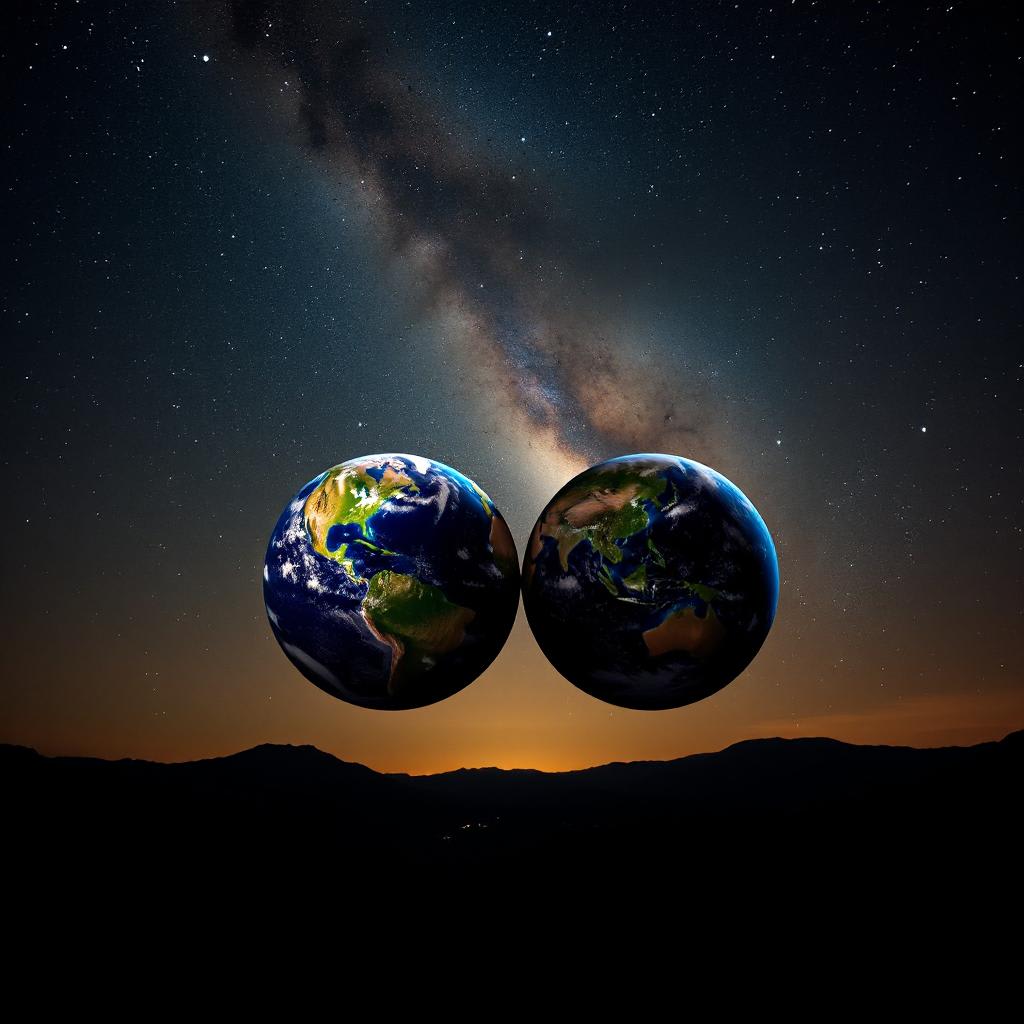
Astronomers have recently identified a new super Earth named TOI 715b. This planet is approximately 1.5 times larger than Earth, which warrants its designation as a super Earth. It is relatively close to our solar system, located about 137 light-years away. In comparison, most exoplanets are typically hundreds of light-years distant.
The concept of the habitable zone is essential to assessing a planet's potential for liquid water. This zone is defined as an area around a star where temperatures may allow water to remain in liquid form. However, estimating this zone is not precise; it depends on various factors, including the type of star and the planet's reflectivity and size. Merely residing in the habitable zone does not guarantee the presence of liquid water. The planet must also possess an appropriate atmosphere.
In 2014, a more stringent definition known as the conservative habitable zone (CHZ) was proposed. This refined term aims to identify candidates with genuine potential for liquid water. Regarding the CHZ, a rocky planet receiving between 40% to 85% of Earth's energy is considered to be within it, regardless of its distance from the star. TOI 715b falls within this range, enhancing its prospects for habitability.
TOI 715b orbits an M-type star, commonly referred to as a red dwarf. This category of stars is significantly smaller and cooler than our Sun, with a size and mass approximately one-quarter of that of our Sun. Despite this, being situated in the habitable zone of a red dwarf could prove advantageous for the development of life. Red dwarfs have longer lifespans than yellow dwarfs, such as our Sun, granting them more time to facilitate the emergence of life. Notably, TOI 715b orbits a red dwarf that is 6.6 billion years old, older than our Sun, estimated at 4.6 billion years.
This red dwarf has limited magnetic activity and does not exhibit harmful flares, unlike some younger red dwarfs, whose flares may strip away planetary atmospheres. Furthermore, TOI 715b completes its orbit in just 19 days, resulting in frequent transits in front of its star. This characteristic allows for clearer observations, making it easier for telescopes like the James Webb Space Telescope to study its atmosphere.
The James Webb Space Telescope represents a significant advancement in our capability to explore distant planets beyond our solar system. It can analyze the composition of gases in the atmospheres of exoplanets millions of light-years away. Currently, efforts are underway to determine whether TOI 715b has an atmosphere, which, if present, may be easier to detect than that of a drier, denser planet.
Compounding the intrigue, there may be another candidate planet within this system, also located in the habitable zone, though its existence is not yet confirmed. This candidate has a name associated with its uniqueness and, if verified, would be the smallest known planet within the habitable zone identified by the TESS telescope.
Another notable aspect of TOI 715b is its potential to be an ocean planet, with extensive bodies of water covering its surface or existing as subsurface oceans. Ocean planets might have minimal dry land. While current technology does not allow for direct detection of surface water on exoplanets, scientists seek water vapor in atmospheres as evidence of liquid water below.
Additionally, TOI 715b falls within what is known as the small planet radius gap. This gap denotes a scarcity of planets between 1.5 and 2 times the size of Earth. Understanding this gap provides insights into planetary formation and evolution. Research indicates these planets may begin larger and subsequently lose mass even as they orbit their stars.
NASA's Transiting Exoplanet Survey Satellite (TESS) has been vital in discovering new exoplanets and has been operational for six years. Launched to enhance our knowledge of smaller, Earth-like planets around nearby bright stars, TESS provides vital data. It observes stars for variations in brightness, which may suggest planets passing in front of them. However, other stellar phenomena can also cause brightness changes, necessitating careful analysis.
TESS has successfully located over 5,000 exoplanets, including TOI 700d, the first Earth-like planet detected in the TOI 700 system. However, TOI 700d is unlikely to be habitable due to extreme temperatures. TESS has also discovered larger planets in various systems, contributing significantly to understanding stellar and planetary dynamics.
As TESS continues its operations, further discoveries are anticipated, enhancing our comprehension of the cosmos.
About the Creator
Enjoyed the story? Support the Creator.
Subscribe for free to receive all their stories in your feed.
Comments
There are no comments for this story
Be the first to respond and start the conversation.