
THE FALL OF AN INFANT
Is it the end of the universe ?

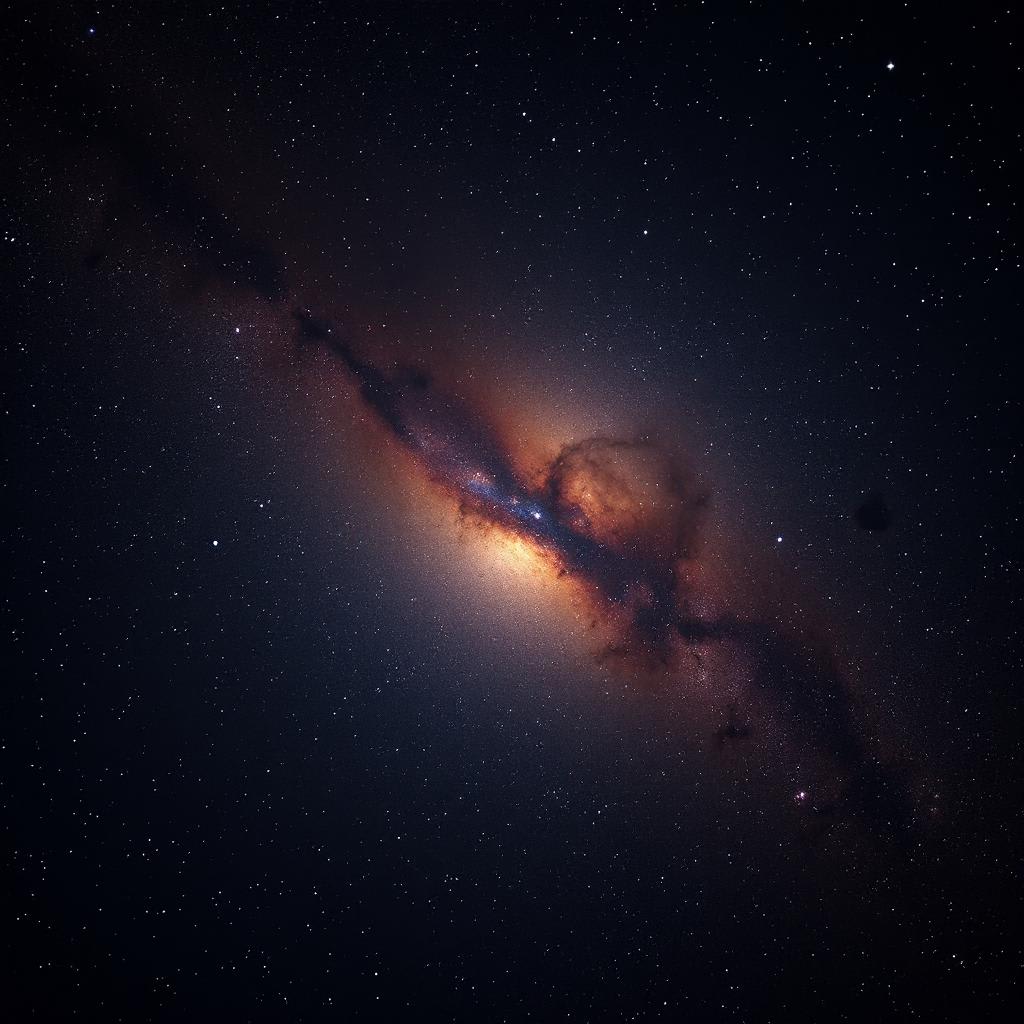
In the far away future, the last star will die, resulting in a dark universe. It is likely that this final star will be a red dwarf, a small type of star. Red dwarfs could serve as humanity's last refuge before the universe becomes uninhabitable. Approximately 70% of the stars in the universe are red dwarfs. These stars are quite small, with a mass ranging from 7% to 50% of our sun's mass. They are not much larger than Jupiter, although they are still substantial in size. Red dwarfs are dim and cannot be seen with the naked eye; thus, you have never observed one in the night sky. Even with advanced technology, we can only clearly observe red dwarfs in our local vicinity. About 20 of the 30 stars nearest to Earth are red dwarfs.
Like all stars, red dwarfs convert hydrogen into helium. However, unlike more massive stars, red dwarfs remain convective, allowing helium and hydrogen to mix continuously. As a result, they use their fuel very slowly before they eventually extinguish. Their average lifespan ranges from 1 to 10 trillion years. In contrast, the Sun will survive for another 5 billion years. Given that the universe is approximately 13.75 billion years old, no red dwarf has reached advanced developmental stages; all existing red dwarfs are still classified as "infants." The smallest star in the universe is also a red dwarf. Small red dwarfs are on the threshold of failing to be classified as stars due to insufficient hydrogen.
Regarding extraterrestrial life and potential new homes for humanity, a search for habitable planets will be essential when our Sun eventually dies. The Kepler space observatory discovered that at least half of all red dwarfs host rocky planets between half and four times the mass of Earth. Many of these planets reside in the habitable zone, where liquid water could exist. However, given the cooler temperatures of red dwarfs, a planet would need to be exceedingly close to the star to maintain habitability, likely as close as Mercury is to our Sun. This proximity poses several challenges, such as tidal locking, which would result in one side of the planet being perpetually hot while the other remains frozen. Nevertheless, a planet with a sufficiently large ocean might manage to distribute the star’s energy, creating a stable environment.
The gravitational forces exerted by red dwarfs could also compress and heat planets, potentially causing them to lose all their water over time, resulting in conditions akin to those on Venus. Additionally, many red dwarfs exhibit variability in their energy output, including star spots that can significantly diminish emitted light for extended periods, freezing oceans on nearby planets. Conversely, red dwarfs can release intense solar flares, rapidly increasing their brightness and potentially stripping away substantial portions of a planet’s atmosphere.
Despite these challenges, the exceptionally long lifespan of red dwarfs is advantageous. A moderately active red dwarf could provide an ideal environment for life to flourish. Life on Earth has existed for about 4 billion years, and we have roughly 1 billion years left before the Sun's increasing temperature renders complex life impossible. At that point, humanity will face a choice: extinction or migration to a new home. A civilization could potentially thrive for trillions of years around a red dwarf with suitable conditions. Approximately 5% of red dwarfs in the Milky Way may host habitable, Earth-sized planets, amounting to over 4 billion possibilities. However, life may not require Earth-like planets; moons of gas giants and massive rocky planets, known as super-Earths, may also serve as habitats. An estimated 60 billion potentially habitable planets may exist around red dwarfs in the Milky Way alone.
Ultimately, red dwarfs may play a crucial role in humanity’s survival. However, just like all stars, red dwarfs will eventually die. In trillions of years, the last red dwarf will exhaust its hydrogen supply, transforming into a blue dwarf as it shrinks and eventually becoming a white dwarf. As a white dwarf, it will be comparable in size to Earth, composed of degenerate gases predominantly made of helium-4 nuclei. Lacking a source of energy, it will cool extremely slowly over trillions of years until it reaches its final form: a cold black dwarf. The phenomena of white and black dwarfs warrant separate exploration. In conclusion, although the last stars in the universe will not vanish for a considerable time, it is reassuring to know that humanity has time to explore space before the universe dims.
About the Creator
Enjoyed the story? Support the Creator.
Subscribe for free to receive all their stories in your feed.
Comments
There are no comments for this story
Be the first to respond and start the conversation.