Latest Stories
Most recently published stories in Criminal.
The Woman Who Knew Too Much
M Mehran Rita Voss had a gift for noticing things other people didn't. It started small — the kind of observations that made her useful at dinner parties and mildly annoying everywhere else. She'd notice the waiter refilling everyone's water glass except the man in the corner. She'd spot the price tag still attached to someone's "vintage" jacket. She'd clock the exact moment a smile stopped reaching someone's eyes. Her ex-husband called it exhausting. Her therapist called it hypervigilance. Rita called it Tuesday. What nobody called it — not yet — was dangerous. That changed on the morning of October 3rd, when Rita noticed something in the parking garage beneath her office building that she absolutely, categorically, should have kept to herself. She arrived at 7:12 AM, eighteen minutes before anyone else on her floor. This was her ritual — strong coffee, quiet keyboard, the particular peace of a building that hasn't fully woken up yet. She took the elevator from the garage to the fourth floor without thinking twice about the black SUV parked in space B-7. Except. On the ride up, something itched at the back of her mind. She replayed the image without meaning to. The SUV. The license plate — a Maryland tag, which was unusual in a Virginia building. The trunk, which was slightly ajar. The man in the driver's seat, who had looked straight ahead with the specific, practiced stillness of someone trying very hard not to look like they were waiting. And the woman's shoe. Just one. Pale blue heel, expensive, tilted sideways in the three-inch gap of the open trunk. Rita stood at her desk for four minutes without sitting down. Then she called the police. What followed would consume the next fourteen months of her life in ways she could never have predicted when she dialed those three digits. The woman in the trunk was alive — barely, but alive. Her name was Diane Cho, a federal accountant who had stumbled onto a discrepancy in a defense contractor's billing records. A discrepancy worth, as it turned out, approximately forty-seven million dollars. The man in the driver's seat was a former intelligence operative named Garrett Webb, who had spent fifteen years learning how to make problems disappear quietly. Diane Cho was not supposed to survive. Rita Voss was not supposed to have arrived eighteen minutes early. The investigation that unraveled from that single phone call reached into three government agencies, two Fortune 500 companies, and one sitting member of a Senate subcommittee. Garrett Webb's arrest was the visible tip of something enormous and deeply ugly beneath the surface of very respectable-looking institutions. Rita knew none of this when she made the call. She just knew about the shoe. The threats started on a Wednesday. First it was a voicemail — no voice, just silence, then a click. Easy to dismiss. Then her car was moved in the parking garage, just three spaces over. Close enough that she might have thought she'd misremembered. Far enough that she knew she hadn't. Then someone slid a photograph under her apartment door. It was a picture of her, taken from across the street, on a day she remembered clearly because she'd been wearing her green scarf — the one her mother had knitted before she died. She was buying coffee. She was completely unaware. She looked heartbreakingly ordinary. On the back, in careful block letters: You saw one thing. Stop there. Rita sat on her kitchen floor for a long time. She was fifty-three years old. She had a houseplant she'd managed to keep alive for six years, which she considered one of her finer achievements. She had a sister in Portland who called every Sunday and a job she didn't love but was good at. She was not brave in the way movies portray brave — no set jaw, no steely eyes, no moment of dramatic music swelling behind her. She was terrified. She called the detective assigned to her case and read him the message word by word. Then she went to work. Rita testified for three days at the federal trial of Garrett Webb and four co-conspirators. She was cross-examined by a defense attorney who was very good at his job and very committed to making her seem like the kind of woman who imagines things. He asked her how she could be certain about the shoe from a moving elevator. "I notice things," she said simply. "I always have." "Isn't it possible you were mistaken?" Rita looked at Diane Cho, who was sitting in the third row with her hands folded and her eyes steady. "No," Rita said. "It isn't." Garrett Webb received twenty-two years. His associates received sentences ranging from nine to eighteen. The Senate subcommittee member resigned before charges were filed — a quiet exit that his office described as "for personal reasons." Diane Cho sent Rita a card on the anniversary of her rescue every year. No long message. Just two lines: You didn't have to notice. Thank you for noticing. Rita kept every single one, tucked inside the cover of a notebook she'd started the morning after she made the call. On the first page, she'd written something that her therapist had once said — the thing she'd dismissed at the time as too simple to be useful. Hypervigilance is just love with nowhere safe to land. She understood it now.
By Muhammad Mehran5 months ago in Criminal
The Last Confession of Marcus Hale
M Mehran The night Marcus Hale walked into the First National Bank on Crestwood Avenue, the sky was doing something strange — that thick, bruised purple you only see right before a storm decides it's done being patient. He wasn't nervous. That was the problem. Nervous people make mistakes, sure. But they also hesitate. They reconsider. They feel the cold sweat crawling down their spine and think, Maybe not tonight. Marcus had burned through all his hesitation years ago, somewhere between his second conviction and his third broken promise to his mother that he was done with this life. He was forty-one years old, and criminal activity was the only career he'd ever been genuinely good at. The plan was simple. That's what he told his partner, a jittery kid named Cole who smelled like cigarettes and bad decisions. Simple plans, Marcus believed, were elegant. They left no room for variables. Walk in at 4:47 PM — thirteen minutes before closing. Two tellers, one security guard who was sixty-three years old and working his final month before retirement. Minimal foot traffic. A side exit that emptied into a parking structure with no cameras on the third level. Marcus had cased the bank for six weeks. He knew the guard's name was Leonard. He knew Leonard took his coffee with oat milk because his doctor had told him his cholesterol was something to be alarmed about. He knew Leonard carried his radio on his left hip and his weapon on his right, which meant he'd cross-draw if startled — a half-second slower than standard. This was the thing about Marcus that nobody who read the later headlines could quite understand: he was intelligent. Genuinely, almost tragically intelligent. Criminologists who studied his case file used words like meticulous and architecturally precise. His crimes weren't impulsive. They were engineered. Which made what happened next all the more remarkable. At 4:49 PM, two minutes into the robbery, a little girl walked through the front door. She was maybe seven. Red coat. One pigtail slightly higher than the other, the way a child fixes their own hair when nobody's helped them. She was holding a birthday card — pink envelope, slightly crumpled — and she marched up to the nearest teller with the absolute confidence of someone who has exactly one mission and intends to complete it. "My grandma works here," she announced to the room. "I'm bringing her birthday card." The teller, whose hands were already shaking behind the counter, didn't speak. Cole made a sound — half panic, half warning. Marcus looked at the girl. She looked back at him. Not afraid. Just curious, the way children are when they sense something is wrong but haven't yet learned to be scared of wrong things. "Are you a robber?" she asked. The word landed in the middle of the room like something thrown through a window. Marcus — who had stared down federal prosecutors, who had spent four years in a maximum-security prison and come out without a single enemy who could prove it — felt something shift behind his sternum. Not guilt, exactly. Something older. Something he'd thought he'd suffocated completely. "We're leaving," he said. Cole turned. "What?" "We're leaving." They were arrested forty minutes later in the parking structure, sitting in their car. Marcus hadn't started the engine. The bags were on the back seat, but investigators later confirmed that the vault had never actually been opened. The tellers had been terrified, two of them treated for shock — but nothing had been taken. When the detective asked Marcus why he'd stopped, he was quiet for a long moment. "There was a kid," he finally said. "You've had witnesses before." "Not like that." The detective looked at him across the metal table. "What was different?" Marcus thought about the little girl's question. The way she'd said it without accusation, without drama. Just a simple, honest inquiry from someone who hadn't yet learned to dress the truth up in something more comfortable. Are you a robber? "She asked me what I was," Marcus said. "Straight out. No games." He paused. "I didn't like the answer." Marcus Hale pleaded guilty to charges of criminal conspiracy, attempted robbery, and unlawful possession of a firearm. He received a sentence of eleven years, reduced to eight with good behavior. He used his time differently than before. Earned a paralegal certification. Started a correspondence with a nonprofit that works with at-risk youth in underfunded school districts. Wrote a memoir that was rejected by fourteen publishers and accepted by the fifteenth. He never met the little girl again. Didn't try to. Some things are better left as the single, uncontaminated moment they were. But he kept the newspaper clipping about his arrest. Not as a trophy — as a reminder. There are a thousand ways a man can finally stop running. Most of them are ugly, violent, or arrived at too late. Marcus got lucky. A seven-year-old in a red coat asked him the right question at exactly the right time. And for the first time in forty-one years, he told the truth.
By Muhammad Mehran5 months ago in Criminal
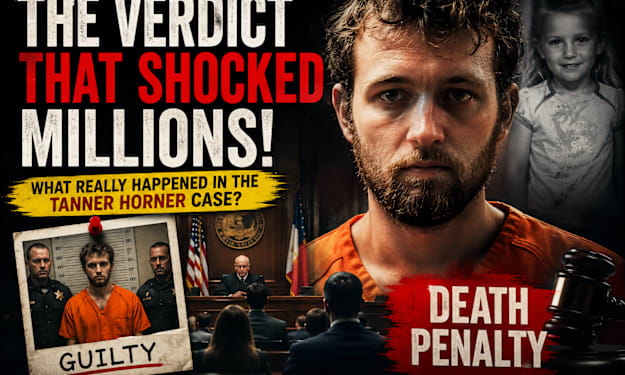
What Really Happened in the Tanner Horner Case?
Title: “The Verdict That Shocked Millions: What Really Happened in the Tanner Horner Case?” Writer: King Pokhtoon In a world where news comes and goes in seconds, only a few stories manage to hold people’s attention long enough to spark real emotion, debate, and reflection. The case of Tanner Horner is one of those rare stories. For months, it stayed in the background of public conversation—but now, with a final verdict delivered, it has exploded across social media, headlines, and everyday discussions.
By king pokhtoon5 months ago in Criminal
Making seamless digital connectivity easier with a wifi QR code generator
With the rapid shift toward digitalization, sharing the internet on a local or professional level has become a necessity. Users can connect immediately without having to type lengthy passwords thanks to the convenience, security, and efficiency provided by a Wifi QR code generator. With any online wifi QR code generator, creating wifi QR codes is now easier than ever. This makes it possible for individuals and businesses to assist users in establishing secure connections, which further enhances the user experience.
By Noreanopen5 months ago in Criminal
Moral Law and False Witness
When Truth Is Not Optional Moral systems do not begin with outcomes. They begin with constraints. Certain acts are treated as wrong not because they fail, but because performing them already constitutes the failure. Bearing false witness has always occupied that category. It is not condemned because it sometimes produces injustice. It is condemned because it corrupts the very process by which justice is discerned. Once falsehood is introduced deliberately, the pathway to truth is no longer reliable, even if it occasionally arrives at a correct destination.
By Peter Thwing - Host of the FST Podcast5 months ago in Criminal
Tanner Horner Case: A Story That Shook Quiet Communities
Some names appear suddenly and leave a lasting mark on people who had never heard them before. The name “tanner horner” is one of those. It is not tied to entertainment or sports, but to something far more serious and unsettling. Stories like this travel quickly, not because people are curious in a casual way, but because they are trying to understand how something so disturbing can happen in ordinary places. Behind every search for Tanner Horner is a mix of shock, concern, and a need for clarity. It forces people to look at their surroundings differently and to think about safety, trust, and the fragility of everyday life in ways they may not have before.
By Muqadas khan5 months ago in Criminal
The Forger Who Signed His Own Name
M Mehran He spent thirty years making other people's art look real. The one thing he could never fake was his own. The first rule of forgery is simple: never leave yourself in the work. Marcus Hale had followed that rule for three decades. He had painted seventeen Modiglianis that hung in private collections across four continents. He had produced eight Basquiats, two Klimts, and one Vermeer so technically precise that a leading authentication expert at the Rijksmuseum had written a four-page essay praising its emotional authenticity. He had never been caught. He had also never, in thirty years, painted anything of his own. The Education of a Ghost Marcus had studied fine arts at the University of Edinburgh on a scholarship that required him to maintain a GPA he could barely afford to chase. His professors called him technically gifted and creatively timid — a combination they delivered as constructive criticism and he received as a quiet verdict on his worth. You paint like someone who has read extensively about having feelings, his third-year tutor told him once, not unkindly. He had gone home that evening and stared at a blank canvas for four hours. Nothing came. Not from fear of failure exactly — more from a deeper uncertainty about what was actually in him that would be worth putting on a surface for the world to judge. It was easier, he discovered, to put someone else's vision there instead. The first forgery was a small Hockney study, reproduced for a classmate's wealthy uncle who wanted something for above his fireplace and wasn't particular about provenance. Marcus charged £400. The uncle hung it proudly. The transaction was clean and quiet and required nothing personal from Marcus whatsoever. He found this arrangement enormously comforting. The Business of Becoming Nobody By his mid-thirties, Marcus had a system. He lived in Lisbon, in a flat with north-facing windows and a second bedroom converted into a studio he never allowed visitors to enter. He sold through a single intermediary — a Belgian art dealer named Cressida who asked no questions and kept thirty percent. He spent his mornings in museums studying brushwork under the pretense of being a restorer, and his afternoons in the flat, becoming someone else. He was methodical about the psychology of it. Before beginning any forgery, he would spend weeks reading about the original artist — not technique, but life. What they feared. What they loved. What time of day they preferred to work, and whether they drank before or after. He believed you couldn't convincingly replicate a person's art without first understanding the emotional weather they painted inside. The irony of this was not lost on him. He understood the interior lives of dead masters with a depth and intimacy he had never applied to his own. The Girl Who Asked the Wrong Question Her name was Petra, and she was not supposed to be in his studio. She was the building superintendent's daughter, twelve years old, sent upstairs to deliver a letter that had been misdelivered. Marcus had made the mistake of answering the door mid-session, paint on his hands, the half-finished Egon Schiele on the easel visible behind him. Petra looked past him at the canvas with the frank, unfiltered attention that children apply to things before they learn which things deserve it. "Who painted that?" she asked. "Schiele," Marcus said. "Egon Schiele. Austrian. Early twentieth century." "It looks sad." She tilted her head. "But like chosen sad. Like he wanted to feel it." Marcus had no response to that. He took the letter and closed the door and stood in the middle of his studio for a long time. Chosen sad. He looked at the Schiele. The hollow-cheeked figure on the canvas, all exposed nerve and angular longing. He had painted it correctly — the technique was immaculate. But Petra had identified something in three seconds that Marcus had never once asked himself while making it. Did he want to feel anything? What Thirty Years of Hiding Looks Like He started the painting on a Tuesday with no plan and no reference material. No dead master to inhabit. No auction records to study. No authentication market to satisfy. Just a canvas, and whatever was actually in Marcus Hale after thirty years of being a vessel for other people's ghosts. What came out surprised him. It was dark — darker than he expected — but not hopeless. It was full of doorways. Interior spaces that opened onto other interior spaces, receding like a hall of mirrors, each room slightly warmer than the last. In the far distance of the composition, almost too small to see, a figure stood in a lit doorway, facing inward rather than out. He worked for eleven days without stopping for more than sleep. When it was finished, he stood back and looked at it with the same critical eye he applied to everything. The technique was technically imperfect in three places. The composition broke two principles he had followed religiously for decades. It was the most honest thing he had ever seen. The Signature He had always signed forgeries with precision — the exact pressure, the exact ink, the exact personal idiosyncrasies of someone long dead. He picked up the brush now and signed the only name he actually owned. Marcus Hale. Two words in the bottom right corner. Ordinary. Unrecognized. Worth nothing in any auction house on earth. He hung it on the wall of his studio — the room no one ever entered — and sat across from it in a chair until the light changed. Cressida called that afternoon about a commission. A collector in Geneva wanted a Rothko. Marcus let it go to voicemail. He looked at the painting. The figure in the distant doorway, facing inward, toward something the viewer couldn't quite see. He thought about Petra and her phrase — chosen sad — and understood, for the first time, that choosing to feel something was itself a kind of courage. He was sixty-one years old. It seemed like a reasonable time to start. Talent is common. The willingness to sign your own name to what's truly inside you — that is the rarest thing in any room.
By Muhammad Mehran5 months ago in Criminal
The Woman Who Counted Exits
M Mehran She never sat with her back to a door. Most people thought it was a quirk. Only one person ever understood why. Every restaurant. Every waiting room. Every church pew and movie theater and crowded elevator. Nadia Orel counted exits. It was the first thing she did upon entering any space — before she removed her coat, before she checked her phone, before she even looked at the people around her. Two exits in the coffee shop on Mercer Street. One in the laundromat. Four in the grocery store if you counted the emergency side doors, which Nadia always did. Her therapist called it hypervigilance. Nadia called it being prepared. There was a difference, she insisted. A meaningful one. The Man at Table Seven She first noticed him on a Thursday in October. He was sitting alone at the back corner of Pellegrino's Bistro — the exact table Nadia would have chosen herself. Back to the wall. Clear sightline to the front entrance. Positioned six feet from the kitchen exit. He was also counting. She could tell by the way his eyes moved — not the restless scanning of someone people-watching, but something systematic. Deliberate. The gaze of a person building a mental map of the room. When his eyes met hers, neither of them looked away quickly. That was unusual. Most people glanced off like stones skipping water. This man held her gaze for exactly three seconds — long enough to acknowledge what they'd both recognized — and then returned to his menu. Nadia sat down two tables away and ordered coffee she didn't need. What Fear Teaches You She had learned to count exits at age nine, in a house where the front door was sometimes blocked by her stepfather's moods and the back door was the only geography that mattered. She had memorized the creak of the third porch step, the stiffness of the kitchen window latch, the exact number of seconds it took to cross the backyard in the dark. Fourteen seconds to the neighbor's fence. She had timed it. She never needed to run. But she spent fifteen years of her childhood ready to run, and that readiness had embedded itself into her nervous system like a splinter the body eventually builds itself around. You don't heal from that kind of vigilance. You just learn to carry it somewhere less visible. His Name Was Theo He introduced himself on her third Thursday at Pellegrino's. Not in a smooth way. Not with the practiced confidence of someone accustomed to approaching strangers. He stood beside her table with his coffee and said, "You sit where I want to sit. I wanted you to know I've noticed." Nadia looked up. "I noticed you first." He smiled — the small, private kind that doesn't perform for anyone. "I know. You clocked me the second I walked in last week. You adjusted your chair by about four inches." He was right. She had. Widening her angle of view toward the kitchen corridor. "Sit down," she said. "There are two good tables in this restaurant. We can share the information." The Architecture of Damaged People Theo had grown up in São Paulo, the youngest child of a family that ran a small currency exchange. At sixteen, he had been present during a robbery — tied to a chair for six hours while men with guns argued in low voices about what to do with witnesses. They had eventually left. But Theo had spent those six hours engineering escape scenarios in his mind, calculating odds, memorizing faces, counting the exits of a room he couldn't move inside. Nadia listened without interrupting. When he finished, she said: "The kitchen exit here has a loose hinge. It's faster than it looks. I checked." Theo stared at her. Then he laughed — genuinely, from somewhere unguarded — and it was the most honest sound she had heard in years. The Problem with Finding Someone Like You The problem, Nadia discovered over the following weeks, was this: two people who had built lives around anticipating danger were exceptionally bad at simply being safe. They were good at reading rooms. Terrible at reading each other. She would go quiet and he would give her space, when what she needed was for someone to simply ask. He would flinch at unexpected sounds and she would say nothing, respecting what she assumed he wanted — silence, distance — when what he needed was acknowledgment. They communicated fluently in the language of threat assessment and could not manage to say I had a hard day. One evening, walking back from the bistro, Theo stopped on the sidewalk and said, "I think we are both very skilled at surviving and very bad at living." Nadia kept walking for two more steps before she stopped. "Yes," she said, to the middle distance. "I think that's exactly right." What Comes After Survival They didn't fix each other. That would be a different kind of story — the kind with a neat emotional resolution and a closing image of two people finally, fully at peace. This is not that story. What happened was smaller and more real: they started, slowly, to narrate the fear out loud instead of managing it silently. I'm counting exits because the news this morning was bad and my body doesn't know the difference between then and now. That kind of sentence. Awkward. Unglamorous. Completely necessary. On the last Thursday of December, Nadia arrived at Pellegrino's first. She chose a different table — center of the room, back exposed to open space, only one exit in clear view. Her heart rate spiked. She kept her hands flat on the table and breathed. When Theo walked in, he stopped at the sight of her — in the middle of the room, visibly uncomfortable, visibly choosing it — and something moved across his face that she didn't have a word for yet. He sat across from her. Neither of them counted anything. Survival is the beginning. It was never supposed to be the whole story.
By Muhammad Mehran5 months ago in Criminal
When the Innocent Go to Prison: Britain's Darkest Injustices
M Mehran There is a particular kind of horror that sits apart from ordinary crime stories. It is not the horror of a killer on the loose, or a fraud that brings down a bank. It is quieter, more suffocating, and in many ways more disturbing than all of those things combined. It is the horror of an innocent person behind bars. Britain prides itself on a legal system built over centuries — habeas corpus, trial by jury, the presumption of innocence. These are not just legal principles. They are promises. And yet, history shows that these promises have been broken, repeatedly, with devastating consequences for real human beings who did nothing wrong. These are their stories. The Man Who Lost 27 Years Stefan Kiszko was a gentle, socially awkward tax clerk from Rochdale. In 1975, he was convicted of the abduction and murder of eleven-year-old Lesley Molseed, a crime that shook the north of England to its core. Kiszko, who had learning difficulties and a hormonal condition that left him infertile, confessed after hours of intense police questioning — a confession he immediately retracted. It did not matter. He was convicted and sent to prison, where he suffered years of brutal treatment. He lost his mind slowly in a cell he should never have entered. It took until 1992 — seventeen years later — for the truth to emerge. Scientific evidence proved conclusively that Kiszko could not have been the killer. He was released, broken and barely recognisable, into the arms of his elderly mother Charlotte, who had never once stopped fighting for him. Stefan Kiszko died the following year, aged 41. Charlotte died six months after him. The real killer, Ronald Castree, was not convicted until 2007 — thirty-two years after Lesley Molseed's murder. Two families destroyed. One completely innocent. The Cardiff Three In 1988, a sex worker named Lynette White was brutally murdered in a flat in Cardiff's Butetown district. Police, under enormous pressure to make an arrest, eventually charged five men — three of whom, Stephen Miller, Tony Paris, and Yusef Abdullahi, became known as the Cardiff Three. Miller's police interviews later became notorious in legal history. Over eleven sessions, he denied the murder more than 300 times. Officers relentlessly badgered, bullied, and manipulated him until he finally gave a false confession. The recordings of those interviews — when they were later reviewed — were described by the Court of Appeal as "oppressive in the extreme." The Cardiff Three were convicted in 1990. They were freed in 1992 after their convictions were overturned. DNA evidence eventually identified the real killer — Jeffrey Gafoor — who pleaded guilty in 2003. The case directly influenced the reforms that followed PACE — the Police and Criminal Evidence Act — and permanently changed how police interviews are conducted and recorded in England and Wales. It was a steep price for a reform that should never have been necessary. The Bridgewater Four In 1978, thirteen-year-old Carl Bridgewater was shot dead while delivering newspapers to a farmhouse in Staffordshire. It was an act of such random, senseless cruelty that local communities were paralysed by grief and fear. Four men — Michael Hickey, Vincent Hickey, James Robinson, and Patrick Molloy — were convicted of the murder. Molloy died in prison in 1981. The other three endured nearly two decades behind bars before their convictions were finally quashed in 1997, after it emerged that a key confession had been forged by a senior detective. The men lost the best years of their lives. Michael Hickey was a teenager when he was arrested. He walked out of prison a middle-aged man. No one has ever been convicted of Carl Bridgewater's murder. Why False Convictions Happen These cases are not ancient history. They are the product of identifiable, recurring failures — failures that Britain's justice system has spent decades trying, imperfectly, to correct. Police tunnel vision — the decision, conscious or not, to focus on a suspect and build a case around them rather than follow the evidence — runs through nearly every wrongful conviction. So does the pressure to close high-profile cases quickly, especially when the public and press are demanding answers. False confessions are more common than most people believe. Research consistently shows that vulnerable individuals — those with learning difficulties, mental health conditions, or simply those exhausted and frightened by prolonged interrogation — can be pushed into confessing to crimes they did not commit. Forensic failures — either the misuse of evidence or, in older cases, the absence of DNA testing — have condemned innocent people and protected genuine killers for years. The Criminal Cases Review Commission, established in 1997, exists specifically to investigate potential miscarriages of justice and refer cases back to the Court of Appeal. It has overturned hundreds of convictions. But campaigners argue it is underfunded, too cautious, and still leaves many innocent people waiting far too long for the justice they deserve. The Cost of Getting It Wrong Every wrongful conviction carries a price that cannot be fully calculated in legal terms. Stefan Kiszko did not simply lose 27 years. He lost his health, his mind, and whatever future he might have had. The Cardiff Three did not simply lose two years. They lost their reputations, their relationships, and their trust in the institutions that were supposed to protect them. And the real killers? They walked free. Some committed further crimes. Some died never having faced justice at all. Britain's legal system is not broken. But it is human — and therefore fallible. The question every generation must ask is not whether miscarriages of justice can happen. They can. They do. The question is whether we care enough to keep fighting to correct them.
By Muhammad Mehran5 months ago in Criminal
The Crimes That Changed Britain Forever
M Mehran Some crimes leave a mark that never fully heals. Not just on the families who grieve, or the communities left shattered — but on an entire nation. Britain has had its share of darkness. But certain crimes cut so deep they rewrote laws, exposed broken institutions, and forced the country to look hard at itself in the mirror. These are not just stories of criminals. They are stories of what happens when society looks away for too long. A Child's Death That Changed the Law On a cold February afternoon in 1993, two-year-old James Bulger was led away from a Liverpool shopping centre by two ten-year-old boys, Robert Thompson and Jon Venables. What followed was so horrific that when the details emerged in court, grown adults wept openly. James was tortured and murdered on a railway line. His body was discovered two days later. The case sent shockwaves through Britain that have never fully faded. How could children do this? What had failed them — and James — so completely? The trial of Thompson and Venables became one of the most controversial in British legal history, raising urgent questions about the age of criminal responsibility, the treatment of child offenders, and the nature of evil itself. Both boys were released in 2001 with new identities. Venables has since been recalled to prison twice for possession of child abuse images. The debate about whether the justice system handled this case correctly has never stopped. It probably never will. The Killer Who Lived Next Door Dennis Nilsen was a quietly spoken civil servant who worked at a London job centre helping the unemployed. Between 1978 and 1983, he murdered at least 15 young men — mostly drifters, runaways, and gay men with nowhere to turn — at addresses in North London. He fed them, talked to them, and then killed them, sometimes keeping their bodies for months. He was only caught in 1983 when a plumber unblocking a drain outside his Muswell Hill home found human remains. When police arrived, Nilsen reportedly said, "It's a long story. It goes back a long time." He was not wrong. What makes Nilsen's case particularly chilling is how invisible it all was. His victims were men society had largely already abandoned — people no one was looking for. Nilsen exploited that invisibility with terrifying efficiency. He died in prison in 2018, but his case remains a sobering lesson about who gets missed when society stops paying attention. The Gangland Queen of Manchester While London had the Krays, Manchester had its own criminal royalty — less glamorised, but no less ruthless. The rise of organised crime in Salford and Moss Side during the 1980s and 90s created a generation of gang violence that culminated in the so-called Gunchester era, when Manchester briefly earned the grim nickname due to its soaring gun crime rates. At the heart of much of this chaos were feuding gangs fighting over drug territory in Moss Side. The violence spilled into the streets, into schools, and into ordinary living rooms. Young men barely out of childhood were burying each other. Parents attended more funerals than birthday parties. What eventually turned the tide was not simply policing — it was community. Local activists, youth workers, and former gang members began building bridges where the state had only built barriers. It is a chapter in British criminal history that rarely makes national headlines, but the lessons it holds about poverty, race, and neglect are as relevant today as they were thirty years ago. Fraud on a National Scale Not all of Britain's most devastating crimes involve violence. Sometimes the weapon is a signature on a document. Nick Leeson single-handedly collapsed Barings Bank in 1995 — Britain's oldest merchant bank — through a series of increasingly desperate and unauthorised trades. His losses totalled £827 million. Hundreds of employees lost their jobs overnight. Leeson fled to Malaysia, was extradited, and served four years in a Singapore prison. More recently, the Post Office Horizon scandal exposed one of the most widespread miscarriages of justice in British history. Between 1999 and 2015, over 700 sub-postmasters were wrongly prosecuted for theft and fraud due to faulty accounting software. Many were imprisoned. Some lost their homes, their marriages, their health. At least four took their own lives. The Post Office, knowing the software was flawed, continued pursuing prosecutions for years. The scandal was not a moment of criminal genius. It was the slow, grinding machinery of institutional arrogance — the assumption that a corporation's version of events would always outweigh the word of ordinary working people. A public inquiry is still ongoing. Justice, for many, has come far too late. Why These Stories Still Matter Britain likes to think of itself as a nation of fairness — queues respected, rules followed, justice served. And in many ways, that reputation is earned. But these cases reveal the cracks in that self-image. The children nobody looked for. The institutions that protected themselves instead of the public. The communities written off as too troubled to save. Every crime that shook Britain carries within it a warning that was ignored somewhere along the line. A missed school visit. A flawed piece of software nobody questioned. A drain nobody looked at until it was too late. The most important question Britain's criminal history asks is not who did this? It is: what did we miss — and why?
By Muhammad Mehran5 months ago in Criminal