
The Figurehead and the Regency: Who Is Really Running the Government?
An examination of presidential power, political handlers, historical precedent, and the machinery that survives the man.

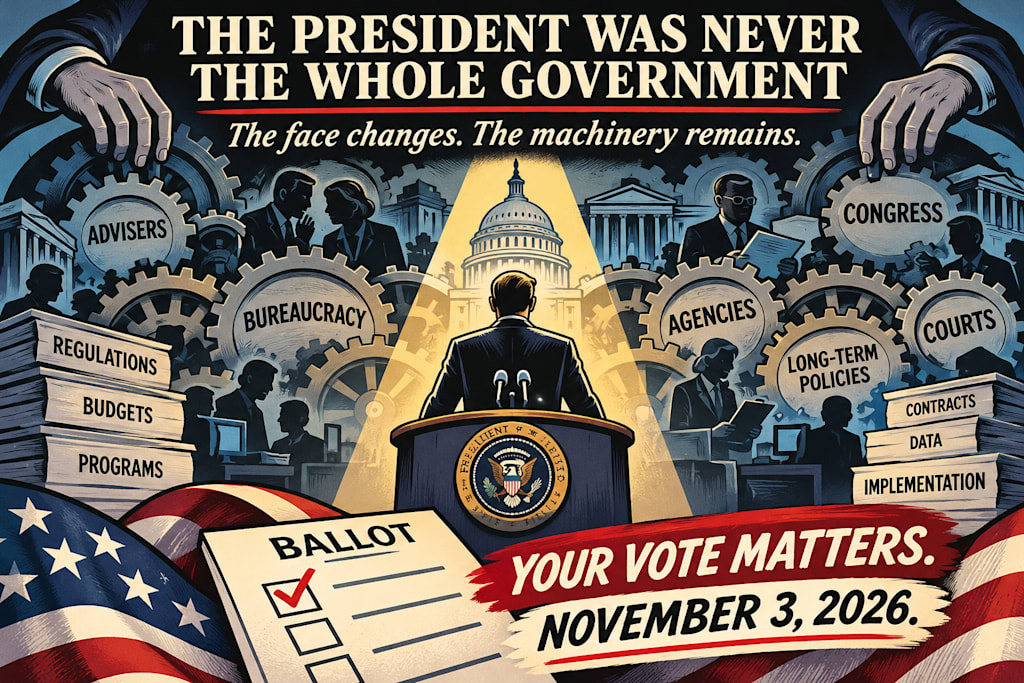
The President Was Never the Whole Government
November 3, 1986.
A Lebanese magazine exposed a secret operation involving the United States, Iran, and the sale of American weapons; what followed became one of the defining scandals of Ronald Reagan’s presidency of Iran-Contra.
The American public was watching a president who had built much of his political identity around strength, patriotism, and opposition to communism. Behind that image, members of his administration had participated in a covert operation involving arms sales to Iran and the diversion of proceeds to support the Contras in Nicaragua, despite congressional restrictions.
Oliver North, John Poindexter, and Robert McFarlane were among the central figures operating within the National Security Council. When the scandal broke, the administration’s explanations began to unravel. Reagan publicly denied trading weapons for hostages. The investigation that followed would establish a far more complicated reality.
Independent Counsel Lawrence Walsh concluded that Reagan had created the conditions that made crimes by others possible through secret departures from announced American policy. Walsh also found that Reagan failed to establish adequate accountability or effectively monitor activities he had authorized.
The president was not absolved of responsibility simply because other people carried out the operations.
But something else was happening.
While the country concentrated on the scandal, the machinery of government continued operating. On October 22, 1986, Reagan signed the Tax Reform Act, reducing the highest individual income tax rate from 50 percent to 28 percent while restructuring deductions, exemptions, and corporate taxation.
Days later, the Anti-Drug Abuse Act established the notorious 100-to-1 sentencing disparity between crack and powder cocaine, a policy whose consequences would fall disproportionately on Black communities.
On November 6, the Immigration Reform and Control Act became law, providing legal status to millions of undocumented immigrants while introducing employer sanctions that would produce their own discriminatory consequences. The administration continued negotiating international agreements, reshaping domestic policy, and making appointments whose effects would extend decades beyond Reagan’s presidency.
Alan Greenspan became chairman of the Federal Reserve in 1987. The Intermediate-Range Nuclear Forces Treaty was signed that December. The Canada–United States Free Trade Agreement followed in January 1988. The machine did not stop for the scandal.
And that is precisely the point.
In February 1987, Howard Baker became Reagan’s chief of staff. Concerned about reports of presidential disengagement, members of his incoming team examined whether Reagan was sufficiently attentive to the responsibilities of office. Accounts from that period described a president who sometimes appeared inattentive, resisted paperwork, and depended heavily on those surrounding him.
One particularly revealing description of who possessed authority within the White House was: “Everybody, and nobody.” Baker’s team considered the possibility of invoking the 25th Amendment. After observing Reagan directly, however, they decided against pursuing it.
That distinction matters. The historical record does not establish that Reagan had already become incapable of governing. It does establish that senior officials were sufficiently concerned to examine the question. Meanwhile, the government continued making decisions with consequences for millions of Americans.
Everybody, and nobody.
Keep those words in mind.
Because the question isn’t merely whether the president is functioning.
The question is who is functioning around him.
A Figurehead Is the Face. A Regency Is the Mechanism.
We often use the word figurehead to describe someone who occupies a prominent position without exercising the authority ordinarily associated with it.
The word is familiar. It is easily understood. But it does not adequately describe the governing mechanism I’m examining.
The more useful term is regency.
Historically, a regency is an arrangement in which authority is exercised on behalf of a sovereign who cannot personally fulfill the duties of the position.
The distinction is important.
A figurehead describes what the public sees.
A regency describes how power operates.
I am not suggesting that the British Regency Acts apply to an American president. They do not. Nor am I claiming that the United States has formally established a regency.
I am using the term as a political analogy for an arrangement in which the nominal leader remains publicly recognizable while significant governing authority becomes concentrated among the people managing access, information, policy and decisions.
That is where the danger lies.
A president can sign a document without originating the policy. He can announce a decision without understanding every consequence. He can defend an action using an explanation supplied by someone else. This is not automatically evidence of misconduct. Modern presidents necessarily rely on advisers, cabinet secretaries, lawyers and administrative staff.
The problem emerges when delegation becomes substitution, when accountability becomes obscured, and when nobody can clearly establish who made a decision or why.
Who benefits from that ambiguity?
Who writes the policy?
Who decides what information reaches the president?
Who controls which people have access to him?
And when a policy becomes controversial, who constructs the explanation?
A regency, in this analytical sense, does not require a ceremonial crown.
It requires a recognizable authority figure, a network of people exercising influence, and a public that continues directing its attention toward the person at the center rather than the people operating around him.
There is another word worth introducing and that is kakistocracy; a government by the least qualified or most unscrupulous.
Regency describes the potential arrangement.
Kakistocracy describes a possible quality of those administering it.
And interregnum, a period between governing orders, describes the political uncertainty that can follow when established authority begins to lose its substance.
These concepts help explain why a political system can appear stable on the surface while undergoing a profound transformation beneath it.
This Has Happened Before…
The danger of treating presidential authority as inseparable from the individual occupying the office is that history repeatedly demonstrates otherwise.
Consider Woodrow Wilson.
On October 2, 1919, Wilson suffered a devastating stroke. The severity of his condition was concealed from much of the public and even from important figures within his administration. His wife, Edith Wilson, assumed a powerful role in screening visitors, reviewing documents, and deciding which matters would reach him. Edith later described her responsibilities as a form of stewardship rather than a seizure of power.
That distinction deserves acknowledgment.
Her motivations may have included protecting her husband, preserving his dignity and maintaining continuity during a national crisis.
But the governing implications remained extraordinary. Access to the president became access to presidential authority.
The people controlling the flow of information acquired influence over what decisions could be made; which questions could be considered and whose concerns would be heard.
The public still had a president.
But the mechanisms through which that president exercised authority had fundamentally changed.
Now consider Richard Nixon.
As the Watergate scandal approached its conclusion in 1974, concerns about Nixon’s emotional state and behavior became intertwined with questions of national security.
Accounts of the period describe Defense Secretary James Schlesinger taking precautions concerning military orders, including the expectation that extraordinary directives would be reviewed through senior defense officials.
Here the concern was different.
Wilson’s vulnerability arose from a catastrophic medical event. Nixon’s arose from political collapse and fears about his judgment.
Yet both cases demonstrate a similar possibility on how officials surrounding a president may take extraordinary measures to manage the exercise of presidential power.
Then there was the Soviet gerontocracy.
During the final years of Leonid Brezhnev’s leadership, the Soviet Union operated through an entrenched political bureaucracy while its aging leader experienced serious health problems.
The system did not simply collapse because the person at its center weakened.
The apparatus continued.
Officials had institutional interests, relationships, privileges and political positions to preserve. Succession carried uncertainty and uncertainty threatened the people whose power depended on the existing arrangement.
In that environment, maintaining the leader could become more convenient than replacing him.
The individual remained important as a symbol of continuity even when the governing structure had developed its own momentum.
More recently, questions surrounding Joe Biden’s final years in office raised concerns about the management of presidential access and the extent to which senior advisers insulated him from scrutiny.
Reporting surrounding Original Sin, by Jake Tapper and Alex Thompson described an inner circle that allegedly restricted access, managed schedules and concealed signs of deterioration.
Those allegations should be evaluated on their evidence; just as comparable allegations about any other president should be. But they matter because they reveal that the underlying problem is not inherently Republican or Democratic.
It is structural.
The incentives surrounding political power do not disappear when a different party wins an election.
An administration has policy objectives, institutional loyalties, financial interests, and political ambitions. Its officials may be motivated by ideology, personal advancement, concern for the country or some combination of all three.
And those incentives can survive the person who brought them into office.
The face changes.
The machinery adapts.
The Reagan Laboratory: What Survives the Scandal?
Iran-Contra provides an especially revealing case because it demonstrates the relationship between presidential authority, administrative action and accountability. The operation was not simply a matter of a president making an unpopular public decision.
It involved covert activity, congressional restrictions, conflicting accounts, destroyed records and attempts to determine who had authorized what.
The Walsh investigation identified serious failures of oversight and accountability.
Records were withheld or destroyed. Witnesses gave inconsistent explanations. Legal proceedings became complicated by congressional immunity grants.
North’s and Poindexter’s convictions were ultimately overturned because of issues involving immunized testimony. Former Defense Secretary Caspar Weinberger was pardoned by President George H. W. Bush in December 1992.
The legal outcomes were complicated.
The political consequences were equally significant.
The administration had demonstrated how difficult it could be to assign responsibility within a system where authority flowed through overlapping officials, informal channels and secret operations. When an action succeeded; the administration could claim the accomplishment.
When an action became a scandal, responsibility could become fragmented among people with different recollections, different explanations and different degrees of documented involvement.
That is the problem with a system in which everybody and nobody appears to possess authority.
The public cannot hold accountable what it cannot clearly identify.
And while investigators worked to reconstruct what had happened, legislation continued shaping the lives of ordinary Americans. The Tax Reform Act changed the structure of federal taxation.
The Anti-Drug Abuse Acts of 1986 and 1988 contributed to a punitive criminal justice framework whose effects were concentrated in communities already facing significant economic and social disadvantages. Immigration reform legalized millions while creating new pressures surrounding employment verification and discrimination.
The McKinney Homeless Assistance Act of 1987 acknowledged an expanding national homelessness crisis and established federal assistance programs.
Housing legislation, trade policy, welfare requirements, and financial appointments continued transforming the country.
Not every policy was harmful, and not every law was simply imposed by presidential handlers. Congress, political negotiations, economic conditions and Reagan’s own priorities all mattered.
The INF Treaty represented a major arms control achievement. The Civil Liberties Act of 1988 formally apologized for the incarceration of Japanese Americans during World War II and provided restitution. The Fair Housing Amendments Act expanded civil rights protections.
Recognizing those achievements does not weaken the argument.
It strengthens the need to examine the entire machinery because the question is not whether every decision was bad. The question is who exercised influence over those decisions, how accountability operated, and whether the public understood the distribution of power.
A presidency is never just a man.
It is a network of institutions, personnel, political incentives and decisions.
And the consequences can last far longer than the presidency itself.
Donald Trump, Russian Diesel and the Graham Act
Fast forward to October 2026.
The United States facing pressure from rising diesel prices, disruption in global energy markets, the continuing Russia–Ukraine war and conflict involving Iran. Against that backdrop, Donald Trump turned toward an arrangement involving Russian diesel exports.
This is not merely another disagreement over presidential rhetoric. It involved legislation, sanctions authority, international trade, competing cabinet explanations and opposition from members of the president’s own party. And unlike a speculative discussion about what may be happening behind closed doors this sequence can be reconstructed through public records.
The chronology begins before October.
On July 11, 2026, Senator Lindsey Graham died at the age of 71. CBS News reported that preliminary medical examiner findings attributed his death to an aortic dissection associated with cardiovascular disease. Graham had been a prominent advocate for increasing economic pressure on Russia over its war against Ukraine.
On September 18, President Trump signed the Lindsey O. Graham Sanctioning Russia and Iran Act of 2026 into law. The law, Public Law 119-111, was named in recognition of the late senator’s work. It authorized extensive sanctions against Russian officials, financial institutions, and other entities, along with tariffs intended to exert economic pressure on Russia and countries purchasing Russian energy.
Its provisions included a proposed 500 percent tariff on certain Russian goods and 100 percent tariffs affecting major purchasers of Russian crude oil and natural gas.
But the legislation contained something equally important: presidential waiver authority. Under Section 115, the president could waive specified provisions after certifying to Congress that doing so served the national interests of the United States.
Those detail matters because the law itself created the mechanism through which its sanctions could be suspended.
Congress enacted the penalties. Congress also authorized the president to waive them. The question would soon become why he chose to exercise that authority.
October 9 The diesel agreement
On October 9, Trump announced an agreement involving Russian diesel exports. The administration presented the arrangement as a response to elevated fuel prices and international supply shortages.
The broader energy crisis is very real. The conflict involving Iran had disrupted energy markets, while Ukrainian strikes against Russian refining infrastructure had affected Russian fuel production and exports.
Axios reported that American diesel prices had reached approximately $6.28 per gallon on October 11, up roughly 71 percent from a year earlier. The administration’s argument was straightforward: additional diesel supplies could help ease pressure on fuel markets and consumers.
But there is another side to the arrangement. Russia’s oil and petroleum exports generate revenue and that revenue supports the Russian economy during its ongoing war against Ukraine. Allowing additional Russian diesel exports therefore raised a question about whether short-term energy relief would undermine the sanctions intended to pressure Moscow.
The agreement also raised legal questions about the relationship between sanctions relief and existing restrictions on Russian petroleum imports. The Treasury Department issued General License No. 135 in connection with the arrangement.
Members of Congress questioned both the wisdom and legality of the decision. At this point, the dispute is not simply about whether Russian diesel would help American consumers.
It was about whether an administration could simultaneously claim to be pressuring Russia while creating additional opportunities for Russian petroleum exports.
October 13 Congress objects before the Graham Act waiver
Four days after the agreement, twelve senators sent Trump a letter demanding that he reverse course. The letter was published on Senator Thom Tillis’s official Senate website.
Its signatories included Republicans Thom Tillis, Susan Collins, Lisa Murkowski, Mitch McConnell, John Cornyn, and Alan Armstrong, alongside Democrats Richard Blumenthal, Jeanne Shaheen, Dick Durbin, Sheldon Whitehouse, Jack Reed, and Chris Coons.
The objection was not subtle.
They argued that allowing Russian diesel to return more freely to international markets would generate revenue for Russia while undermining American efforts to support Ukraine. They also pointed to the Graham Act, which Congress had passed only weeks earlier.
The senators wanted Trump to rescind the diesel arrangement, withdraw the relevant Treasury license, and use the sanctions authorities Congress had provided.
what happened next?…The congressional objections did not arise only after Trump waived the Graham Act...They were already public.Members of his own party had warned him about the arrangement before the October 16 executive order.
The White House was therefore acting against the backdrop of documented bipartisan opposition.
October 16 The president waives the sanctions
On October 16, Trump signed Executive Order 14436, Implementing the Lindsey O. Graham Sanctioning Russia and Iran Act of 2026.
The order described the penalties established by the Graham Act.
It also waived numerous sanctions, restrictions, and tariffs that otherwise would have taken effect.
The White House simultaneously submitted a waiver certification and report to Congress and that filing is significant because it is not a journalist’s interpretation or an anonymous official’s account.
It is the administration’s own explanation of its decision.
Trump certified that applying the relevant sanctions and restrictions would interfere with ongoing efforts to negotiate a durable peace between Russia and Ukraine.
The order retained the ability to impose penalties later if circumstances changed.
This is where precision matters. Trump did not simply refuse to comply with the law. He used waiver authority provided within the law itself. Whether that decision was wise, strategically effective, or consistent with the legislation’s broader purpose is a separate question.
The legal mechanism existed.
The president exercised it.
And he provided a formal explanation.
But that explanation did not end the controversy.
October 17 The backlash expands
The next day, Republicans and Democrats criticized the decision.
Senator John Cornyn invoked the memory of Lindsey Graham, arguing that the late senator would have opposed the waiver.
Senator Thom Tillis criticized the administration’s approach.
Senator Ted Cruz described the waiver as a mistake.
Representative French Hill argued that the United States should increase pressure on Russia and requested a classified briefing. Other Republican lawmakers, including Don Bacon and Michael McCaul, had already expressed objections to the diesel arrangement.
Ukrainian President Volodymyr Zelenskyy also criticized the easing of pressure on Moscow.
The administration maintained that its approach was intended to advance negotiations and address energy prices.
This created an unusually revealing political conflict.
A sanctions law named for a Republican senator had been signed by a Republican president. Republicans had supported the legislation. Then the same president used waiver provisions, prompting objections from members of his own party.
The dispute is not simply partisan opposition. It is a disagreement over what the administration’s actions would accomplish.
Would easing sanctions create diplomatic leverage?
Would it relieve pressure on American consumers?
Or would it provide Russia with economic benefits while weakening the incentives intended to bring it toward a peace agreement?
Those are competing policy judgments but we the people, the public was about to hear something else about competing explanations from the administration itself.
October 18 Who Is Explaining Whose Decision?
On October 18, Axios published Ben Geman’s reporting on the different explanations offered by three senior Trump administration officials. Secretary of State Marco Rubio argued that Russian diesel would have been sold regardless of the administration’s intervention.
Energy Secretary Chris Wright offered a different emphasis. He described the sanctions relief as a diplomatic incentive intended to encourage Russia to reduce hostilities and make progress toward ending the war. Wright rejected the suggestion that the arrangement amounted to an economic lifeline for Russia.
Treasury Secretary Scott Bessent defended the administration’s broader record on Russian sanctions, pointing to previous penalties against Russian energy companies.
Three officials.
Three explanations.
One administration.
Rubio’s argument focused on inevitability.
Wright’s argument focused on leverage.
Bessent’s argument focused on the administration’s overall sanctions record.
These explanations are not logically impossible to reconcile.
Russia might have found alternative buyers while the United States still possessed some influence over the terms of international trade. A temporary concession might also have been intended to create an incentive for future negotiations.
But the differences deserve scrutiny.
If the diesel would have been sold regardless, what meaningful leverage did the administration gain by easing restrictions?
If allowing the exports was intended to encourage Russia to reduce hostilities, what specific conditions had Russia agreed to meet?
If the decision was part of a negotiating strategy, how would success be measured?
And if previous sanctions demonstrated the administration’s toughness, how did those earlier penalties justify the decision to waive new ones?
The problem is not that officials used different words.
The problem is that the public deserves to understand the governing rationale behind a consequential decision.
A policy may have several objectives.
But those objectives should be identifiable.
Who developed the arrangement?
Which agencies evaluated its consequences?
What did the State Department recommend?
What did the Treasury Department recommend?
What role did the Energy Department play?
What information did Trump receive before authorizing the agreement?
And how did the administration weigh the economic benefits against the potential financial benefits to Russia?
Those questions cannot be answered merely by observing that cabinet officials gave different interviews.
The interviews do not prove that Trump was uninvolved or unaware.
But they identify the questions an investigation should pursue.
Who is explaining whose decisions?
The Diesel Shipments When Policy Becomes Physical Reality
The controversy does not remain confined to legislation, interviews and press releases.
Russian diesel begins moving toward North America. On October 23, the Associated Press reported that a tanker carrying approximately 40,000 tons of Russian diesel had departed for the United States with an expected arrival in New York in early November.
On October 24, reporting attributed to Reuters described Russian Deputy Prime Minister Alexander Novak’s statement that three tankers were heading toward North America. By October 29, The Guardian reported that Greenpeace had identified six tankers carrying an estimated 268,000 metric tonnes of Russian diesel toward the United States.
The newspaper subsequently corrected its initial tanker count.
These developments matter because they move our story beyond a theoretical policy. Sanctions relief is not merely a legal abstraction.
It can affect the movement of commodities, the behavior of banks, shipping companies, ports, insurers and international buyers.
The public can see the consequences developing in real time.
But another distinction is essential.
A tanker sailing toward the United States is not proof that its cargo has been unloaded, purchased or distributed.
Like the reporting cited here, there remained questions about whether the shipments could legally and practically complete their deliveries.
Lawmakers had raised concerns about existing restrictions. Banks and port authorities faced potential legal and reputational risks.
New Jersey Governor Mikie Sherrill was reportedly examining possible ways to prevent unloading. The reporting also raised questions about whether the expected increase in supply would actually reduce diesel prices.
uncertainty matters.
The administration has presented an increased supply as a potential benefit to American consumers. But a shipment that cannot reach buyers does not deliver the same benefit as fuel that enters the market.
And even completed shipments would need to be evaluated against broader market conditions before anyone could confidently attribute a price change to the agreement.
So the question becomes more complicated.
What economic benefit was expected?
Who calculated it?
Who assumed the legal risks?
Who would profit from the transaction?
And what consequences would follow if the arrangement provided Russia with revenue without producing meaningful relief for American consumers?
This is what happens when a political decision becomes a real world economic process.
The machinery becomes visible.
A Sanctions Law Named for a Dead Senator
There is a particular historical irony in the Graham Act. Lindsey Graham spent years advocating stronger pressure on Russia.
He died in July 2026.
Two months later, legislation bearing his name became law. Less than a month after that, Trump exercised the law’s waiver authority to suspend major penalties.
Members of Graham’s own party objected, arguing that the decision undermined the purpose of the legislation.
The irony does not establish that the waiver was illegal. It does not prove that Trump misunderstood the law. And it does not establish that his advisers were governing independently. But it does demonstrate how political authority can produce results that diverge from the intentions of some of the people who helped create it.
A law can carry a legislator’s name.
A president can sign it.
Congress can celebrate its passage.
And the executive branch can later exercise discretion in a way that produces an outcome its supporters oppose.
That is not necessarily a constitutional failure.
It is a consequence of how power is distributed.
The question is whether the public understands that distribution.
The president receives attention for signing the law.
The president receives attention for waiving it.
The cabinet explains the waiver.
Congress objects.
Agencies administer the decision.
Private businesses assess whether they can act on it.
And the people affected by the resulting economic conditions may never know which part of the process mattered most.
Everybody, and nobody.
There is that phrase again.
Presidential Capacity Is Not the Same as Presidential Accountability
There is a temptation, whenever a president appears confused, fatigued, inconsistent, or unusually defensive, to turn the entire political conversation into a debate about medical fitness.
Does he have dementia?
Is he experiencing cognitive decline?
Can he remember information?
Does he understand the questions being asked?
Those questions can be relevant, but they can also become distractions.
A cognitive screening test is not an intelligence test. The Montreal Cognitive Assessment, commonly called the MoCA, is designed to screen for certain forms of cognitive impairment. A perfect score does not establish that someone possesses exceptional intelligence, nor does it comprehensively determine whether a person can govern.
Likewise, awkward speech, unusual behavior, fatigue, or a confusing public statement cannot independently establish a neurological diagnosis.
The material in my research includes concerns raised by physicians and commentators about Trump’s behavior, as well as references to congressional discussions of presidential capacity.
Those statements must be accurately attributed and evaluated according to what the authors actually examined. An outside professional opinion is not equivalent to a direct clinical examination or a formal determination under the 25th Amendment.
That distinction is vital.
We should not need to diagnose a president from a television screen to ask whether the government is functioning responsibly ever.
The 25th Amendment provides constitutional procedures for addressing presidential inability, but it does not automatically activate whenever physicians, lawmakers or members of the public express concern.
Its formal procedures involve the vice president, designated executive officials and potentially Congress.
A public debate about fitness is not itself a transfer of power. And even if a president were medically capable of fulfilling every constitutional responsibility, serious questions about administrative control could remain.
A fully competent president can authorize harmful policies.
A capable president can delegate excessive authority.
An attentive president can knowingly permit corruption.
A president can also be misled by advisers without being medically impaired.
That is why I believe the governing structure deserves more scrutiny than speculative diagnoses.
The question is not simply whether Trump is capable of understanding the decisions made in his name.
It is whether the public can identify who develops those decisions, who benefits from them and who bears responsibility when they fail.
Presidential capacity matters.
But so does accountability.
And one should not become an excuse to ignore the other.
The People Who Govern Without Being Elected President
Consider the four layers of power surrounding a major executive decision.
The first is formal authority.
The president signs an executive order, approves a policy, or authorizes an action. The signature establishes an identifiable legal and political act.
The second is policy development.
Cabinet officials, advisers, lawyers, agencies, lobbyists and other interested parties may influence the options presented to the president.
The third is public explanation.
Press secretaries, cabinet officials, political allies and communications staff translate the decision into a narrative designed to defend it.
The fourth is institutional continuity.
The officials, agencies, regulations, contracts and political relationships involved may continue operating after the president leaves office.
These layers are not inherently illegitimate. They are part of how modern government works.
The danger comes when the layers become so opaque that the public can no longer distinguish the president’s judgment from the preferences of the people surrounding him.
This is where the analogy of regency becomes useful. The person occupying the office remains the visible center of authority. But the practical exercise of power may depend on an increasingly complex network of people whose influence is difficult to measure and whose accountability is indirect.
The public concentrates on the president’s words, gestures, controversies and personality.
Meanwhile, policies move through departments and agencies.
Contracts are negotiated.
Regulations are changed.
Appointments are made.
Economic priorities are established.
And ordinary people live with the consequences.
The president remains the symbol.
The machinery produces the results.
Who Pays for the Machinery?
This is where the historical comparison becomes more than an argument about presidential behavior.
It becomes an argument about the people governed.
During the Reagan years, major decisions reshaped taxation, criminal justice, housing, immigration, trade, and social policy.
The effects were not distributed equally.
The crack-to-powder sentencing disparity contributed to severe racial inequalities in federal punishment.
Changes in taxation altered how the federal government collected revenue and distributed tax burdens.
Trade agreements created opportunities for some industries while exposing others to new competitive pressures.
The Medicare Catastrophic Coverage Act of 1988 expanded certain benefits but imposed financing requirements that generated intense opposition among seniors. Congress repealed much of the legislation in 1989.
These policies had different purposes and outcomes. Their effects should be evaluated individually rather than attributed to one simple motive.
But collectively they demonstrate something important. The decisions of a presidency do not disappear when the president leaves. They become part of the legal, economic, and institutional environment in which people live.
A factory worker experiencing job insecurity may not know which adviser helped shape a trade policy.
A family affected by federal sentencing law may never learn who negotiated a particular provision.
A senior struggling with health-care costs may have little knowledge of the political bargaining that produced a funding mechanism.
Yet the consequences are real.
This is why I am less interested in whether the public finds a president personally embarrassing than in what his administration is doing.
The same principle applies to contemporary energy policy.
When sanctions are imposed, waived, or selectively enforced, the consequences can reach far beyond diplomatic negotiations.
Energy markets respond.
Businesses adjust.
Consumers encounter changing costs.
Foreign governments gain or lose economic opportunities.
And the political arguments surrounding those decisions can obscure the actual distribution of benefits and burdens.
Who profits?
Who absorbs the costs?
Who possesses the information necessary to make those decisions?
And who can be held accountable?
Those questions should remain central regardless of which party occupies the White House.
The System Does Not Need to Love the Man
One of the most unsettling possibilities in politics is that a leader may remain valuable to the people around him for reasons entirely separate from his ability to govern.
He may command a loyal political following.
He may attract media attention.
He may provide legitimacy to policies that would otherwise struggle to gain public acceptance.
He may serve as a convenient explanation for controversial decisions.
He may absorb criticism that would otherwise fall on the officials developing those decisions. In that sense, the president can become both the administration’s greatest political asset and its most useful shield. This is not proof that Trump’s advisers have secretly displaced him.
It is an explanation of why the relationship between a political leader and the people surrounding him deserves careful investigation.
A leader who commands extraordinary loyalty can provide cover for decisions that supporters might otherwise question.
People defend the individual.
The defense of the individual becomes a defense of the administration.
And the administration’s policies receive less scrutiny because criticism is interpreted as an attack on the leader himself.
The arrangement can become self-reinforcing.
The more controversy surrounds the president; the more attention he receives.
The more attention he receives, the less attention may remain for the institutions operating behind him.
Meanwhile, those institutions continue making decisions.
If the president becomes politically inconvenient, the people and organizations surrounding him may seek other ways to preserve their influence.
Some will lose power.
Others will adapt.
And some policies will survive regardless of who holds the office next.
That is not a conspiracy theory.
It is a reason to examine political institutions as institutions, rather than treating government as the biography of one man.
The Interregnum When the Old Order No Longer Functions as We Imagine
Antonio Gramsci wrote about an interregnum in which an old political order is dying and a new one cannot yet emerge. He described the resulting period as one in which morbid symptoms appear. The concept holds relevance far beyond its original historical setting.
An interregnum is not merely a vacancy between rulers.
It can also describe a period when established political arrangements lose legitimacy, when institutions continue operating despite a crisis of public confidence and when the relationship between formal authority and actual power becomes increasingly uncertain.
That is the condition I am trying to understand.
We are encouraged to treat elections as decisive transfers of political control.
A president wins.
A president governs.
A president loses or leaves office.
Another president takes his place.
But the machinery of government is not rebuilt from nothing every four years.
Agencies remain.
Institutional interests remain.
Political donors remain.
Economic relationships remain.
Professional networks remain.
Some officials depart, but others continue.
Policies already enacted can shape society for generations.
This continuity is not automatically sinister. Stable institutions are essential to constitutional government.
But continuity becomes dangerous when it obscures responsibility or allows powerful interests to operate without meaningful democratic oversight.
The danger is not simply that a president may become weak.
It is that the public may continue believing all power resides in the president even when crucial decisions are being shaped elsewhere.
We direct our anger toward the face.
We direct our loyalty toward the face.
We debate the face’s intelligence, personality, health, and public behavior.
And all the while, the machinery continues.
That is the recurring pattern I see in the historical record.
Wilson’s administration continued during his incapacitation.
Nixon’s national security apparatus continued through the collapse of his presidency.
Reagan’s administration continued producing consequential policy while questions about oversight and presidential attentiveness emerged.
The Soviet bureaucracy continued operating around aging leaders.
Questions about Biden’s inner circle raised similar concerns about access and transparency.
And now Trump’s administration deserves the same scrutiny.
Not because every historical case is identical.
Not because every allegation has been proved.
And not because the president is necessarily unaware of what is happening.
But because the relationship between the visible leader and the people exercising power is one of the most important questions a democracy can ask.
The Enemy We Think We’re Fighting
The enemy that we think we’re fighting is not necessarily the enemy we are actually fighting.
We are taught to concentrate our political attention on individual leaders.
We are encouraged to believe that removing one person will resolve the problems associated with an entire administration.
Sometimes removing a leader is necessary.
Sometimes it produces meaningful change.
But replacing the person at the center does not automatically dismantle the institutions, incentives, and relationships that shaped the decisions made under that person.
If a harmful policy survives the president who signed it, what exactly has been defeated?
If the same political interests continue shaping legislation, appointments, and economic decisions, what has fundamentally changed?
If the public can identify the president but cannot identify the people responsible for developing major policies, how meaningful is democratic accountability?
This is not an argument for excusing Trump.
It is not an argument for excusing Reagan, Biden, Nixon, Wilson, or anyone else who occupied the presidency.
The responsibility of a president does not disappear because advisers exert influence.
The responsibility of advisers does not disappear because the president signs the final document.
Both must be examined.
That is the point.
The public deserves to know not merely who holds office but who exercises power.
Who develops the policies?
Who controls the information?
Who constructs the explanations?
Who benefits from the decisions?
Who pays for them?
And who remains when the president is gone?
Perhaps the most troubling possibility is not that the machinery will someday learn to function without the man at its center.
Perhaps it is that the machinery has always possessed that capacity.
And we have spent so much time watching the man that we have forgotten to watch the hands.
The question was never only whether the president was fit to govern.
The question is who governs, how they exercise that power and why the public so rarely gets to see the machinery at work.
_____________________
References and Research Sources
October 2026 — primary records and contemporary reporting
Congress / Government Publishing Office. Lindsey O. Graham Sanctioning Russia and Iran Act of 2026, Public Law 119-111, September 18, 2026. https://www.govinfo.gov/content/pkg/PLAW-119publ111/html/PLAW-119publ111.htm
The White House. Executive Order 14436: Implementing the Lindsey O. Graham Sanctioning Russia and Iran Act of 2026, October 16, 2026. https://www.whitehouse.gov/presidential-actions/2026/10/implementing-the-lindsey-o-graham-sanctioning-russia-and-iran-act-of-2026/
Government Publishing Office. Lindsey O. Graham Sanctioning Russia and Iran Act of 2026 Waiver Certification and Report, October 16, 2026. https://www.govinfo.gov/content/pkg/CDOC-119hdoc202/html/CDOC-119hdoc202.htm
Office of Senator Thom Tillis. Tillis, Colleagues Urge President Trump to Rescind Russian Diesel Deal, October 13, 2026. https://www.tillis.senate.gov/2026/10/tillis-colleagues-urge-president-trump-to-rescind-russian-diesel-deal
CBS News. Sen. Lindsey Graham Dies at 71 From Aortic Dissection, According to Medical Examiner’s Preliminary Findings, updated July 13, 2026. https://www.cbsnews.com/news/senator-lindsey-graham-dies-after-brief-and-sudden-illness/
Axios. Trump’s Russia Deal Leaves GOP Candidates With a Putin Problem, October 12, 2026. https://www.axios.com/2026/10/12/trump-russia-diesel-deal-republicans-midterms
Axios. Five Things to Watch After Trump’s Russian Diesel Deal, October 13, 2026. https://www.axios.com/2026/10/13/trump-russia-diesel-deal
Axios. Russian Diesel Deal “a Betrayal,” Bipartisan Coalition Says, October 13, 2026. https://www.axios.com/2026/10/13/trump-russian-diesel-deal-betrayal-bipartisan-letter
Axios. Trump Waives New Russia Sanctions in the “National Interests”, October 17, 2026. https://www.axios.com/2026/10/17/trump-russia-sanctions
ABC News. Trump Signs Order Waiving Graham Act Sanctions on Russia, Drawing Backlash From Some Lawmakers and Zelenskyy, October 17, 2026. https://abcnews.com/Politics/trump-signs-order-waiving-graham-act-sanctions-russia/story?id=137341529
Ben Geman, Axios. Trump Team Defends Russia Energy Moves but Offers Contradictory Reasons, October 18, 2026. https://www.axios.com/2026/10/18/trump-russia-diesel-deal-rubio-wright-sanctions
Axios. The Fallout From Trump’s Russia Energy Moves, October 19, 2026. https://www.axios.com/2026/10/19/fallout-trump-russia-energy
Associated Press. Reporting on the first tanker carrying Russian diesel toward the United States, October 23, 2026. https://apnews.com/article/f2c733604fd4fbd82e7b668c94fad978
Reuters / The Moscow Times. Three Tankers of Russian Diesel Headed for North America, Russian Deputy PM Says, October 24, 2026. https://www.themoscowtimes.com/2026/10/24/3-tankers-of-russian-diesel-headed-for-north-america-russian-deputy-pm-says-a94073
The Guardian. Six Oil Tankers Carrying 268,000 Tonnes of Russian Diesel Sail Towards US, October 29, 2026, subsequently corrected. https://www.theguardian.com/us-news/2026/oct/29/seven-oil-tankers-288000-tonnes-russian-diesel-sail-us-putin-trump
Iran-Contra and the Reagan administration
Lawrence E. Walsh, Final Report of the Independent Counsel for Iran/Contra Matters, particularly Chapter 27, “President Reagan,” and Part X, “Political Oversight and the Rule of Law.”
Ronald Reagan Presidential Library, presidency timeline and legislative signing statements.
American Presidency Project, Ronald Reagan presidential documents and chronology.
The New Yorker, “Worrying About Reagan,” February 24, 2011.
CBS News, “Lesley Stahl’s Book Weighs In on Reagan Alzheimer’s Controversy,” January 20, 2011.
Historical precedents
Miller Center, University of Virginia, historical material on Edith Wilson.
Politico Magazine, “The Madman and the Bomb,” August 11, 2017.
Foreign Affairs, “The Soviet Union: The Next Decade,” June 1984.
PBS NewsHour, discussion of Original Sin by Jake Tapper and Alex Thompson, May 22, 2025.
NPR, reporting on Original Sin and allegations concerning Biden’s inner circle, May 19, 2025.
Reagan-era legislation and policy
Balanced Budget and Emergency Deficit Control Act of 1985.
Tax Reform Act of 1986.
Anti-Drug Abuse Acts of 1986 and 1988.
Immigration Reform and Control Act of 1986.
Stewart B. McKinney Homeless Assistance Act of 1987.
Intermediate-Range Nuclear Forces Treaty, 1987.
Housing and Community Development Act of 1987.
Canada–United States Free Trade Agreement, 1988.
Medicare Catastrophic Coverage Act of 1988.
Civil Liberties Act of 1988.
Omnibus Trade and Competitiveness Act of 1988.
Fair Housing Amendments Act of 1988.
Family Support Act of 1988.
Department of Veterans Affairs Act, 1988.
Social Security Amendments of 1983.
Government Publishing Office, relevant public laws.
Social Security Administration, historical legislative summaries.
Los Angeles Times, “Congress Kills Catastrophic Care Program,” November 22, 1989.
CNN, “Alan Greenspan Fast Facts.”
Political and constitutional concepts
Cambridge Law Journal, “Royal Incapacity and Constitutional Continuity.”
Baturo and Elkink, “On the Importance of Personal Sources of Power in Politics,” 2017.
Dexter, “Court Politics,” Administration & Society, 1977.
Antonio Gramsci, writings on interregnum and political crisis.
About the Creator
Cadma
A sweetie pie with fire in her eyes
Instagram @CurlyCadma
TikTok @Cadmania
Enjoyed the story? Support the Creator.
Subscribe for free to receive all their stories in your feed. You could also become a paid subscriber, letting them know you appreciate their work.
Comments
There are no comments for this story
Be the first to respond and start the conversation.