white house
The epicenter of DC and by extension, the country: The White House is US government incarnate, it's hard to discern what goes on behind those walls...
The Urban-Spoke Problem
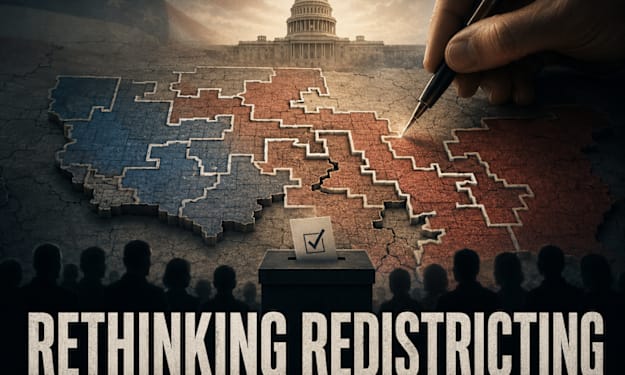
A Legal Map Can Still Be a Distorted Map The most obvious redistricting abuses are easy to notice when the district lines look absurd. A district stretches across the map through a narrow corridor. A city is cut into pieces. A rural region is split again and again, with each piece attached to a different portion of the urban center. The final map may still satisfy the formal requirement of equal population, but the structure reveals the real purpose. The district was not designed around a coherent community. It was designed around an outcome.
By Peter Thwing - Host of the FST Podcast4 months ago in The Swamp
Compact Geographic Districts
The Simplest Reform Is Still Worth Defending Compact geographic districts are not a complete answer to every representational problem, but they remain one of the most important safeguards against obvious manipulation. When district lines are regular, understandable, and tied to recognizable places, it becomes harder for political actors to hide what they are doing. A voter can look at the map and understand the basic logic. The city is mostly kept with the city. The rural region is mostly kept with the rural region. Suburbs are grouped with similar suburbs. Counties, municipalities, neighborhoods, and local economic regions are preserved when possible. The district begins to look less like a partisan machine and more like a real place.
By Peter Thwing - Host of the FST Podcast4 months ago in The Swamp
The Epicenter Model
Start With the Population Center Instead of the Political Outcome The epicenter model begins with a simple correction. Instead of starting with the outcome a party wants, it starts with where people actually are. A dense urban center is treated as the center of its own representation, not as a pile of voters to be divided and stretched outward into surrounding territory. The city is not cracked into spokes. The surrounding rural districts are not forced to reach into the city through long narrow tips. The map begins with the population center, builds outward until the district reaches the required population, then repeats that process until the urban area has been represented in a coherent way.
By Peter Thwing - Host of the FST Podcast4 months ago in The Swamp
The Problem Is Not Just Gerrymandering
The Argument Begins in the Wrong Place Most arguments about redistricting begin after the most important assumption has already been accepted. The public is usually invited to argue about whether a map is fair, whether a district is too stretched, whether a city has been divided too many times, whether one party gained an advantage, or whether a court should force the lines to be redrawn. Those questions matter, but they are not the deepest questions. They all assume that representation must begin with geography, and that the only real dispute is how the land should be divided.
By Peter Thwing - Host of the FST Podcast4 months ago in The Swamp
Why This Conversation Has to Happen Now
This Is Not an Abstract Exercise Brainstorming alternatives to redistricting can sound theoretical until the country enters a moment when the map itself becomes one of the main weapons of national power. At that point, the question stops being academic. It becomes immediate. If congressional control can be altered not mainly by persuading voters, but by changing the containers those voters are placed into, then redistricting is not a procedural side issue. It is one of the most consequential political powers in the country.
By Peter Thwing - Host of the FST Podcast4 months ago in The Swamp
Trump’s Record in Full Context (Part 5). AI-Generated.
(Continued from Part 4...) --- Parts 1 and 2 recorded Trump’s accomplishments. Part 3 recorded failures, blocked promises, and shortfalls. Part 4 recorded false, misleading, exaggerated, or unproven claims made against him. Part 5 records the narrower category of things that survive the same truth filter: legal findings, documented conduct, self-created damage, and unresolved matters that have a factual basis but have not been proven as crimes.
By Peter Thwing - Host of the FST Podcast4 months ago in The Swamp
Trump’s Record in Full Context (Part 4). AI-Generated.
(Continued from Part 3...) --- Parts 1 and 2 documented what Donald Trump objectively did. Part 3 documented what he did not fully deliver, what was blocked, what became legally complicated, and what should be judged with broader context. Part 4 addresses a different category: claims made about Trump that were false, misleading, overreaching, unproven, selectively framed, or materially incomplete.
By Peter Thwing - Host of the FST Podcast4 months ago in The Swamp
Power Prefers Ambiguity to Truth
Ambiguity Is Safer Than a Lie Power rarely announces itself through outright lies. Lies are risky. They can be disproven. They can be exposed. They can be traced back to the person or institution that made them. What power often prefers instead is ambiguity. Ambiguity is safer than falsehood because it cannot be cleanly falsified. It blurs edges, stretches timelines, multiplies interpretations, and turns clarity into controversy.
By Peter Thwing - Host of the FST Podcast4 months ago in The Swamp
Belief Does Not Create Truth
When Belief Is Treated as Authority One of the most persistent confusions in modern discourse is the idea that belief itself carries epistemic authority. People speak as though believing something strongly, collectively, or sincerely grants it a special status, as if conviction were a substitute for correspondence with reality. This confusion is not harmless. It collapses the distinction between what people think and what actually is. Once that distinction collapses, truth becomes negotiable and error becomes untouchable.
By Peter Thwing - Host of the FST Podcast4 months ago in The Swamp
Moral Law and False Witness
When Truth Is Not Optional Moral systems do not begin with outcomes. They begin with constraints. Certain acts are treated as wrong not because they fail, but because performing them already constitutes the failure. Bearing false witness has always occupied that category. It is not condemned because it sometimes produces injustice. It is condemned because it corrupts the very process by which justice is discerned. Once falsehood is introduced deliberately, the pathway to truth is no longer reliable, even if it occasionally arrives at a correct destination.
By Peter Thwing - Host of the FST Podcast4 months ago in The Swamp
Created Risk, Inherited Risk, and the Moral Line We Keep Erasing (A Society That Tells the Truth: Chapter 3)
The Distinction Modern Rules Refuse to Make One of the quiet failures of modern rule making is the refusal to clearly distinguish between risk created by choice and risk inherited by existence. When this distinction collapses, responsibility becomes confused, guilt spreads outward indiscriminately, and ordinary behavior is treated as morally suspect. This is not a minor philosophical oversight. It is the foundation beneath many of the injustices people now experience in public life, from transportation and health policy to everyday regulation and enforcement. When systems fail to differentiate between what someone causes and what simply exists, moral clarity erodes at every level.
By Peter Thwing - Host of the FST Podcast5 months ago in The Swamp
Trump’s Record in Full Context (Part 2). AI-Generated.
(Continued from Part 1...) --- Building on first-term foundations, the second administration (2025– ) prioritized rapid executive action on border control, bureaucracy reduction, and cultural/policy reversals. This section records key executed actions and claimed outcomes through April 2026.)
By Peter Thwing - Host of the FST Podcast5 months ago in The Swamp