corruption
A prime locale to talk bribery, suspect campaign funding, and all other instances of political corruption. The shadier, the better.
Polanski Compared to Farage.
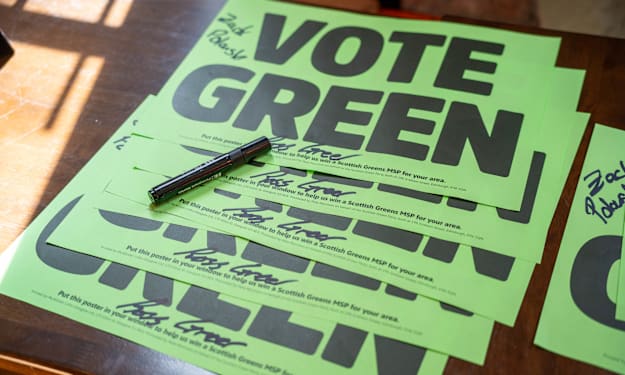
No doubt about it, Thursday night's local elections were a huge slap in the face for Starmer. Labour saw losses across the country. Though this wasn't a general election, Labour's results were a huge reversal of their 2024 general election landslide that ousted the government of "Wishy Washy" Rishi Sunak. For the Conservatives, their vote was down. That may be a reflection that voters remember that they had 13/14 years in power and did nothing. Kemi Badenoch has been the leader of the Conservatives for a little while, so maybe she's not doing enough to attract back voters who have deserted the Tories for good or for now to Reform UK.
By Nicholas Bishop5 months ago in The Swamp
The World’s Most Critical Oil Lane Just Became a War Zone — and Nobody’s Talking About It Enough
U.S. destroyers dodged Iranian missiles in the Strait of Hormuz this week. Here’s why that single waterway could determine the future of the global economy — and possibly trigger a wider war.
By Gideon Polycarp5 months ago in The Swamp
Iranian and American Reports Contradict.
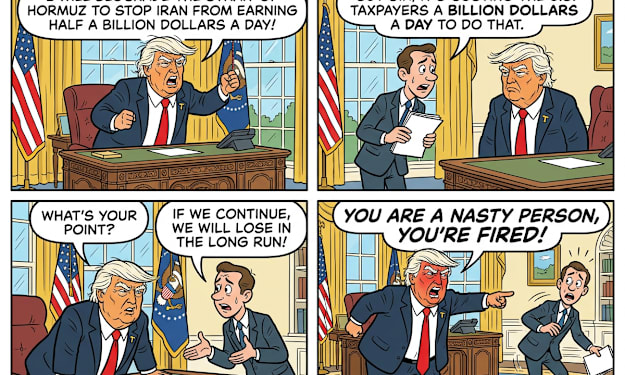
US and Iranian forces have clashed in the Straits of Hormuz. Iran has been blockading the Straits of Hormuz since April, causing economic chaos in the West. The US, in response, imposed a blockade of its own on Iranian ports to give Iran similar grief. Trump reported that "3 world-class destroyers just transited very successfully, out of The Straits of Hormuz, under fire. There was no damage done to the 3 destroyers, but great damage was done to the Iranian attackers". Mr. Trump posted this on his social media outlet, "Truth Social".
By Nicholas Bishop5 months ago in The Swamp
Every Alternative Is An Admission
The Current System Should Not Be Treated as the Neutral Baseline The current redistricting system is often treated as the normal starting point, while every alternative is treated as an experiment that must justify itself. That framing is backwards. The current system is already an experiment in political assignment. It already decides which voters belong together before they vote. It already gives enormous power to whoever controls the boundaries. It already allows voters to be packed, cracked, attached, diluted, concentrated, divided, or rearranged while still maintaining the appearance of legal process. The familiar system should not receive moral credit merely because people are used to it.
By Peter Thwing - Host of the FST Podcast5 months ago in The Swamp
What Redistricting Reveals About Power
The Line Is Never Just a Line Redistricting is usually presented as a technical process. Population changes. Census numbers are updated. Districts must be adjusted. Boundaries are redrawn so each representative serves roughly the same number of people. On paper, this sounds administrative, almost mechanical. The map changes because the population changed. The process is described as maintenance.
By Peter Thwing - Host of the FST Podcast5 months ago in The Swamp
The Best System Is Probably Layered
The Failure Begins With a False Choice The redistricting debate is often presented as if the only real choice is between a fair geographic map and an unfair geographic map. One side draws lines. The other side challenges the lines. Courts, commissions, parties, activists, analysts, and voters then argue over compactness, contiguity, partisan advantage, racial balance, community preservation, competitiveness, and legal compliance. Those arguments matter, but they still leave the deeper assumption untouched. They assume representation must begin with land, and that the only real reform is drawing the land more fairly.
By Peter Thwing - Host of the FST Podcast5 months ago in The Swamp
The Case for Organic Districts
Representation Should Begin With the Citizen The ordinary districting system begins outside the voter. A map is drawn. A boundary is approved. A district number is assigned. The voter is then placed inside that district by address. Only after that does the voter get to choose from the candidates allowed within that container. This means the first act of representation is not the vote. The first act is the assignment of the voter to a political constituency. Under the current model, that assignment is usually controlled by geography, law, mapmakers, courts, commissions, legislatures, or administrative rules. The voter participates later.
By Peter Thwing - Host of the FST Podcast5 months ago in The Swamp
Competitive Districts Are Not Inherently More Representative
Competition Is Not the Same Thing as Representation Competitive districts are often treated as the obvious goal of redistricting reform. A district split close to 50-50 is assumed to be fair because either side can win. A landslide district is assumed to be suspicious because one side appears too secure. This sounds reasonable at first. If elections are supposed to give voters a real choice, then a district where the outcome is uncertain appears healthier than one where the result is almost guaranteed.
By Peter Thwing - Host of the FST Podcast5 months ago in The Swamp
Anti-Abuse Rules for Any New Districting System
No System Is Safe Without Guardrails Every redistricting reform is vulnerable to abuse because every representative system must decide who belongs with whom. That decision is powerful. In a geographic system, the power appears in boundary lines. In an ideological system, it appears in labels and categories. In a ranked-preference system, it appears in assignment rules and caps. In a political compass system, it appears in questions, scoring, and weights. In a lottery system, it appears in the voter pool, randomization method, and audit process. The abuse does not disappear simply because the old map is removed. It moves.
By Peter Thwing - Host of the FST Podcast5 months ago in The Swamp
Communities of Interest Should Mean Something
A Community Is More Than a Demographic Category The phrase “community of interest” is often used in redistricting debates, but it can become vague enough to mean almost anything. A mapmaker can claim to protect a community of interest while splitting a real town, attaching unrelated neighborhoods, dividing rural regions, or combining voters who share little beyond usefulness to a political outcome. When a phrase becomes flexible enough to justify almost any map, it stops protecting representation and starts protecting the mapmaker.
By Peter Thwing - Host of the FST Podcast5 months ago in The Swamp
The Hybrid Chamber Model
One Representative System Cannot Carry Every Burden The redistricting debate often becomes trapped because one district is expected to represent everything at once. A geographic district is asked to represent population equality, local infrastructure, culture, economy, municipal boundaries, party fairness, ideological alignment, minority voice, class interests, rural concerns, urban density, and voter accountability. That is too much weight for one structure. No single map can represent every kind of human concern. The result is constant conflict over which value should dominate.
By Peter Thwing - Host of the FST Podcast5 months ago in The Swamp
Random Samples vs. Real Communities
Equality at the Point of Assignment Is Not the Whole Goal A random lottery district system has one powerful advantage: it removes much of the human ability to manipulate district composition before the election begins. If voters are randomly assigned to districts, no mapmaker can crack a city, pack opponents, dilute rural communities, or attach narrow urban corridors to surrounding land. The district is not drawn around voters. The voters are assigned by chance. That creates a kind of procedural purity that ordinary redistricting cannot easily match.
By Peter Thwing - Host of the FST Podcast5 months ago in The Swamp