
What Redistricting Reveals About Power
Why the Fight Over Lines Is Really a Fight Over Who Gets to Define Representation

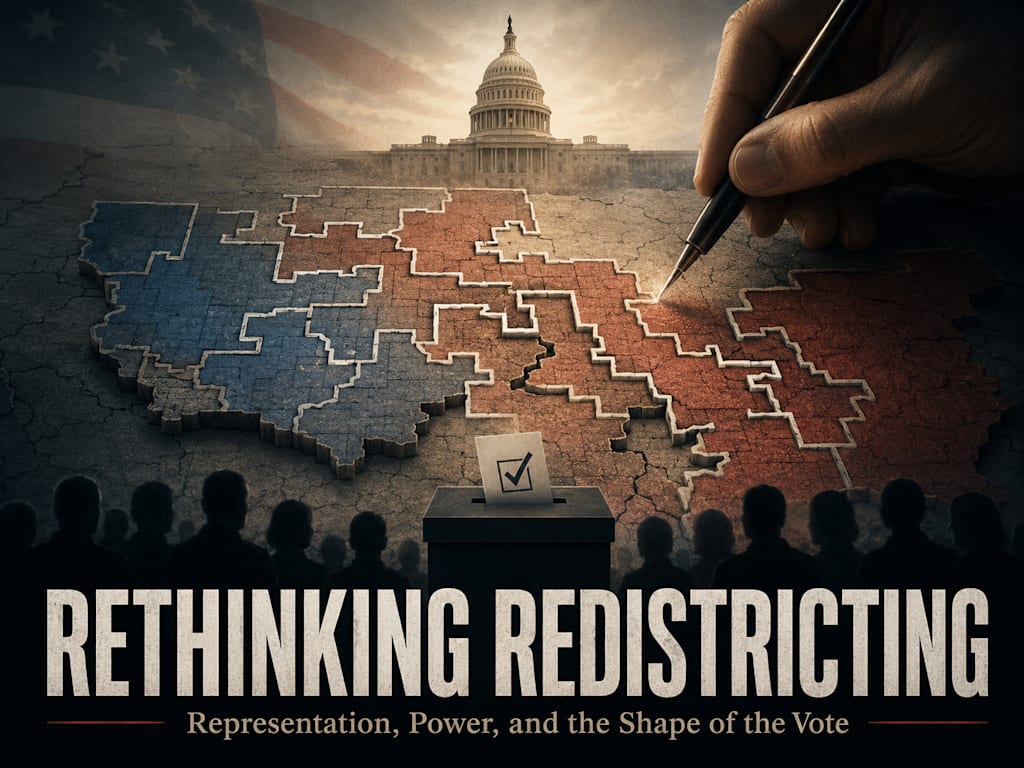
The Line Is Never Just a Line
Redistricting is usually presented as a technical process. Population changes. Census numbers are updated. Districts must be adjusted. Boundaries are redrawn so each representative serves roughly the same number of people. On paper, this sounds administrative, almost mechanical. The map changes because the population changed. The process is described as maintenance.
But a district line is never just a line. It decides which voters belong together. It decides which communities are kept whole and which are split apart. It decides whether a city speaks with a coherent voice or is divided into fragments. It decides whether a rural region can elect someone who understands rural life or whether it becomes an attachment to a dense urban population. It decides whether a political minority is concentrated, scattered, diluted, or preserved. Long before voters choose a representative, someone has already shaped the battlefield.
That is why redistricting reveals power. The power is not only in who wins the election. The power is in who gets to define the unit of representation before the election happens. A voter may think the democratic act begins at the ballot box, but districting proves something more uncomfortable. The ballot is cast inside a container. Whoever controls the container influences the meaning of the vote.
The First Act of Representation Happens Before the Vote
Most people think representation begins when voters choose a candidate. That is only partly true. In a district-based system, representation begins when voters are grouped. The district is the first act. It decides which people form the political body that will choose one representative. That grouping may be natural, coherent, manipulative, or artificial. But once it exists, the election happens inside it.
This is the hidden power of redistricting. A voter can remain in the same house, hold the same values, vote the same way, and still have the force of that vote changed by the district line. If the voter is grouped with people who share similar interests, that voter may have a meaningful voice. If the voter is grouped into a district where another bloc dominates, that voter may be counted without being represented. Nothing about the voter changed. The container changed.
That is why the argument over district lines is not a minor administrative dispute. It is a fight over political meaning. The same vote can be powerful in one district and nearly useless in another. The same community can be whole in one map and broken in another. The same city can speak for itself in one system and become a reservoir of votes in another. The same rural region can elect someone who understands it or be attached to a population center that overwhelms it. The line determines the context in which the ballot will be counted.
Power Prefers to Hide Inside Procedure
Power is most effective when it can describe itself as procedure. A map can be defended as technical. A boundary can be described as necessary. A district can be justified by population requirements, contiguity, legal constraints, or community language. Those things may all matter, but they can also conceal the deeper question: why are these voters grouped together, and who benefits from that grouping?
That is the problem with treating redistricting as neutral administration. Legal compliance is not the same as representational justice. A map can satisfy population rules and still divide real communities. A district can be contiguous and still be artificial. A boundary can follow procedure and still serve a political outcome. Technical language can make a power decision sound like routine paperwork.
This is how manipulation becomes respectable. The public sees a map, a hearing, a commission, a legal standard, and a set of official explanations. But beneath those formal elements sits a more basic reality: someone arranged voters into political containers. If that arrangement was made to preserve power, dilute opposition, protect incumbents, or convert one community into an attachment to another, then the procedure has become a mask.
The Mapmaker Chooses the Battlefield
Elections are often discussed as contests between candidates, parties, ideas, and voters. But redistricting shows that the battlefield itself can be chosen before the contest begins. The mapmaker decides where the fight will happen. The mapmaker decides which voters are inside the arena together. The mapmaker decides whether a district contains a coherent community or a forced collision of opposing blocs.
That choice can matter as much as the campaign. A strong candidate may lose because the district was drawn to bury their coalition. A weak candidate may win because the district was built to protect their party. A rural community may consistently lose because it was attached to urban voters. A city may be fractured so that no representative is fully accountable to its urban problems. A political minority may be packed into one district to limit its influence elsewhere. None of this requires changing a single vote. It only requires changing the district.
This is why redistricting is so tempting to those who seek power. It lets political actors shape outcomes without appearing to touch the ballot. The voter still votes. The election still happens. The count may still be accurate. But the decisive act happened earlier, when the representative unit was defined. Power does not always need to silence voters. Sometimes it only needs to decide which voters are allowed to speak together.
Communities Become Materials
A corrupt districting process treats communities as materials. A city neighborhood becomes a useful pocket of voters. A rural county becomes land to be attached. A suburb becomes a balancing tool. A working-class area becomes a number. A religious community becomes a bloc. A minority viewpoint becomes a problem to manage. The people remain human in theory, but the map treats them as components.
This is the moral injury behind gerrymandering. It is not merely that one side gains an advantage. It is that communities are handled as objects. They are packed, cracked, stretched, merged, divided, or diluted according to usefulness. The mapmaker does not need to hate the community. Indifference is enough. The community is not seen as a real body with its own voice. It is seen as a resource in a larger strategy.
A representative system should do the opposite. It should ask what real communities exist and how they should be heard. A rural region should be recognized as more than empty space. A city should be recognized as more than a vote reservoir. A suburb should be recognized as more than filler. A working-class corridor should be recognized as more than a turnout calculation. A religious, ideological, or nonaligned constituency should be recognized as more than a statistical inconvenience. Representation begins by seeing the community as real.
The Language of Fairness Can Be Used to Justify Control
Every side in redistricting uses the language of fairness. Fairness can mean equal population. It can mean compactness. It can mean competitiveness. It can mean partisan balance. It can mean preserving communities. It can mean racial representation. It can mean preventing wasted votes. It can mean local coherence. Because fairness has many meanings, it can be used honestly or strategically.
One faction may demand competitive districts because it benefits from breaking coherent communities into closer contests. Another may demand compact districts because compactness happens to preserve its advantage. Another may defend communities of interest while defining those communities selectively. Another may invoke equal population while ignoring the representational damage caused by how those equal populations are grouped. Fairness language can clarify, but it can also conceal.
This is why the deeper question must always be asked: fair for what purpose? If the goal is local representation, then preserving place matters. If the goal is value alignment, then ideology and governing philosophy matter. If the goal is anti-manipulation, then randomization or transparent assignment may matter. If the goal is consent, then voter-selected districts may matter. A system cannot be judged by the word fairness alone. It must be judged by the kind of representation it produces.
Competitive Districts Reveal the Confusion
The obsession with competitive districts reveals how easily representation can be confused with electoral suspense. A close race is often treated as a healthier race because either side can win. But a district split 50.01 percent to 49.99 percent does not necessarily represent a coherent people. It may simply empower a bare majority while leaving nearly half the district without a meaningful voice.
That does not mean competition is worthless. Competition can hold representatives accountable. It can prevent arrogance. It can force candidates to listen beyond their base. But competition is not automatically representation. A close district can be healthy if it emerges from real disagreement inside a coherent community. It can also be artificial if created by combining communities that do not belong together.
Power benefits when the public confuses closeness with justice. A map can break a community, create a close election, and then claim fairness because the race is competitive. But forced conflict is not representation. A district should be judged first by whether it gives a real community a meaningful voice. If it also produces competition, that may be useful. But the margin is not the moral standard.
The Current System Pretends Geography Can Do Everything
Geography matters. A local representative should know the roads, bridges, potholes, business owners, factories, schools, churches, neighborhoods, and local culture. A county commissioner should understand land, towns, infrastructure, farms, and emergency services. A city council member should understand density, zoning, traffic, housing, public safety, and municipal life. Where government manages place, geography is essential.
But geography cannot represent everything. It cannot automatically represent values, moral priorities, federal philosophy, views on war, speech, privacy, taxation, immigration, national debt, agency power, religious liberty, labor, or constitutional limits. Two neighbors may share a street and disagree about every major national question. Two voters across the state may share a deeper political philosophy than people living next door to each other.
The current system often pretends geography can do every job. It asks one map to represent place, population, culture, values, party balance, competitiveness, class interest, and community identity all at once. That is too much. The result is predictable conflict. Every district becomes a battleground over which kind of representation will dominate. Power hides in that confusion because the public cannot easily tell which standard is being served.
Alternatives Expose the Hidden Premise
Every alternative to ordinary redistricting exposes the same hidden premise: someone must decide what kind of representation matters most. Compact districts say place matters. Epicenter districts say density and urban coherence matter. Voter-selected districts say consent matters. Ranked-preference districts say voter agency and layered identity matter. Named ideological districts say values matter. Numbered spectrums say simplicity matters. Multi-axis districts say political complexity matters. Political compass tools say self-understanding matters. Party-affiliation sorting says practical political identity matters. Lottery districts say procedural equality matters. Hybrid chambers say no single method is enough.
These alternatives are valuable even when imperfect because they make the premise visible. The current system often smuggles its premise in silently. It says districts are geographic and lets the public fight over the map. But once alternatives are considered, the deeper question appears: what is the district supposed to represent? Land? Density? Local culture? Values? Party? Random equality? Consent? Communities of interest? Some combination?
That question is the beginning of real reform. A system cannot be honest until it names what it is trying to represent. A map that claims neutrality while serving power is less honest than an alternative that openly declares its tradeoff and builds safeguards around it.
The Strongest Reform Limits the Container-Maker
The central political problem is not only bad lines. It is unchecked control over containers. Whoever defines the district defines the first stage of representation. In a geographic system, that person draws boundaries. In a value-based system, that person defines categories. In a ranked system, that person writes overflow rules. In a political compass system, that person writes questions and scoring formulas. In a lottery system, that person controls the randomization process. Every model has a container-maker.
Reform must therefore ask who controls the container and how that control is limited. A geographic system needs compactness, community evidence, anti-corridor rules, and public justification for splits. A value-based system needs stable labels, public definitions, equal caps, and voter choice. A ranked system needs transparent assignment rules. A political compass system must be voluntary and auditable. A lottery system needs verified randomization. A hybrid system needs clear separation between place representation and value representation.
The goal is not to find a system without power. That does not exist. The goal is to make power visible, limited, and accountable. The container-maker must not be allowed to operate in shadow. The voter should not be arranged without knowing the principle of arrangement.
The Voter Should Not Be the Object of the System
A just representative system treats the voter as a citizen, not as an object. The voter is not raw material to be sorted into districts for institutional convenience. The voter is not a coordinate on a map to be connected to other coordinates for partisan advantage. The voter is not a demographic unit to be packed or cracked. The voter is not a number to be balanced after the real political decision has already been made.
This is why consent-based and ranked-preference models matter even if they are not used everywhere. They restore the idea that citizens should have some role in defining their representation. A voter may not always get a first-choice district because equal population caps matter. But allowing voters to rank constituencies is still morally different from drawing a line around them and declaring the matter settled.
Local government still requires geography. A voter cannot choose a distant pothole district if the office manages local roads. But for higher offices, especially those dealing with national principles, voter agency deserves more weight. The citizen should not be permanently trapped inside a district that exists because someone else found the arrangement useful.
Power Is Not Defeated by Better Language
New language does not automatically create justice. Calling a district “compact” does not make it fair. Calling a category “constitutionalist,” “progressive,” “labor,” or “nonaligned” does not make it honest. Calling a process “ranked,” “random,” “independent,” or “data-driven” does not make it incorruptible. Power can wear any vocabulary.
That is why every reform needs anti-abuse rules. The new system must name its own corruption points before they are exploited. If the system uses labels, labels must be stable and descriptive. If it uses tests, tests must be voluntary and transparent. If it uses caps, caps must be equal. If it uses wait-lists, wait-lists must be auditable. If it uses randomization, the draw must be verifiable. If it uses communities of interest, those communities must be evidenced before maps are finalized.
A reform that does not restrain its own power becomes a new costume for the old failure. The mapmaker can become the category-maker. The category-maker can become the test designer. The test designer can become the algorithm keeper. The algorithm keeper can become the new gerrymanderer. The form changes. The temptation remains.
The Fight Is Over Who Gets to Speak Together
At its deepest level, redistricting is about who gets to speak together. A district is a collective voice. It says these people, grouped this way, will send one representative. That grouping determines whether the voice is clear, divided, diluted, coherent, manipulated, or random. The representative is not only chosen by voters. The representative is chosen by voters who have already been grouped.
This is why districting carries such moral weight. A community that is kept whole can speak. A community that is split may whisper through several districts without controlling any of them. A value group that is scattered may never elect anyone. A city that is fractured may lose coherent accountability. A rural region attached to a city may lose the ability to speak for rural life. A random district may speak equally but thinly. A value-based district may speak clearly but separately.
The question is not whether grouping happens. It must happen in any district system. The question is whether the grouping is honest. Does it reflect a real place, real values, real consent, real equality, or real community? Or does it reflect the advantage of those who drew the container?
Representation Requires a Moral Standard
Redistricting cannot be judged only by legality, math, or appearance. It requires a moral standard. Equal population matters, but equal population is not enough. Compactness matters, but compactness is not enough. Competitiveness may matter, but competitiveness is not enough. Party balance may matter in some contexts, but party balance is not enough. A district must be judged by whether it gives a real people a real voice.
That standard requires clarity about what the office represents. If the office governs local place, the district should preserve place. If the office governs national principle, the district should preserve values more directly. If the office is meant to check corruption, random assignment may help. If the office is meant to balance place and principle, a hybrid system may be necessary. The moral standard is not one method. The moral standard is fit between the office and the represented reality.
This is what the current system often fails to provide. It relies heavily on geography even when geography cannot represent the relevant political reality. It praises competition even when competition creates permanent conflict without voice. It treats legal assignment as meaningful representation. It allows power to define the container and then tells voters that the election inside it is enough.
Redistricting Reveals Whether the System Trusts the People
A system that refuses voter agency reveals something. It assumes citizens should vote only after the container is built for them. It allows them to choose candidates, but not the representative body they belong to. This may be appropriate for local offices where place determines function. But when applied everywhere, especially to higher offices, it suggests the system trusts administrators, mapmakers, parties, courts, or commissions more than voters to define representation.
A system with voter-selected or ranked constituencies reveals a different assumption. It assumes voters can participate in defining their political voice. It still uses rules, caps, wait-lists, and safeguards, but it moves some power closer to the citizen. It treats the voter as capable of association, not merely placement.
That does not mean every voter will choose wisely. No system can guarantee wisdom. But the current system does not guarantee wisdom either. It often guarantees only that someone else made the first decision. A representative order worthy of trust should be careful before denying citizens any role in the first act of representation.
The Capstone Truth Beneath the Map
Redistricting reveals power because it shows that democracy can be shaped before voting begins. The ballot matters, but the district determines the arena in which the ballot operates. The representative may be elected, but the constituency was constructed first. That construction is where power hides.
A just system must therefore ask harder questions than whether the line technically works. Who drew the container? What does the container claim to represent? Which communities were preserved? Which were split? Which voters were diluted? Which values were ignored? Which interests were made visible? Which power was restrained? Which abuse point remains hidden? These questions matter because they decide whether representation is real or merely procedural.
The fight over redistricting is not ultimately a fight over shapes. It is a fight over who gets to define the people before the people speak. That is why better maps are not enough. The deeper reform is to make the basis of representation honest, visible, limited, and matched to the office being filled. Until that happens, redistricting will remain one of the quietest ways power speaks before the voter ever does.
About the Creator
Peter Thwing - Host of the FST Podcast
Peter unites intellect, wisdom, curiosity, and empathy —
Writing at the crossroads of faith, philosophy, and freedom —
Confronting confusion with clarity —
Guiding readers toward courage, conviction, and renewal —
With love, grace, and truth.
Enjoyed the story? Support the Creator.
Subscribe for free to receive all their stories in your feed.
Comments
There are no comments for this story
Be the first to respond and start the conversation.