
The Case for Organic Districts
Letting Representation Grow From Voters Instead of Being Imposed on Them

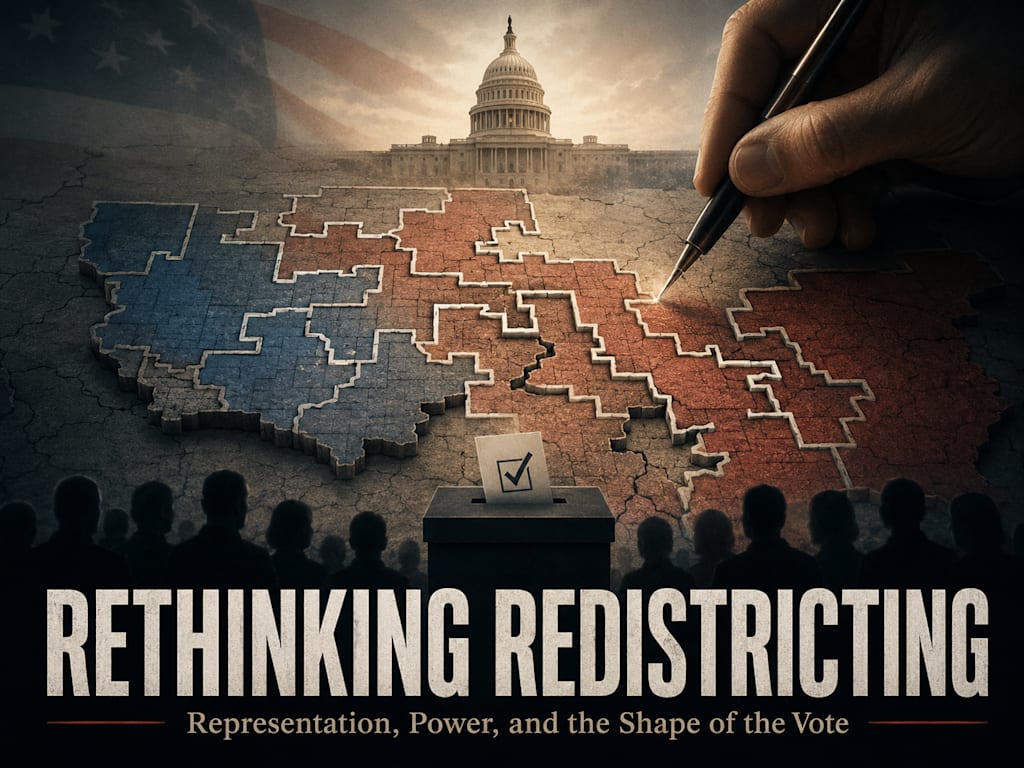
Representation Should Begin With the Citizen
The ordinary districting system begins outside the voter. A map is drawn. A boundary is approved. A district number is assigned. The voter is then placed inside that district by address. Only after that does the voter get to choose from the candidates allowed within that container. This means the first act of representation is not the vote. The first act is the assignment of the voter to a political constituency. Under the current model, that assignment is usually controlled by geography, law, mapmakers, courts, commissions, legislatures, or administrative rules. The voter participates later.
Organic districts reverse that order. They begin with the citizen’s own act of association. Instead of asking only where a voter lives, the system asks which constituency the voter wants to be represented by. That choice may be based on values, party affinity, governing philosophy, regional interest, class interest, local culture, ideology, issue priority, or some combination. The district is not merely imposed from the outside. It grows from voters choosing the representative body that most closely reflects them.
This does not mean the system becomes unlimited or chaotic. Organic districts still need equal population caps, ranked preferences, wait-lists, registration windows, privacy protections, and public rules. But the moral starting point changes. The citizen is no longer treated as raw material for a map. The citizen becomes part of forming the district itself. That is why organic districts deserve serious consideration. They move representation closer to consent.
The Political Container Is the Hidden Power
In every district system, the container matters. Before a candidate can win, voters must be grouped. That grouping shapes the election. If a rural region is attached to a city slice, the outcome changes. If a city is cracked into multiple pieces, the outcome changes. If a working-class area is merged with a professional suburb, the outcome changes. If ideological minorities are scattered across hostile districts, the outcome changes. The vote still happens, but the political container has already done much of the work.
This is the hidden power of redistricting. The public often focuses on who wins the election, but the district decides who is allowed to win. The candidates, campaign strategy, voter coalitions, issue priorities, and likely outcome are all shaped by the container. A voter can be counted honestly on election day and still be placed dishonestly before election day. That is why gerrymandering is so corrosive. It manipulates representation before persuasion begins.
Organic districts challenge that hidden power directly. If voters choose or rank their constituencies, mapmakers lose some ability to determine political meaning through boundaries. The voter’s address no longer has complete control over the voter’s representative identity. The container is not handed down as a finished object. It is formed through citizen choice within equal-population limits.
Organic Does Not Mean Lawless
The word organic can sound loose, as if the system would simply let voters sort without structure. That would not work. A representative system still needs rules. It needs equal population. It needs stable assignment. It needs a clear election process. It needs protection against fraud, coercion, tactical flooding, and administrative manipulation. Organic districts are not lawless districts. They are voter-formed districts inside a disciplined structure.
The cleanest model would begin with a set number of districts. Each district has an equal population cap. Voters submit ranked district preferences. Districts may be labeled by values, ideology, party affinity, issue priority, nonalignment, or geographic community. Voters are assigned to the highest-ranked district with available room. Once a district is full, later voters move to a lower-ranked option or join a wait-list. Switching happens only during defined registration windows. District membership locks before elections.
This structure preserves order while giving voters agency. The voter cannot demand unlimited entry into any district, because equality still matters. The voter cannot flood an opposing district instantly, because caps and wait-lists prevent that. The voter cannot destabilize the election at the last moment, because timing rules apply. Organic districts are not a rejection of structure. They are a different structure, one that places citizen choice earlier in the representative process.
Consent Is a Better Starting Point Than Assignment
A geographic district assigns representation by residence. That can be legitimate when the office governs place. A city council member should represent a city area. A county commissioner should represent a county region. A school board member should understand the families and schools in the district. For local offices, geographic assignment has a strong practical basis because the government is managing physical communities.
But for offices that govern broader principles, forced geographic assignment becomes weaker. A federal representative votes on war, debt, constitutional limits, speech, privacy, federal agencies, immigration, taxation, national regulation, and foreign policy. On those issues, a voter’s values may matter more than a voter’s street address. Two people living near each other may share roads but disagree completely about the purpose of government. Two people far apart may share the same governing philosophy.
Organic districts allow representation to begin from consent rather than imposed proximity. A voter can join the constituency that best reflects the voter’s governing priorities. This does not guarantee perfect agreement. It does not eliminate political loss. But it makes the voter an active participant in the formation of representation. That is morally stronger than a system where the voter is placed inside a district and then told that legal assignment equals meaningful voice.
The District Becomes an Association
An organic district is closer to an association than a map. Citizens enter it because they see it as the best available representative home. A constitutionalist district represents voters who choose constitutional limits and ordered liberty as central concerns. A libertarian district represents voters who prioritize individual freedom, privacy, speech, and limits on coercion. A labor district represents voters concerned with workers, wages, production, debt, trade, and class pressure. A localist district represents voters who prioritize decentralization and community authority. A nonaligned district represents voters who reject fixed ideological or party labels.
This form of districting makes the representative relationship clearer. The representative knows what kind of constituency elected them. The voter knows what standard to apply. The candidate cannot hide as easily behind an incoherent district with conflicting expectations. If a representative from an anti-war constituency supports unnecessary intervention, the breach is visible. If a representative from a localist constituency supports unnecessary centralization, the breach is visible. If a representative from a labor constituency repeatedly sides with financial power over workers, the breach is visible.
Association creates accountability because the district’s purpose is known. The representative is not merely from a place or party. The representative is sent by a defined body of citizens who chose that association for a reason.
Honest Sorting Is Self-Protecting
Organic districts create an incentive for honest sorting. A voter gains representation by joining the district that most closely reflects their values. A voter loses representation by joining a district that opposes them. If a red voter joins a blue district, that voter will likely be outnumbered. If a blue voter joins a red district, the same applies. If a libertarian joins an authoritarian district, or an anti-war voter joins an interventionist district, the voter weakens their own voice. The rational choice is to select the nearest fit.
This does not require the state to police motives. That is important. The state should not be deciding whether a voter truly belongs in a district. That would create dangerous ideological enforcement. The safer design lets consequences do much of the work. Voters are free to choose, but if they choose a poor fit, they bear the representational cost.
Caps strengthen this self-protection. Without caps, organized groups might try to flood opposing districts. With caps, a district fills and closes. New entrants must wait for vacancies. A hostile takeover becomes difficult because it cannot happen all at once. A voter entering an opposing district before enough allies can enter is simply choosing weaker representation. The system naturally rewards alignment and discourages sabotage.
Caps Preserve Equality Without Drawing Lines
The cap is what allows an organic district to remain a district rather than becoming an unlimited club. Every district must represent roughly the same number of voters or residents. Once the district reaches its population cap, it is full. This preserves equal voting power. No district can become oversized just because it is popular. No representative can speak for far more people than another. Equality remains built into the system.
The cap replaces the geographic boundary. In a map-based district, the boundary says who is inside and outside. In an organic district, the cap says how many people can be inside. The voter’s ranked preferences determine where they may enter. The population limit keeps every district balanced. This is a different way to preserve the same basic principle that each representative should serve a comparable number of people.
This also makes the system flexible. Districts can be formed around values, party affinity, issue priority, or nonalignment without abandoning equal population. A district does not need to occupy a compact shape to be limited. It needs a transparent cap and a fair assignment process. That opens the door to representation by real political community rather than only by geography.
Wait-Lists Allow Change Without Chaos
An organic system must allow change. People move. Views change. Young voters enter the electorate. Older voters leave. Party loyalties shift. Priorities reorder. A voter may once identify as progressive and later become nonaligned. Another may once identify as conservative and later become libertarian. Another may move from party loyalty toward localism, anti-war politics, religious conservatism, labor populism, or constitutionalism. A system that never allows reassignment would freeze citizens in outdated categories.
Wait-lists allow movement without instability. If a preferred district is full, the voter may join a wait-list. When a vacancy opens, the voter may enter according to public rules. This creates a future path while protecting district continuity. The district can evolve, but it cannot be instantly taken over. Voters have agency, but the district remains stable enough for real representation.
Registration windows are also necessary. District switching should not be continuous up to election day. That would invite tactical movement and administrative confusion. A clear window allows voters to update preferences while giving candidates and election officials a stable electorate. Organic districts need motion, but ordered motion. Wait-lists and timing rules provide it.
Ranked Preferences Make Organic Districts More Fair
Organic districts become strongest when voters rank preferences rather than choose only one district. A voter may prefer one constituency but find it full. Without ranked preferences, that voter may be forced into a poor fit or left waiting. With ranked preferences, the voter can identify the next best options. This is especially important because political identity is layered.
A voter might rank Constitutionalist first, Libertarian second, Localist third, and Nonaligned fourth. Another might rank Labor first, Anti-War second, Progressive third, and Nonaligned fourth. Another might rank Religious Conservative first, Populist second, Constitutionalist third, and Localist fourth. These rankings reveal more than a single party label. They show the voter’s order of representational priorities.
Ranked preferences also reduce pressure to game the system. The voter can list honest choices rather than trying to guess which district will have room. If the first district is full, the system moves to the next. If all preferred districts are full, the voter can join a wait-list or accept a lower-ranked assignment. The process is not perfect, but it gives voters a more truthful way to participate.
Organic Districts Are More Honest Than Hidden Sorting
Opponents may say organic districts are artificial because they group people by values rather than land. But current districts are often artificial too. The difference is that geographic artificiality can be hidden. A district may claim to represent a region while actually being drawn to produce a partisan outcome. A city slice may be attached to a rural county. A suburb may be split. A county may be divided. The voter may never know the full strategy behind the map.
Organic districts make the sorting visible. If the district is constitutionalist, progressive, labor, libertarian, anti-war, localist, religious conservative, or nonaligned, the purpose is public. Voters know what they are choosing. Candidates know whom they are addressing. Critics can debate whether the categories are fair. That is healthier than pretending the only thing happening is neutral geography.
This does not mean organic districts are immune to abuse. Labels can be manipulated. Caps can be adjusted. Wait-lists can be mismanaged. Category descriptions can become propaganda. But those problems can be named directly. The hidden map becomes an open structure. That is an improvement if the rules are transparent and stable.
Organic Districts Can Better Represent Minority Viewpoints
One of the strongest benefits of organic districts is that they give scattered minorities a path to representation. A voter may be part of a political community that is spread across the state rather than concentrated in one place. Anti-war voters, constitutionalists, libertarians, religious conservatives, labor populists, localists, civil-liberties voters, and nonaligned citizens may not live in a single geographic area. Under map-based districts, they can be scattered into permanent minorities.
Organic districts allow those voters to find one another politically. They do not need to live next door to share a representative. They can form a capped constituency based on shared governing priorities. That may produce more meaningful representation than being divided across geographic districts where they never have enough concentration to elect someone who speaks for them.
This matters because representation should not depend entirely on residential clustering. If a community exists politically but is geographically dispersed, the current system may treat it as invisible. Organic districts make such communities visible. They give them a way to speak without requiring them to move into the same neighborhood.
The Main Weakness Is Loss of Place
The strongest weakness of organic districts is that they can weaken geographic representation. If voters are grouped by values rather than place, a district may include citizens from many parts of the state. The representative may understand the constituency’s philosophy but not know the local roads, bridges, factories, farms, schools, neighborhoods, or businesses of every member. That is a serious limitation.
This is why organic districts should not replace local geographic districts. Local government manages place. It needs representatives who know the ground. A city council member, county commissioner, school board member, or utility board member should be tied to a real area. Organic value-based districts are weaker where government handles concrete local services.
The model is strongest at higher levels of government, especially federal representation, where the issues are more national, moral, constitutional, and philosophical. It may also work inside a hybrid chamber model, where one chamber represents place and another represents values. That allows organic representation without erasing geographic accountability.
The Second Weakness Is Category Power
Organic districts still need categories. Even if voters choose freely, they must choose from available options. Whoever defines those options has power. If the categories are biased, incomplete, unstable, or manipulative, the system can become ideological gerrymandering. The abuse moves from line-drawing to category design.
This risk must be taken seriously. District labels should describe real political communities, not slogans. Descriptions must be public. Changes must require high thresholds and public notice. No party should be able to rewrite the categories after voters have sorted. A Nonaligned District should exist for voters who reject the available labels. Voters should be allowed to rank districts rather than be forced into one. A voluntary political compass may guide, but final choice should remain with the voter.
The category problem does not defeat organic districts. It shows where safeguards must be built. Every system has a control point. For organic districts, the control point is the menu of constituencies and the assignment rules. That is where transparency must be strongest.
Organic Districts Could Reduce Map Warfare
One practical benefit is that organic districts could reduce the constant war over maps. If voters choose representative constituencies directly, then the exact placement of geographic lines matters less for those offices. Politicians lose some ability to arrange voters by boundary. Courts and commissions may spend less time debating whether a city was split properly or whether a district is too narrow. The fight shifts from map design to constituency rules.
That shift is not a magic solution, but it may be healthier. Instead of hiding politics inside geography, the system openly debates representation. What constituencies should exist? How should voters rank them? What caps preserve equality? How should wait-lists work? What privacy rules are needed? How can labels remain honest? These are real questions, but they are more direct than pretending a strange boundary is neutral.
A state adopting organic districts would still need geographic representation for local and likely state-level offices. But for federal offices or value-based chambers, organic districts could remove the most visible incentive to carve land for partisan gain. The voter’s choice would matter more than the mapmaker’s line.
Why Citizens Might Want Organic Districts
Citizens might want organic districts because they offer a direct path to meaningful representation. A voter trapped in a hostile geographic district could choose a constituency closer to their beliefs. A scattered minority could find others with shared priorities. An independent could avoid being dumped into the center by default. A voter who rejects party labels could rank nonaligned or issue-based districts. A voter whose first choice is full could still list second and third choices.
This gives citizens more than a ballot inside an assigned district. It gives them a voice in the formation of the district itself. That can restore a sense of agency. The voter is not merely waiting to see how mapmakers arrange the political world. The voter participates in choosing the representative community.
Organic districts may also increase clarity. Voters would know what their district exists to represent. Candidates would campaign to a defined constituency. Representatives would have a clearer standard of accountability. The system would still have conflict, but the conflict would occur inside visible structures rather than hidden map strategies.
Why a State Might Benefit
A state might benefit from organic districts by reducing gerrymandering conflict, improving representational alignment, and giving politically isolated voters another route to voice. This could be especially valuable in states with sharp urban-rural divides, large numbers of independents, strong ideological minorities, or repeated redistricting fights. Organic districts would not eliminate disagreement, but they could make representation more honest.
A state could implement the model gradually. It might begin with a pilot advisory body, a value-based chamber, or a portion of federal representation. It could use ranked preferences, equal caps, public district descriptions, and wait-lists. It could collect data on voter satisfaction, turnout, candidate quality, stability, and representation. If the system works, it could expand. If weaknesses appear, they could be corrected before full adoption.
This gradual path matters because organic districts are unfamiliar. Public trust would require testing, explanation, audits, and visible safeguards. A state should not adopt them casually. But it should not dismiss them merely because they challenge inherited assumptions about geography. The question is whether they represent citizens better for the offices where geography is a weak proxy.
The Best Version Is Hybrid
The strongest use of organic districts is probably inside a hybrid system. Local offices remain geographic because they govern place. State offices use compact geography and strong communities-of-interest rules, perhaps with some value-based representation in one chamber. Federal or higher-level offices allow organic constituencies based on ranked preference, caps, and voter choice. One channel represents place. Another channel represents values.
This prevents organic districts from being asked to do what they are bad at. They should not manage potholes, bridges, school routes, zoning, or utility districts. They should not replace local knowledge. But they can represent national governing principles, moral commitments, ideological alignment, anti-war priorities, constitutional limits, labor concerns, localist commitments, and nonaligned citizens. They should be used where consent and values matter more than physical service territory.
A hybrid approach also reduces fear of political separation. Citizens still share local geographic representation. They still live in towns, counties, cities, and school districts. Organic value districts add a layer of representation without erasing shared civic life. That is the safer and stronger model.
Organic Representation Is Not Perfect, but It Is More Honest
Organic districts do not solve every problem. They can be abused through labels, caps, wait-list rules, category design, privacy failures, or administrative manipulation. They can weaken geography if used at the wrong level. They can create ideological separation. They require voter education and careful rules. They are not a simple replacement for everything.
But they are honest about one thing the current system often hides: representation begins with grouping. Whoever controls the grouping controls much of the election. Organic districts give citizens a role in that first act. They let voters participate in forming the constituency rather than merely voting inside one chosen for them.
That is the central case. A representative system should not treat voters as objects to be arranged. It should treat them as citizens capable of association, judgment, and consent. Organic districts are not merely a technical reform. They are a different moral starting point. They say representation should grow from the people being represented, not be imposed on them by lines drawn around their homes.
About the Creator
Peter Thwing - Host of the FST Podcast
Peter unites intellect, wisdom, curiosity, and empathy —
Writing at the crossroads of faith, philosophy, and freedom —
Confronting confusion with clarity —
Guiding readers toward courage, conviction, and renewal —
With love, grace, and truth.
Enjoyed the story? Support the Creator.
Subscribe for free to receive all their stories in your feed.
Comments
There are no comments for this story
Be the first to respond and start the conversation.