
Anti-Abuse Rules for Any New Districting System
How to Stop Gerrymandering From Reappearing Under a New Name

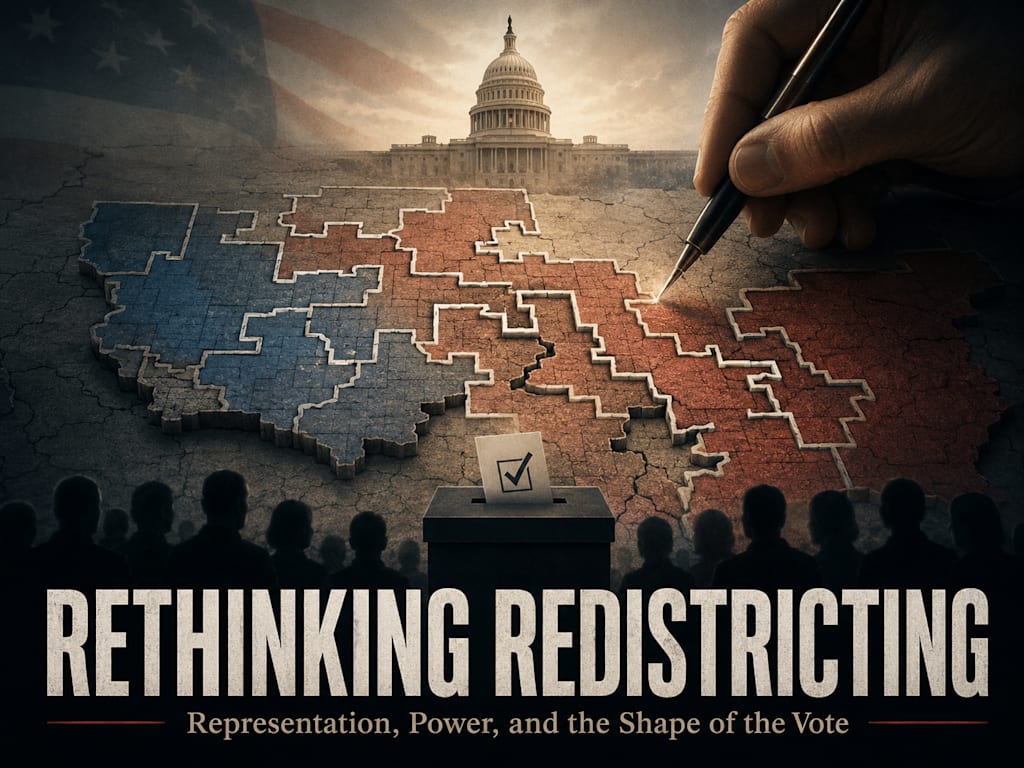
No System Is Safe Without Guardrails
Every redistricting reform is vulnerable to abuse because every representative system must decide who belongs with whom. That decision is powerful. In a geographic system, the power appears in boundary lines. In an ideological system, it appears in labels and categories. In a ranked-preference system, it appears in assignment rules and caps. In a political compass system, it appears in questions, scoring, and weights. In a lottery system, it appears in the voter pool, randomization method, and audit process. The abuse does not disappear simply because the old map is removed. It moves.
That is the first rule of any serious reform: never assume the new method is pure. A compact district can still be drawn for advantage. An epicenter district can still define the center dishonestly. A voter-selected district can still be raided or manipulated through caps. A named ideological district can still be shaped through propaganda labels. A political-values test can still sort voters through biased questions. A party-affiliation system can still preserve party capture. A random lottery system can still be corrupted through hidden administration. The form changes, but the temptation remains the same.
A new districting system should therefore be judged not by whether abuse is possible, but by whether abuse is harder, more visible, more limited, and easier to challenge than under the current system. The goal is not perfection. The goal is fewer hiding places. Any reform that fails to identify its own abuse points will eventually recreate the same problem under different language.
Geographic Districts Need Boundary Rules
Traditional geographic districts can be abused through cracking, packing, stretching, splitting, and artificial attachment. A city can be divided into narrow pieces and connected to surrounding rural districts. A rural region can be split so that it never elects someone who speaks for rural life. Suburbs can be combined or divided depending on the preferred partisan outcome. Counties and municipalities can be fractured while the map still satisfies equal population.
The safeguard is not merely saying districts should be fair. The safeguard must be specific. Geographic districts should be compact where possible. Thin corridors should be heavily restricted. Cities should not be cracked without a strong public explanation. Rural regions should not be repeatedly attached to urban fragments. Counties, municipalities, school areas, infrastructure regions, and communities of interest should be preserved when population rules allow. If a natural community is split, the split should be explained in public language that ordinary citizens can understand.
There should also be a burden of justification. A regular district that follows recognizable boundaries may require less explanation. A strange district should require more. If a mapmaker draws a district that snakes through several unrelated areas, the mapmaker should explain the real connection. Contiguity alone is not enough. Two areas can touch through a narrow strip and still have no meaningful community relationship. Geographic districting needs rules that treat place as a real community, not as a legal excuse.
Epicenter Districts Need Objective Centers
The epicenter model protects cities and rural areas from the urban-spoke problem by building districts outward from population centers. But it can also be abused if the center is chosen dishonestly. If mapmakers can decide after the fact where the urban epicenter is, they can shift the rings to produce a preferred outcome. A model meant to prevent manipulation can become a new tool of manipulation if its starting point is flexible enough to be gamed.
The first safeguard is an objective definition of the center. The center could be based on the densest contiguous population area, the population-weighted center of the urban region, the historic city core, or a publicly defined urban growth boundary. Whatever rule is used, it must be set before the map is drawn. The center cannot be selected after political effects are known. The method for identifying the center must be public, stable, and data-based.
The second safeguard is consistent expansion. Districts should expand outward into adjacent areas before skipping to distant pockets. Natural boundaries may shape the rings, but they should not be used as excuses for selective voter capture. If a river, mountain, highway, park, industrial zone, or municipal line affects the district, that reason should be stated clearly. The public should be able to see whether the ring follows urban reality or whether it has been bent for political advantage.
Communities of Interest Need Evidence
“Community of interest” is one of the easiest phrases to abuse because it sounds meaningful while remaining flexible. A mapmaker can claim almost any grouping protects some kind of community if no evidence is required. The phrase can be used to defend compact districts, strange districts, urban-spoke districts, rural splits, suburban attachments, or ideological categories. Without standards, it becomes a decorative phrase for whatever outcome was already desired.
The safeguard is evidence. A claimed community of interest should be supported by real shared conditions. These may include municipal boundaries, school districts, transportation routes, commuting patterns, industries, farms, factories, business corridors, churches, cultural institutions, local economies, water systems, public testimony, historical ties, or shared governing concerns. The public should be able to understand why the community exists and why the district preserves it.
Communities should also be identified before the map is finalized, not invented afterward to justify the map. Public hearings should gather testimony about real communities. Map proposals should then be judged against that record. If a district claims to protect a community no one identified until after the line was drawn, suspicion is justified. A serious community standard should prevent backward justification.
Voter-Selected Districts Need Caps
Voter-selected districts give citizens agency by allowing them to choose the constituency that best represents them. But without caps, the system becomes unequal. One popular district could absorb too many voters. Another could become too small. Voting power would no longer be balanced. Equal representation requires each district to contain the same or nearly the same number of voters or residents.
The cap is therefore essential. It functions like the boundary in a geographic district. Instead of a line saying where the district ends, the cap says when the district is full. Once the cap is reached, new voters must choose another district, submit ranked alternatives, or join a wait-list. The district cannot grow endlessly simply because more voters prefer it.
Caps also prevent rapid district takeover. If a group tries to enter an opposing district to flip it, the cap blocks mass entry. Once the district is full, movement can happen only through vacancies. This makes hostile takeover slow and uncertain rather than immediate. The cap protects equal population and district identity at the same time.
Wait-Lists Need Transparent Rules
A cap creates a new question: what happens when a voter wants to enter a full district? That is where wait-lists matter. A wait-list gives voters a future path into a preferred district without destabilizing the district immediately. When someone leaves, moves, dies, becomes ineligible, changes registration, or otherwise creates a vacancy, the next eligible voter may enter according to the published rule.
The rule cannot be hidden. If the wait-list is secret, it becomes a new control point. Administrators could favor certain voters, delay others, manipulate timing, or quietly influence district composition. Voters should know whether the wait-list is first-come, first-served, lottery-based, ranked-preference-based, or governed by another public formula. They should know when openings are filled and when changes take effect.
A good wait-list system should also prevent last-minute election raids. District switching should occur only during defined registration windows. Once an election cutoff arrives, district membership should lock for that cycle. This protects stability. Voters can still change district preference, but the district cannot be flooded immediately before voting begins.
Ranked Assignment Needs Public Overflow Rules
Ranked-preference district assignment allows voters to list several preferred districts. The system assigns each voter to the highest-ranked district with available space. This is more flexible than forcing one choice. It also helps voters who do not fit perfectly into one label. But ranked assignment creates a sensitive question: what happens when too many voters rank the same district first?
Overflow rules must be public. If a district receives more first-choice voters than it can accept, the system needs a fair method for deciding who gets placed there and who moves to the next preference. Possible methods include first-come, first-served, lottery among excess voters, periodic allocation rounds, or another transparent formula. Each has strengths and weaknesses. What matters most is that the rule is known before voters submit preferences.
The system should also allow voters to choose whether they prefer immediate assignment to a second-choice district or wait-list placement for a first-choice district. Some voters may value immediate representation. Others may prefer to wait for the constituency that fits best. The more clearly these choices are presented, the less room there is for administrative manipulation.
Named Ideological Districts Need Stable Labels
Named ideological districts can improve clarity. A district called Constitutionalist, Libertarian, Progressive, Labor, Localist, Anti-War, Religious Conservative, Populist, or Nonaligned tells voters more than District 1. But names can also be abused. A label can attract, repel, flatter, stigmatize, confuse, or manipulate. The new gerrymander may not be a crooked line. It may be a crooked name.
The safeguard is stable, descriptive labeling. District names should describe real political constituencies, not advertise moral superiority. Labels like Freedom, Justice, Truth, Common Sense, or Real Americans are too promotional unless defined with extraordinary care. Better labels describe recognizable governing orientations. Each label should also have a short public description explaining the district’s purpose.
Labels should not be changed casually. If politicians can rename districts every cycle, they can manipulate voters through language. Any label change should require public notice, high thresholds, and enough time for voters to respond. No mid-cycle redefinition should be allowed. A voter who joins a district based on one description should not discover later that the category has been quietly changed.
Political Compass Systems Need Voluntary Use
A political compass-style assessment can help voters understand which district best fits their values. It can reveal cross-pressured voters, anti-war voters, localists, libertarians, constitutionalists, labor-populists, religious conservatives, progressives, institutionalists, skeptics, and nonaligned citizens. But a mandatory political test is dangerous. It gives the state power to classify citizens by belief.
The safest use is voluntary guidance. Voters may answer questions privately and receive suggested districts, but the final choice should remain with the voter through ranked preference. The test may advise. It should not command. A citizen should not have to prove ideological identity to the state in order to receive representation.
If any assessment is used, the questions, scoring, weights, and district suggestions must be public. Loaded questions should be challenged. Hidden formulas should be rejected. The system should measure real tradeoffs, not slogans. It should ask how voters order competing goods: liberty and safety, equality and freedom, local control and national uniformity, institutional trust and skepticism, peace and intervention, order and speech. A test that hides tradeoffs will misclassify voters.
Political Data Needs Privacy Protection
Any non-geographic districting system may reveal political identity. A voter assigned to a Constitutionalist District, Progressive District, Libertarian District, Labor District, Religious Conservative District, Anti-War District, or Nonaligned District may be associated with that constituency. A political compass system may reveal even more sensitive information. Without privacy protections, reform can become surveillance.
The system should minimize stored ideological data. If a voter uses a values guide, the underlying answers should not become a permanent public file. The final district assignment may need to be recorded for election administration, but detailed belief profiles should not be broadly retained or exposed. Aggregate data can be public. Personal ideological answers should be protected.
The distinction is important. Transparency of rules is necessary. Exposure of citizens is dangerous. The public should be able to inspect the assignment method, caps, district totals, wait-list rules, and audit results. That does not mean every citizen’s political reasoning should be searchable. A free people should not have to sacrifice conscience privacy to obtain better representation.
Party-Affiliation Sorting Needs Escape Routes
Party-affiliation sorting is administratively simple because party registration and primary participation already exist in many systems. But party labels are crude. A Republican may be libertarian, populist, constitutionalist, religious conservative, nationalist, business-oriented, or anti-war. A Democrat may be progressive, labor-oriented, institutionalist, environmentalist, civil-liberties focused, anti-war, or managerial. Independents are even more varied. Treating party as destiny misrepresents many voters.
The safeguard is escape. Party affiliation may serve as a starting suggestion, but voters should be able to rank alternative districts. A registered Republican should not be forced into a generic Republican district if a Libertarian or Constitutionalist District better fits. A registered Democrat should not be forced into a generic Democratic district if a Labor or Anti-War District better fits. Independents should not be dumped automatically into the center.
Party sorting should never become party ownership of voters. Citizens must remain free to update registration, choose non-party districts, or rank districts by values rather than affiliation. The goal is representation, not party management.
Lottery Systems Need Auditable Randomness
Random lottery districts remove mapmaker control by assigning voters to districts through chance. This can eliminate geographic cracking, packing, and urban-spoke manipulation. But randomness is only trustworthy if the process is auditable. A secret lottery is simply another machine of power.
The voter pool must be verified. The district caps must be equal. The randomization method must be public or independently verifiable. The timing must be clear. The process must produce an audit trail. Independent observers should be able to confirm that the assignment was not manipulated. The public should know how errors are corrected.
Lottery systems also need rules about stability. Are voters assigned for one election cycle, ten years, or some other period? How are new voters added? How are movers removed? How are vacancies handled? If reassignment happens too often, accountability weakens. If it happens too rarely, imbalance can grow. Randomness removes one problem, but it does not remove the need for institutional discipline.
Hybrid Systems Need Separation of Functions
A hybrid chamber model separates representational functions. One body represents place. Another body represents values. This is one of the strongest overall models because it does not force one districting method to represent every kind of reality. But hybrid systems can also be abused if the functions blur or if one chamber is manipulated to overpower the other.
The geographic chamber needs geographic safeguards: compactness, community preservation, municipal respect, anti-corridor rules, and public explanations for splits. The values chamber needs value safeguards: ranked preference, equal caps, stable labels, privacy, wait-lists, and transparent assignment. Each chamber should be judged by its own purpose. A values chamber should not pretend to be geographic. A geographic chamber should not be quietly rigged for ideology while claiming to represent place.
The design must also define how the chambers interact. If both chambers must approve laws, gridlock may increase. If one chamber dominates, the other becomes decorative. The powers of each body should match its representative purpose. A hybrid system is strongest when place and principle can check each other without either becoming meaningless.
Timing Rules Matter More Than They Appear
District systems can be manipulated through timing. Registration windows, category changes, cap adjustments, wait-list updates, assignment lotteries, and district redefinitions can all be timed for advantage. A party in power could alter rules shortly before an election, open or close enrollment strategically, delay wait-list movement, or redefine categories after seeing likely voter behavior.
The safeguard is fixed timing. District rules should be set well before an election cycle. Registration windows should be known in advance. District membership should lock before campaigning enters its final stage. Category changes should apply only after the next cycle or after a long public notice period. Cap adjustments should follow population formulas, not political convenience.
Timing is often where abuse hides because it looks administrative. A system can be fair in theory but unfair in scheduling. That is why every reform needs a calendar as much as a rulebook. The public should know when choices are made, when they take effect, and when they cannot be changed.
Audits Must Be Built In From the Beginning
A system that cannot be audited cannot be trusted. This applies to every model. Geographic maps should be auditable through public data, compactness metrics, community impact reports, and district explanations. Value districts should be auditable through assignment totals, cap compliance, wait-list reports, category definitions, and aggregate demographic or political distribution where lawful and appropriate. Lottery systems should be auditable through randomization records. Political compass tools should be auditable through public questions and scoring.
Audits should not depend on goodwill after suspicion arises. They should be part of the design from the beginning. The system should expect challenge. It should preserve records. It should allow independent review. It should produce public summaries ordinary citizens can understand. A reform that requires blind trust will fail.
Audits should also protect privacy. The purpose is to verify process, not expose individual voters. Public confidence requires both transparency and restraint. The people need to know the system is fair without turning every voter into a public data point.
Appeals Protect Citizens From Administrative Error
Any districting system will produce errors. Voters may be assigned incorrectly. Registrations may be outdated. Wait-list positions may be wrong. Party affiliation may be misread. A voter’s ranked preferences may not be processed properly. A political compass suggestion may misclassify someone. A lottery assignment may use incorrect eligibility data. If there is no appeal process, administrative error becomes disenfranchisement by bureaucracy.
Appeals should be simple, timely, and transparent. A voter should be able to see their district assignment, understand how it was determined, and challenge clear mistakes before the election cutoff. The appeals process should not require legal expertise. It should not be so burdensome that ordinary citizens give up. It should correct errors without allowing tactical abuse.
Appeals are especially important in non-geographic systems because voters may have more active choices. If a voter ranks districts, joins a wait-list, updates affiliation, or uses a values guide, the system must record that accurately. A strong appeal process protects the citizen from becoming trapped by administrative failure.
No Reform Should Depend on Perfect Administrators
A good system assumes administrators may be biased, pressured, incompetent, corrupt, or simply mistaken. It does not require cynicism to design this way. It requires realism. Political power attracts manipulation. Rules should be built for flawed human beings, not imaginary neutral angels.
This is why power should be divided. No single party, office, vendor, commission, or administrator should control every step. Public rules, independent audits, open data, appeal rights, fixed calendars, privacy protections, and high thresholds for change all exist because trust should not rest on personality. Good design reduces the damage any one actor can do.
A reform is weak if its defense is, “Trust the people running it.” A reform is stronger if it can say, “Even if the people running it are tempted to abuse it, the rules make that abuse difficult, visible, and challengeable.” That is the standard.
The New Gerrymander Must Be Named Before It Appears
The most important anti-abuse habit is naming the new gerrymander before it appears. In geographic systems, the gerrymander is the manipulated map. In ideological systems, it may be the manipulated category. In political compass systems, it may be the manipulated question. In ranked systems, it may be the manipulated overflow rule. In lottery systems, it may be the manipulated randomization process. In party systems, it may be the manipulated affiliation rule. In hybrid systems, it may be the manipulated balance of chamber powers.
Every reform should begin with a list of its own likely corruptions. This does not weaken the reform. It strengthens it. A system that admits its vulnerabilities can build defenses. A system that pretends its method is inherently fair becomes dangerous.
The public should be trained to ask: where does the power move? Who defines the categories? Who controls the timing? Who audits the assignment? Who handles overflow? Who changes labels? Who verifies the voter pool? Who benefits if the rule is adjusted? These questions are the difference between reform and rebranding.
The Goal Is Fewer Hiding Places
No districting system can eliminate politics. No rule can remove ambition, faction, strategy, self-interest, or corruption from human affairs. The goal is not to create a system that cannot be abused in theory. The goal is to create a system where abuse is harder to perform, easier to see, easier to challenge, and less capable of controlling the entire representative structure.
Compact districts reduce the hiding places in maps. Epicenter districts reduce the hiding places in city fragmentation. Voter-selected districts reduce the hiding places of imposed assignment. Caps and wait-lists reduce the hiding places of strategic takeover. Ranked preferences reduce the hiding places of forced labels. Stable names reduce the hiding places of propaganda categories. Voluntary values guides reduce the hiding places of mandatory classification. Auditable lotteries reduce the hiding places of secret randomization. Hybrid chambers reduce the hiding places created when one districting method controls everything.
That is the standard for every alternative in this collection. A new system is not good because it is new. It is good only if it represents people more honestly and gives manipulation fewer places to hide.
Reform Must Be Built With Human Nature in Mind
Redistricting fails when power is allowed to arrange voters while pretending the arrangement is neutral. Any alternative can fail the same way if its control points are left undefended. The mapmaker can become the category-maker. The category-maker can become the test designer. The test designer can become the algorithm keeper. The algorithm keeper can become the new gerrymanderer. Reform does not abolish the problem unless it restrains the new form of power it creates.
The anti-abuse principle is simple: identify the container, identify who controls it, and limit that control. If the container is geographic, restrict the lines. If the container is ideological, stabilize the labels. If the container is ranked assignment, publish the overflow rules. If the container is a test, make it voluntary and transparent. If the container is a lottery, audit the draw. If the container is a hybrid chamber, define the function of each body. In every case, the voter should be represented, not arranged.
A better system must be honest about the corruption it prevents and the corruption it could create. That honesty is not a weakness. It is the beginning of serious design. The goal is not merely to stop old gerrymandering. The goal is to prevent gerrymandering from being reborn under cleaner language, better graphics, more technical formulas, or more respectable institutions. Representation deserves more than a new disguise for the same old power.
About the Creator
Peter Thwing - Host of the FST Podcast
Peter unites intellect, wisdom, curiosity, and empathy —
Writing at the crossroads of faith, philosophy, and freedom —
Confronting confusion with clarity —
Guiding readers toward courage, conviction, and renewal —
With love, grace, and truth.
Enjoyed the story? Support the Creator.
Subscribe for free to receive all their stories in your feed.
Comments
There are no comments for this story
Be the first to respond and start the conversation.