
The Hybrid Chamber Model
One Body for Place, One Body for Values

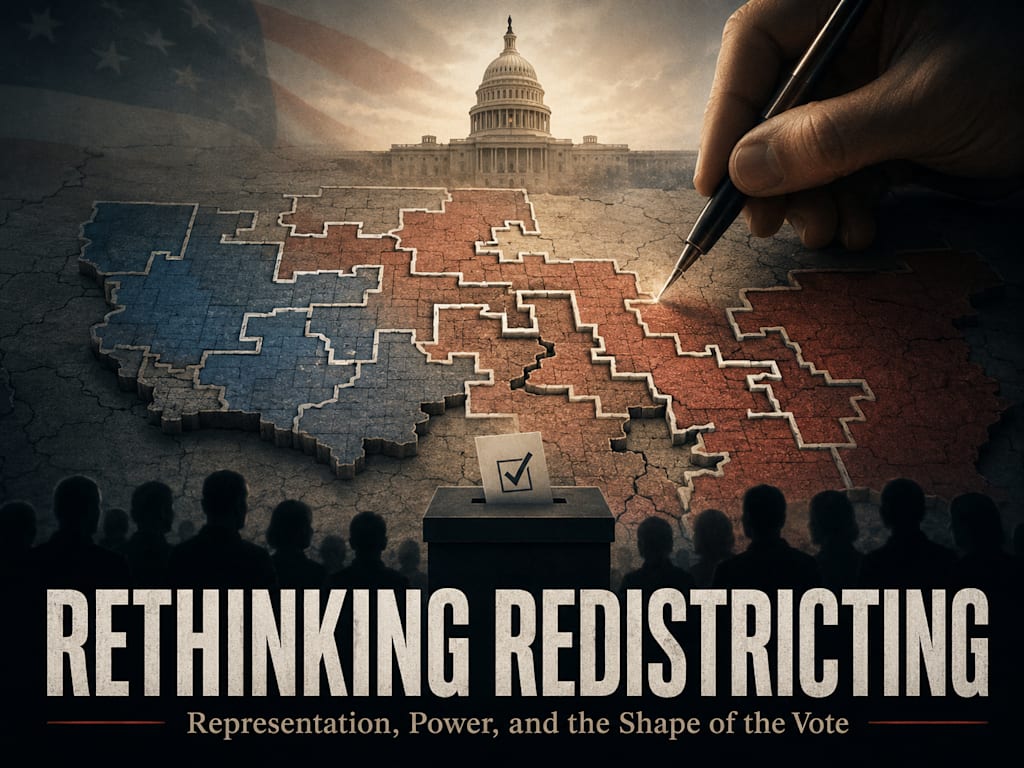
One Representative System Cannot Carry Every Burden
The redistricting debate often becomes trapped because one district is expected to represent everything at once. A geographic district is asked to represent population equality, local infrastructure, culture, economy, municipal boundaries, party fairness, ideological alignment, minority voice, class interests, rural concerns, urban density, and voter accountability. That is too much weight for one structure. No single map can represent every kind of human concern. The result is constant conflict over which value should dominate.
A compact geographic district may protect local place but fail to represent voters who are ideological minorities inside that place. A value-based district may give voters a representative who shares their governing priorities but may weaken local knowledge. A random lottery district may remove mapmaker control but may produce scattered constituencies with no shared identity. A party-affinity district may be easy to administer but may flatten voters into labels too crude to reflect their actual values. Each model captures something true and misses something real.
The hybrid chamber model begins from that reality. Instead of forcing one system to do every job, the political structure could divide representational functions. One body could represent place. Another body could represent values. One chamber could preserve geography, municipalities, counties, roads, schools, industries, farms, factories, and local culture. Another chamber could represent ideology, governing philosophy, party affinity, ranked voter preference, anti-war voters, constitutionalists, progressives, libertarians, populists, labor voters, religious conservatives, localists, or nonaligned citizens. The point is not complexity for its own sake. The point is accuracy.
Place and Principle Are Both Real
Human beings are not only residents of places. They are also carriers of values, convictions, duties, interests, beliefs, and priorities. A person lives somewhere, but also stands for something. A representative system that recognizes only geography may count the person as a resident while ignoring the person as a moral and political agent. A system that recognizes only ideology may represent the person’s principles while neglecting the road, bridge, school, factory, business corridor, or neighborhood where the person actually lives.
Both failures matter. A farmer may need a representative who understands land, water, roads, weather, equipment, fuel, markets, and county-level realities. That same farmer may also need a national representative who shares a view of constitutional limits, federal agencies, religious liberty, war, debt, and property rights. A city resident may need someone who understands housing, density, transit, policing, sanitation, zoning, and school crowding. That same person may also need someone who reflects broader views on federal spending, immigration, privacy, speech, and national policy.
The hybrid model says these needs should not be collapsed into one district. Place and principle should both have channels. A voter should not have to choose between a representative who understands the local bridge and a representative who shares the voter’s view of government power. A well-designed system could provide both, through different bodies or different categories of representation.
The Geographic Chamber
The geographic chamber would preserve the traditional strengths of district representation. Its members would be elected from compact, coherent areas. The boundaries would respect counties, municipalities, neighborhoods, school zones, business corridors, rural regions, urban neighborhoods, suburban belts, infrastructure systems, and communities of place. This chamber would be responsible for representing the material life of the state, region, city, or district.
At the local and state levels, this chamber would be especially important. It would ensure that roads, bridges, potholes, factories, farms, schools, water systems, police response, zoning, local businesses, churches, and municipal cultures do not disappear behind abstract ideology. Representatives in this chamber would be accountable to recognizable places. Voters could point to a road, a school, a failing agency, a business district, or a neglected region and demand action.
This chamber would also resist the weakness of purely ideological sorting. If every representative were chosen by value alignment alone, local realities could become secondary. A geographic chamber prevents that. It says a place deserves a voice because government acts on places. Even if voters disagree ideologically, they still share roads, schools, water systems, emergency services, local markets, and physical constraints. That shared life requires representation.
The Values Chamber
The values chamber would represent the political, moral, ideological, and governing convictions that geography cannot reliably capture. Members could be elected through voter-selected districts, ranked-preference district assignment, capped ideological constituencies, party-affinity sorting, multi-axis value districts, or another non-geographic method. The purpose would be to give voters a representative who speaks for their governing priorities rather than merely their residence.
This chamber could include districts organized around political philosophy or value clusters. One district might represent constitutionalists. Another might represent libertarians. Another might represent progressives. Another might represent labor-populists. Another might represent anti-war voters. Another might represent religious conservatives. Another might represent localists. Another might represent nonaligned citizens. The exact categories would depend on the population, the number of seats, and the structure chosen.
The values chamber would be strongest for issues where geography is a weak proxy: war, national debt, federal power, speech, privacy, immigration, taxation, national regulation, institutional trust, civil liberties, family policy, and constitutional limits. These questions are often not answered by location. Two neighbors may share a road and disagree completely about government. Two voters far apart may share a governing worldview. The values chamber would give that reality direct representation.
Why Two Channels Are Better Than One
The strength of the hybrid model is that it avoids forcing voters into a false choice. A purely geographic system can leave voters ideologically misrepresented. A purely ideological system can leave voters locally unrepresented. A hybrid system lets each channel do what it does best. The geographic chamber speaks for place. The values chamber speaks for principle. Together, they produce a fuller picture of the people.
This also reduces the pressure on redistricting itself. If the only representative body is geographic, every map fight becomes a war over total political power. Whoever controls the lines controls the main structure of representation. But if one chamber is geographic and another is value-based, then map manipulation cannot control everything. A bad geographic map would still matter, but it would not be the only channel through which citizens are represented.
The same is true in reverse. If ideological districts become too narrow or too separated, the geographic chamber preserves shared civic reality. People still have representatives tied to towns, counties, municipalities, and regions. The values chamber gives coherent voice to political convictions, but it does not erase local accountability. The two forms check each other.
A State-Level Version
A state could adopt a hybrid chamber model by assigning different representational functions to its legislative bodies. One chamber could remain geographic, using compact districts, county preservation, municipal boundaries, communities of interest, and anti-gerrymandering rules. The other chamber could use value-based constituencies, ranked-preference district assignment, party-affinity sorting, or capped ideological districts.
For example, a state house could represent local geographic districts. Representatives would answer to cities, towns, counties, rural areas, suburbs, industrial corridors, agricultural regions, and neighborhoods. A state senate could include broader value-based constituencies that represent political philosophy across the state. Or the reverse could be used, depending on constitutional design and local preference.
This model would recognize that state government handles both place and principle. State legislatures deal with roads, schools, water, policing, courts, taxes, land use, energy, public universities, and regional development. But they also decide issues involving parental rights, religious liberty, speech, gun law, abortion, public health authority, agency power, education content, and civil rights. A geographic chamber and a values chamber would allow both realities to be represented without pretending one map can do everything.
A Federal Version
At the federal level, the hybrid model may be even more important. The United States already has one body representing states equally and one body representing population through districts. But the House of Representatives remains tied to geographic districts, which leaves it vulnerable to gerrymandering. A future reform could imagine part of federal representation remaining geographic while another part becomes value-based, proportional, party-affinity-based, ranked-preference-based, or otherwise non-geographic.
One version could preserve compact geographic congressional districts for regional concerns while adding value-based statewide constituencies. Another version could replace some geographic districts with voter-selected federal constituencies. Another could retain geography in one chamber while introducing proportional or ranked value representation elsewhere. The purpose would be to reduce the ability of mapmakers to dominate federal representation by controlling geographic boundaries.
Federal questions are often national and philosophical: war, debt, taxation, speech, privacy, immigration, federal agencies, constitutional limits, foreign policy, and national regulation. A values-based channel would allow voters to select representatives based on those governing priorities. The geographic channel would still preserve state and regional concerns such as agriculture, ports, energy, military bases, infrastructure, and local industries.
A Local Version Should Be More Limited
At the local level, the hybrid model should be used carefully. Local offices mostly govern place. City councils, county commissions, school boards, utility boards, zoning boards, sheriff jurisdictions, and local service districts should remain strongly geographic. A representative for local government needs to know the roads, bridges, potholes, neighborhoods, schools, business owners, factories, churches, farms, water systems, and local culture.
That does not mean values are irrelevant locally. Voters still care about policing philosophy, school policy, taxes, zoning, religious liberty, parental authority, development, homelessness, crime, and public services. But because the office is tied directly to physical communities, geography should remain the foundation. A local ideological chamber could become too detached from concrete responsibility.
A limited local hybrid might work through at-large seats, advisory councils, issue-based boards, or citizen panels. For example, a city could have geographic council seats plus a few at-large seats chosen through ranked-choice or proportional methods. A school district could have geographic seats plus parent advisory bodies representing different educational priorities. The local level can include value channels, but it should not replace place-based accountability.
The Model Reduces Winner-Take-All Distortion
One of the major problems in ordinary districting is winner-take-all distortion. If a geographic district is split 51 to 49, the 51 percent elect the representative and the 49 percent may receive no meaningful voice. If that pattern repeats across many districts, large groups of voters can be counted but underrepresented. They are present inside districts but unable to elect someone who speaks for them.
A values chamber can reduce that distortion. Voters who are minorities in their geographic areas can still join or rank a value-based constituency that represents them. A conservative in a blue city, a progressive in a red rural area, a libertarian in a two-party suburb, an anti-war voter in an interventionist region, or a nonaligned voter surrounded by strong partisans could still have a path to representation. They would not be entirely dependent on the political majority of their neighborhood.
This matters because representation should not disappear just because a voter lives in the wrong place. Geography should matter where place matters, but it should not be allowed to swallow every other form of political voice. The hybrid model gives displaced minorities another channel without erasing local geographic representation.
The Model Preserves Local Accountability
At the same time, the hybrid model protects against the opposite danger. If representation becomes only ideological, local accountability weakens. A value-based representative may share broad beliefs but know little about a local bridge, school zone, water system, business corridor, factory, farm, zoning fight, or neighborhood problem. The geographic chamber prevents that by keeping place represented directly.
This is especially important because politics can become abstract. National debates often turn people into symbols. Local government reminds representatives that citizens live under concrete conditions. Roads must be maintained. Schools must function. Water must be safe. Police must respond. Businesses must survive. Factories must operate. Farms must produce. Bridges must hold. A system that represents values without place can forget the physical costs of policy.
The hybrid model therefore protects both dimensions of accountability. One representative can be held accountable for local conditions. Another can be held accountable for governing principles. Together, they better reflect the whole citizen.
How the Values Chamber Could Be Filled
There are several possible methods for filling the values chamber. The simplest is party-affiliation sorting. Voters are grouped by party or primary affiliation into equal-population capped constituencies. This is easy to administer but crude. It treats party as the main proxy for values, which can misrepresent independents, cross-pressured voters, and minor-party citizens.
A stronger method is ranked-preference district assignment. Voters rank clearly described value districts, and the system assigns them to the highest-ranked district with room under the cap. This preserves agency while maintaining equal population. If the first-choice district is full, the voter moves to the next preference or joins a wait-list.
A more complex method is multi-axis value clustering. Districts are created around recurring political patterns such as constitutionalist-localist, labor-populist, libertarian-civil-liberties, progressive-institutionalist, anti-war, religious conservative, market-oriented, or nonaligned. A voluntary political compass could help voters understand their options, but final assignment should remain voter-directed. The more complex the method, the stronger the safeguards must be.
Safeguards for the Hybrid Model
A hybrid system would need serious protections. The geographic chamber should have compactness rules, anti-corridor rules, protections for municipalities, county preservation where possible, public justification for splits, and strong community-of-interest standards. It should prevent urban-spoke maps, rural dilution, and artificial attachments.
The values chamber should have equal population caps, ranked preferences, transparent district descriptions, stable labels, privacy protections, registration windows, wait-lists, public audit rules, and safeguards against category manipulation. No party should be allowed to redefine districts for advantage. No mandatory ideological test should control assignment. No hidden algorithm should decide representation without public review.
Both chambers need anti-abuse rules because both can be corrupted. A bad geographic chamber can gerrymander place. A bad values chamber can gerrymander ideology. The point of the hybrid model is not that either side is pure. The point is that each chamber’s weakness can be limited when its function is clearly defined and openly guarded.
The Tradeoff Is Complexity
The obvious weakness of the hybrid chamber model is complexity. It is easier to say every voter lives in a district and elects one representative from that district. A hybrid system asks voters to understand different forms of representation. A person may have one representative tied to geography and another tied to values. District assignment may involve maps for one chamber and ranked preferences for another. That requires explanation.
But the current system is already complex. Voters already deal with overlapping city, county, school, state, congressional, judicial, party, and special district elections. The complexity is often hidden rather than absent. A hybrid system would be more complex in design, but potentially clearer in purpose. Each chamber would have a defined job. One represents place. One represents values. That clarity could justify the added structure.
The real question is whether the complexity produces better representation. If voters understand that one representative is responsible for local or regional reality and another speaks for broader governing principles, the system may become more intuitive over time. The complexity would serve a visible purpose rather than existing as bureaucratic clutter.
The Tradeoff Is Institutional Conflict
A hybrid system may also create conflict between chambers. The geographic chamber may support a policy because it benefits local infrastructure, regional economy, or municipal needs. The values chamber may oppose it because it violates principles of limited government, civil liberty, fiscal restraint, religious conscience, or national direction. Or the reverse may happen. The values chamber may demand reform while the geographic chamber resists because of local cost.
That conflict is not necessarily a weakness. It may be the point. Good political design often forces different goods to check each other. Place should check ideology when abstract policy ignores real communities. Principle should check place when local interests demand unjust or shortsighted action. A geographic chamber and a values chamber would make those tensions visible.
The danger is gridlock. If the chambers are too opposed, government may struggle to act. But gridlock is not automatically worse than misrepresentation. A system that slows government when place and principle conflict may be healthier than one that lets a temporary majority impose policy without both kinds of representation being heard. The structure should require negotiation between real communities and governing values.
The Model Helps Clarify Political Responsibility
One benefit of a hybrid system is clearer responsibility. In the current system, a representative may claim to speak for the district while avoiding clarity about what the district actually represents. Is the representative speaking for the local economy, the party majority, the ideological bloc, the city, the suburbs, the rural areas, the donors, the activists, or the median voter? The answer is often blurred.
In a hybrid model, the role is clearer. A geographic representative should answer for the place. A values representative should answer for the values constituency. The voter can judge each according to the proper standard. Did the geographic representative understand local needs? Did the values representative defend the governing principles of the district? Each office has a more specific accountability frame.
This can also improve candidate quality. A candidate for a geographic chamber needs local knowledge and regional credibility. A candidate for a values chamber needs philosophical consistency and issue clarity. The offices would reward different strengths. That is good because representation itself requires different kinds of competence.
The Model Could Reduce Redistricting Warfare
If geographic districting controls all legislative power, map fights become existential. Every line matters because every seat depends on the map. Parties fight to control commissions, courts, state legislatures, census interpretation, district criteria, and legal challenges. The public is told the fight is about fairness, but much of it is about power.
A hybrid system could reduce the stakes of map control. Geographic districts would still matter, but they would not be the only path to representation. Voters who are geographically diluted could still have value-based representation. Ideological minorities trapped in hostile regions would not be completely silenced. The map would lose some of its power to define the whole political system.
This does not eliminate conflict. Parties and factions would fight over value districts, category definitions, caps, and assignment rules. But the conflict would be more explicit. Instead of hiding political design inside boundary lines, the system would openly debate what kinds of representation should exist. That may be healthier than pretending maps are neutral while every side knows they are not.
The Model Is Not a Shortcut Around Civic Unity
A hybrid chamber model should not be used to avoid the need for shared civic order. If one chamber represents values, the system still needs a common constitutional frame. Ideological constituencies cannot become separate nations inside the nation. They must operate under shared law, equal citizenship, due process, civil rights, and public rules. The purpose is better representation, not social fragmentation.
The geographic chamber helps preserve common life because it keeps citizens connected to shared places. People who disagree ideologically still share roads, schools, courts, counties, neighborhoods, water systems, and emergency services. The values chamber lets them speak politically from their convictions. The two together can preserve both unity and voice.
This matters because a system that represents values without shared civic structure can become tribal. A system that forces unity without meaningful voice can become oppressive. The hybrid model attempts to hold both realities together. Citizens share a political order, but they are not forced into one kind of district for every purpose.
Why a State Might Benefit
A state might benefit from a hybrid chamber model because it could reduce the failures of ordinary redistricting without abandoning local representation. Geographic districts would continue to protect local roads, schools, municipalities, business regions, farms, factories, infrastructure, and culture. Value-based districts would give voters a better path to representatives who share their governing priorities. The result would be broader representation than either model provides alone.
The state could also experiment gradually. It could begin with advisory value constituencies, proportional at-large seats, or a limited number of ranked-preference value districts. It could preserve the existing geographic chamber while adding a values-based body or reforming one chamber at a time. That would allow public testing before full adoption.
The state would benefit most if it has sharp divides between urban and rural regions, strong ideological minorities trapped in hostile districts, or repeated redistricting conflict. A hybrid system would reduce the pressure to solve every problem with map lines. It would give different communities different channels of representation.
Why Citizens Might Want It
Citizens might want a hybrid system because it recognizes more of who they are. A citizen is not only a resident of a ZIP code. A citizen is also a parent, worker, believer, business owner, farmer, renter, taxpayer, veteran, student, employer, neighbor, constitutionalist, progressive, libertarian, localist, populist, anti-war voter, religious conservative, or nonaligned citizen. A single geographic district may not capture all of that.
A hybrid system gives a voter one representative who understands the place and another who reflects broader values. That can reduce the feeling of being trapped. A voter who lives in a region dominated by opposing values still has a value-based channel. A voter who belongs to a statewide ideological minority still has a possible voice. A voter who cares deeply about local roads and national principles does not have to pretend those are the same representational need.
This is closer to the real structure of human life. People are rooted and principled at the same time. They need representation for both.
The Strongest Form of the Proposal
The strongest form of the hybrid chamber model can be stated simply:
- One chamber should represent geography because government acts on places.
- One chamber should represent values because government also acts on principles.
The geographic chamber should use compact districts, preserve municipalities, protect rural and urban coherence, respect communities of interest, and maintain local accountability. The values chamber should use voter choice, ranked preferences, equal caps, stable labels, wait-lists, privacy safeguards, and transparent assignment rules. Each chamber should have a different job. Each should check the other.
This model does not pretend to be simple. It does not pretend to remove all abuse. It does not pretend geography is irrelevant or ideology is sufficient. Its strength is that it refuses to flatten representation into one dimension. It admits that the people need more than one kind of voice.
A Better System Represents the Whole Citizen
The hybrid chamber model is the most complete answer because it understands that representation has layers. A voter lives in a place. That place has roads, bridges, schools, water, businesses, factories, farms, culture, and local problems. The voter also holds values about power, law, speech, war, family, debt, liberty, authority, faith, markets, labor, and national direction. A political system that represents only one layer will misrepresent the other.
One map cannot represent everything. One ideological label cannot represent everything. One random sample cannot represent everything. The best system may be one that separates representational functions honestly. Let place be represented as place. Let values be represented as values. Let each chamber do the work it is suited to do.
That is the heart of the hybrid model. It does not destroy geography. It rescues geography from being forced to represent what it cannot. It does not turn ideology into the whole of politics. It gives values a proper channel without erasing local life. A representative system worthy of the name should not ask one district to carry the entire burden of human reality. It should build different channels for the different things citizens need represented.
About the Creator
Peter Thwing - Host of the FST Podcast
Peter unites intellect, wisdom, curiosity, and empathy —
Writing at the crossroads of faith, philosophy, and freedom —
Confronting confusion with clarity —
Guiding readers toward courage, conviction, and renewal —
With love, grace, and truth.
Enjoyed the story? Support the Creator.
Subscribe for free to receive all their stories in your feed.
Comments
There are no comments for this story
Be the first to respond and start the conversation.