
The World’s Most Critical Oil Lane Just Became a War Zone — and Nobody’s Talking About It Enough
U.S. destroyers dodged Iranian missiles in the Strait of Hormuz this week. Here’s why that single waterway could determine the future of the global economy — and possibly trigger a wider war.
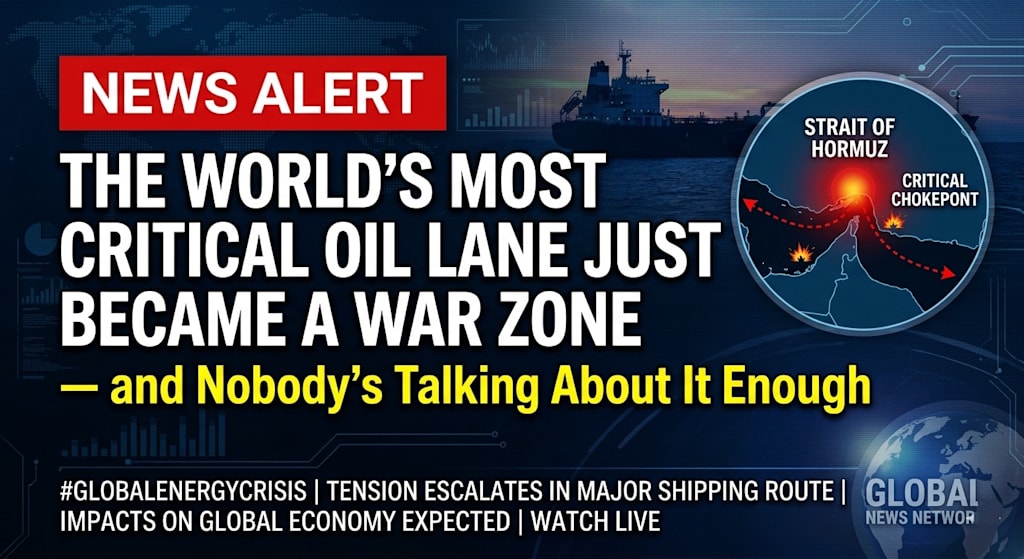
U.S. destroyers dodged Iranian missiles in the Strait of Hormuz this week. Here’s why that single waterway could determine the future of the global economy — and possibly trigger a wider war.
There is a narrow strip of water, just 34 kilometres wide at its tightest point, that sits between Iran and Oman.
You probably don’t think about it often. But right now, it is the most dangerous piece of ocean on the planet — and what happens there in the coming weeks could affect your energy bills, your country’s economy, and possibly the stability of the entire Middle East.
This is the Strait of Hormuz. And it is effectively closed.
How We Got Here
On February 28, 2026, the United States and Israel launched coordinated airstrikes on Iran in an operation called Operation Epic Fury. The targets included Iranian military installations, nuclear sites, and top leadership. Iran’s Supreme Leader, Ali Khamenei, was killed. His son has since been named as his successor.
Iran responded with fury. Missile barrages hit Israeli cities and U.S. military bases in the UAE, Qatar, and Bahrain. Hezbollah launched rockets into northern Israel. And then Iran did something that sent shockwaves through every financial market on earth: it announced the closure of the Strait of Hormuz.
Before the war, roughly 20% of the world’s seaborne oil trade and 20% of its liquefied natural gas passed through that strait every single month. Around 3,000 vessels used it per month. Today, traffic stands at approximately 5% of pre-war levels.
This Week’s Escalation
On May 7, 2026, three U.S. destroyers — the USS Mason, USS Truxtun, and USS Rafael Peralta — attempted a transit of the strait. Iranian forces responded with missiles, drones, and small assault boats. The U.S. military confirmed all threats were neutralised. No vessels were struck.
Trump responded with “self-defense strikes” against Iranian ports and posted on social media: “They trifled with us today. We blew them away. They should not have done that today.”
He also issued a stark warning: “If there’s no ceasefire, you’re not going to have to know. You’re just going to have to look at one big glow coming out of Iran.”
The Human and Economic Cost
The numbers are staggering.
More than 300 commercial vessels remain stranded in the Persian Gulf, their crews trapped at sea for weeks. War-risk insurance premiums for a single tanker transit have quintupled. The International Energy Agency and its 32 member nations have already released 400 million barrels of emergency oil reserves — and global prices remain painfully elevated.
The UAE — one of America’s closest regional allies — has come under direct Iranian missile fire for the first time since a fragile April ceasefire. Fifteen missiles and four drones targeted the country in a single day. A drone struck an oil facility in Fujairah, the emirate that serves as the UAE’s main oil access point outside the strait, wounding three workers.
And Russia? Still producing. Still exporting through alternative routes. Quietly collecting the windfall from prices pushed up by a war it did not start.
The Bigger Picture
Here is what keeps energy analysts awake at night.
This strait handles oil supplies for Europe, Japan, South Korea, India, and China. All of them have declined to join the U.S.-led effort to physically reopen the waterway, calculating the military risk is too high. Pakistan-mediated peace talks collapsed in April. The reopening of Hormuz is now the central demand in any future negotiations — but Iran has explicitly threatened military action if the U.S. counter-blockade on Iranian ports does not end first.
Neither side is flinching.
The world has rarely been this close to a genuine energy catastrophe — and the window for diplomacy is narrowing by the day.
About the Creator
Enjoyed the story? Support the Creator.
Subscribe for free to receive all their stories in your feed.
Comments
There are no comments for this story
Be the first to respond and start the conversation.