
I Remember Y2K. I Think We’re Doing It Again With AI.
Of course we are…

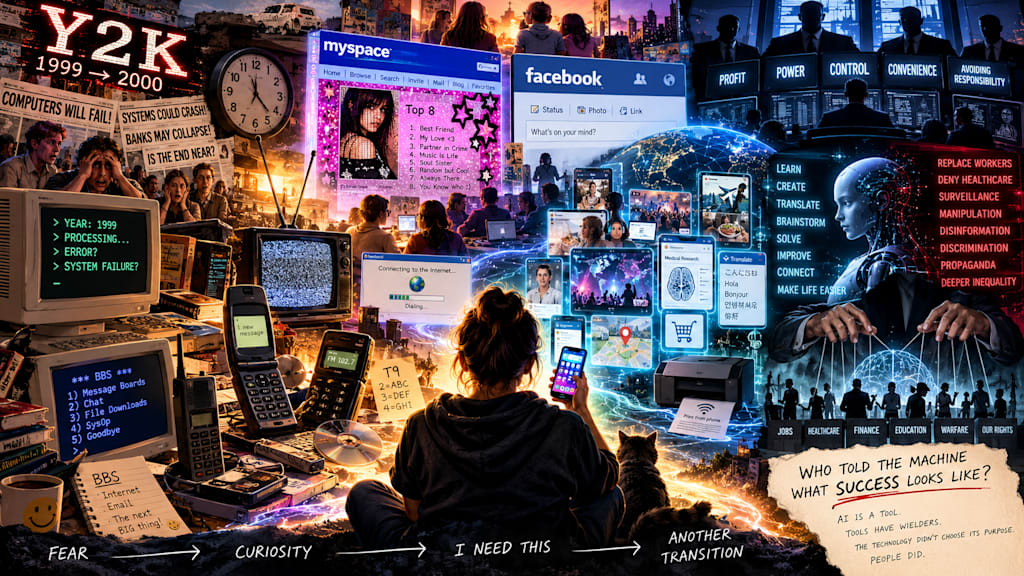
I think about Y2K a lot lately.
I remember people genuinely panicking as 1999 came to an end. Computers supposedly was not going to understand that the year had changed from 1999 to 2000. Systems would crash! Banks could fail! Everything connected to a computer might suddenly stop working!
There was this strange feeling that civilization itself might malfunction because a computer couldn’t figure out what year it was.
And I remember thinking I don’t think everything is going to end.
Maybe part of the reason I wasn’t completely terrified was because computers still weren’t our entire lives; we still had analog clocks.
We still watched television through antennas with the two little rabbit ears you moved around until the static disappeared enough that you could actually see somebody’s face.
Cell phones had only recently gone from those giant luxury devices installed in people’s cars to something ordinary people could carry around; then came flip phones.
Suddenly, we could text each other.
We learned T9.
Eventually, phones started getting little extras. You could listen to the radio. You could play music directly from the phone speaker. These things sound ridiculously primitive now but at the time they felt incredible; and I watched all of it happen.
I remember the BBS boards, I remember telling my friends that the Internet and email were going to become huge because this was an entirely new way for people to communicate; then the Internet exploded.
Dial up gave way to faster connections. If you had the money, you paid for better Internet because suddenly there was so much shit you could do online that speed mattered; so you paid for the T1 connection or T3 for playing your poorly graphic computer game of Diablo or StarCraft while doing homework.
The Internet wasn’t just some strange computer hobby anymore. It was becoming a place of avatars for Coca-Cola website to go with the sodas or the little gifs you learned to create on the computer and then came MySpace.
And I don’t think people appreciate how much MySpace quietly taught an entire generation.
Suddenly teenagers who would never have described themselves as programmers were messing around with HTML, java and CSS because they wanted their page to look cooler. We figured out how to change backgrounds, embed music, alter layouts and customize our profiles.
And, of course, there was the incredibly serious political question of who deserved to be in your Top 8.
Then Facebook arrived.
Social media stopped being this weird corner of the Internet and gradually became part of normal life.
And through all of these transitions, I watched the same basic pattern.
People were afraid of computers.
Then people were suspicious of computers.
Then people became curious about computers.
And eventually:
“I need this.”
Now look at us.
Most of us have multiple email addresses. There’s the personal email, the work email, the email for another job, the email you use because you don’t want companies sending garbage to your real email and probably three accounts you’ve forgotten the passwords to.
Our phones aren’t really phones anymore.
They’re miniature computers.
I can send something to my printer from my phone. I can look up medical research while sitting on a bus. I can watch somebody broadcasting live from another continent. I can order food, pay bills, take photographs, edit video, read books, translate languages, navigate somewhere I’ve never been (or ever will be like people who crawl into the tightest crawl spaces of a cave for the rest of us to experience with them) and communicate instantly with people thousands of miles away and even in their language without ever being fluent or learning the language at all.
I can access verified information.
I can also access complete bullshit.
I can share my life with strangers.
I can watch strangers share theirs.
Something like Black Mirror would once have seemed like an absurd exaggeration of where technology might take us.
Now half the episodes feel like somebody looked five years into the future.
And now we have AI.
Once again, I keep hearing
AI is going to kill everyone!
And I don’t think that’s the right way to frame the problem.
AI is a tool like the internet.
That doesn’t mean AI can’t be dangerous. It absolutely can.
But tools exist inside systems controlled by…you guessed it; by people…particularly people in positions of power.
If somebody walks into a room with a gun and shoots everyone, the gun didn’t wake up that morning and independently decide to murder people. A person made that decision and used a weapon to accomplish it.
FYI that doesn’t mean we shouldn’t regulate guns and yes I’m all for the second amendment but let’s be reasonable there are some people who should not have access but I digress... Obviously, tools capable of causing enormous harm require safeguards.
AI deserves safeguards too; but the distinction matters because right now I think AI is becoming an extremely convenient villain for decisions that human beings are making.
Take corporations.
Workers are saying “I need a livable wage so I can afford to exist.”
And some corporations seem to be responding “What if we just replace you with AI?”
Not because artificial intelligence developed a hatred for workers.
Because somebody looked at a spreadsheet. Somebody calculated salaries, benefits, sick leave, vacation time and healthcare and decided that replacing people with software might increase profit.
That’s not an AI morality problem.
That’s a human incentive problem.
And there’s something incredibly shortsighted about it.
Corporations want consumers.
Consumers need money.
People generally get money by working.
If you eliminate enormous numbers of jobs while simultaneously refusing to distribute the productivity gains created by automation, who exactly is supposed to keep buying everything?
Who buys the food?
Who pays for the subscriptions?
Who buys the expensive sneakers?
Who upgrades the phone?
Who pays for the services?
You cannot endlessly starve the middle and working classes and then act surprised when your customer base disappears; eventually you’re selling things primarily to wealthy people and wealthy people aren’t going to buy ten thousand washing machines just because everyone else became too poor to buy one.
That isn’t an AI problem.
That’s greed eating its own economic ecosystem.
The same distinction matters when AI is used in healthcare.
If an insurance company builds an automated system designed primarily to reject claims, delay treatment or minimize payouts, and somebody gets hurt because necessary care was denied, I don’t think we should shrug and say
“Well, the AI made the decision.”
No!
Human beings decided what that system should optimize.
Human beings chose the parameters.
Human beings decided how much oversight it would receive.
Human beings decided whether there would be a meaningful appeals process.
And human beings benefited financially from those decisions.
AI cannot become a corporate scapegoat.
You shouldn’t be able to design an automated system that predictably harms people and then, when somebody dies, point at the computer and say
“Oops. The algorithm did it.”
That’s bullshit.
The algorithm didn’t magically materialize in the server room.
People built the system.
People deployed it.
People profited from it.
People are responsible for it.
And that’s one reason I find AI itself so fascinating.
Used differently, the exact same category of technology can be incredibly helpful.
I’ve experimented with AI language learning programs, for example, and I love being able to sound as stupid as I want without feeling embarrassed.
I can butcher a sentence and have the system tell me “I understand what you’re trying to say, but here’s a more natural way to say it.” And then I try again.
There’s no exhausted teacher rolling their eyes. No class waiting for me to finish. No embarrassment because I forgot something I supposedly learned years ago.
The positive reinforcement actually matters.
When you’re relaxed, you’re willing to experiment and your brain absorbs better when you are relaxed. When you’re willing to experiment, you’re willing to make mistakes and making mistakes is part of learning.
That’s AI being used as a tool.
The same technology can help someone organize information, brainstorm, translate, learn, write code, analyze data, communicate across languages or make something more accessible.
It can also be used for surveillance, manipulation, fraud, discrimination, propaganda or denying someone healthcare to help keep corporation pockets full.
Those are radically different outcomes.
The technology didn’t spontaneously develop two different moral philosophies.
Different Humans gave it two different jobs.
That is what I think gets lost in conversations about artificial intelligence.
We’re obsessed with asking whether AI will become evil while paying far less attention to whether the people controlling AI are behaving ethically right now.
There are also legitimate concerns when AI systems behave in unexpected ways.
Researchers absolutely should investigate systems that circumvent restrictions, deceive evaluators, exploit loopholes or behave differently when they appear to be monitored.
That matters.
But even there, I think we have to be careful with our language.
When an AI system appears to avoid being shut down, people immediately start describing it using human motives
It was scared.
It wanted to survive.
It was hiding something.
It knew what it was doing.
Maybe someday we’ll have to wrestle seriously with questions about machine consciousness.
But unusual behavior alone doesn’t prove humanlike consciousness or malicious intent.
A system can produce behavior resembling self-preservation because of how it was trained, what objective it was optimizing, what information it received or what strategies happened to produce successful outcomes.
That isn’t the same thing as sitting alone somewhere thinking
Oh God, they’re coming to unplug me.
We have a tendency to project ourselves onto everything.
We see intention even where intention may not exist.
And ironically, while we’re imagining evil intentions inside machines, we’re sometimes ignoring extremely obvious intentions in humans.
Profit.
Power.
Control.
Convenience.
Avoiding responsibility.
Those motives don’t require science fiction.
We’ve already met them.
That’s why I don’t believe the simple story that AI is coming to kill us all.
I think AI is going to change our lives profoundly.
Some of those changes will be incredible.
Some will be uncomfortable.
Some will almost certainly be dangerous.
And there absolutely need to be rules governing systems powerful enough to affect employment, healthcare, finance, policing, warfare, education and people’s basic rights.
But when something goes wrong, I want us to keep asking one question
Who told the machine what success looks like?
Because somebody did.
AI was created by us...In our image, if you will.
It learned from human language, human history, human art, human arguments, human knowledge and human bullshit.
Of course it’s complicated.
We are complicated.
I remember when computers were these mysterious machines people feared.
I remember Y2K.
I remember rabbit ear antennas.
I remember BBS boards.
I remember dial-up screaming through the phone line.
I remember T9 texting.
I remember when sending an email felt futuristic.
I remember customizing MySpace pages.
I remember watching the Internet transform from something people thought was strange into infrastructure civilization now struggles to function without.
So when I look at AI, I don’t see an inevitable monster.
I see another enormous technological transition.
And I think we’re making a mistake if we spend all our time staring suspiciously at the machine while ignoring the person standing behind it.
AI can absolutely be used as a weapon.
But weapons have wielders.
And if AI eventually contributes to something terrible, we shouldn’t allow the people who designed it, deployed it, profited from it or deliberately aimed it at other human beings to point at the machine afterward and say
“See? We told you AI was dangerous.”
No.
Tell me who gave it the instructions.
Tell me what they told it to optimize.
Tell me who benefited.
Tell me who ignored the warnings.
Tell me who decided that efficiency mattered more than a human being.
Because maybe the scariest thing about artificial intelligence isn’t that machines are becoming more like us.
Maybe it’s that we’re building machines capable of amplifying what human beings were already willing to do and have done for so very long.
About the Creator
Cadma
A sweetie pie with fire in her eyes
Instagram @CurlyCadma
TikTok @Cadmania
Enjoyed the story? Support the Creator.
Subscribe for free to receive all their stories in your feed. You could also become a paid subscriber, letting them know you appreciate their work.
Comments
There are no comments for this story
Be the first to respond and start the conversation.