
The Power of Perception to Dictate Our Reality
Do you actually see what you think you see?


For anyone who believes that they simply SEE with their eyes, nothing could be further from the truth. We might see the world in a superficial way, but what we THINK we see is actually an interpretation made by our PERCEPTION - an individual view that has been formed, and maintained, by other factors that mould our personality.
Perception controls how we view people, how we treat them, and the bases and prejudices we expose to them, especially if they are different from us. Hence why people from different cultures, who speak different languages, and who are even different in gender and race, are not likely to perceive their world in the same way.
We tend to seek order and consistency in life to foster a sense of personal security and control. However, this can only be achieved by giving meaning to the world around us through an individual viewpoint, one formed from the specific social culture, system of beliefs, and values we inherit and then develop. This becomes our own perception of life which enables us to make sense of the reality we experience, and shapes the personality we become. It means that where we stand in life, our values and experiences in our childhood, determine not only what we choose to see, but how we see it, and when we want to see it, making our viewpoints highly individual.
Whatever we see, according to the Scientific American, is then interpreted through our own experiences and socialisation. No given context is ever predictable, because each one of us brings our own knowledge, values, expectations and fears - all part of our perception - to bear on every interaction, giving it meanings another person might not share, understand, or even appreciate. For this reason, if a situation is defined as real for one person within that interaction, it is real in its consequences for that person, regardless of how the other party might view it.
The clamour around Prince Harry’s book, Spare, was a classic case in point. He told his truth in his book, purely from his perception, as he experienced it, which makes it very real to him. Someone might criticise what he says, but they cannot deny his truth as he experienced it, or impose their version of the truth over his as the valid one, because they didn’t share his life.
For example, one of his perceptions of his treatment within the Royal Family was very telling. He had trekked to the South Pole, despite much pain and discomfort, and felt great at his achievement. Yet when he returned, he felt completely undervalued because there was no acknowledgement or praise for his accomplishment. That reinforcement was important to him. Yet, if such acknowledgement was not a priority for other members of the Family, one might hazard a guess that their perception of what happened might differ somewhat.
Personal perception, being so central to our interpretation of our world, lies at the core of any kind of bias or prejudice. Donald R. Clarke notes that bias and prejudice have strong roots. From the moment we’re born, we learn about ourselves, our environment and the world. He believes that many of our personal biases are good, as they allow us to assume that something is true without proof. Otherwise, we would have to start learning everything anew each time we do it. However, he noted, ”If we allow our bias to shade our perceptions of what people are capable of, then the bias is harmful. We start prejudging others on what we think they cannot do."
When people communicate, they also use these biases, or filters, and Clarke provides a good example of how such filters work. He says, ”For example, if you know me as a heavy drinker and I tell you I was in a fight last night, you might draw a picture of me in a bar-room brawl. On the other hand, if you knew me as a boxer and I told you the same thing, you would probably visualise me in the boxing ring.” Obviously, where these biases become destructive is when we prejudge others, without them even saying anything.
Thus how we perceive any individual, object, or situation, is controlled entirely by our beliefs, value system, culture, socialisation, aspirations, and personal confidence. That is why a person lacking confidence with low self-esteem is likely to approach, and deal with, an interaction differently from a fearless, confident, knowledgeable one. The confident person tends to have a more positive perception of others, and to act accordingly, while the non-confident one tends to believe that others, especially if they are different, do not deserve any attention or effort. Thanks to perception, discrimination and bias - especially racism, sexism, and homophobia - are still the most pervasive social evils in a world where disrespect and the denigration of certain vulnerable groups mindlessly continue.
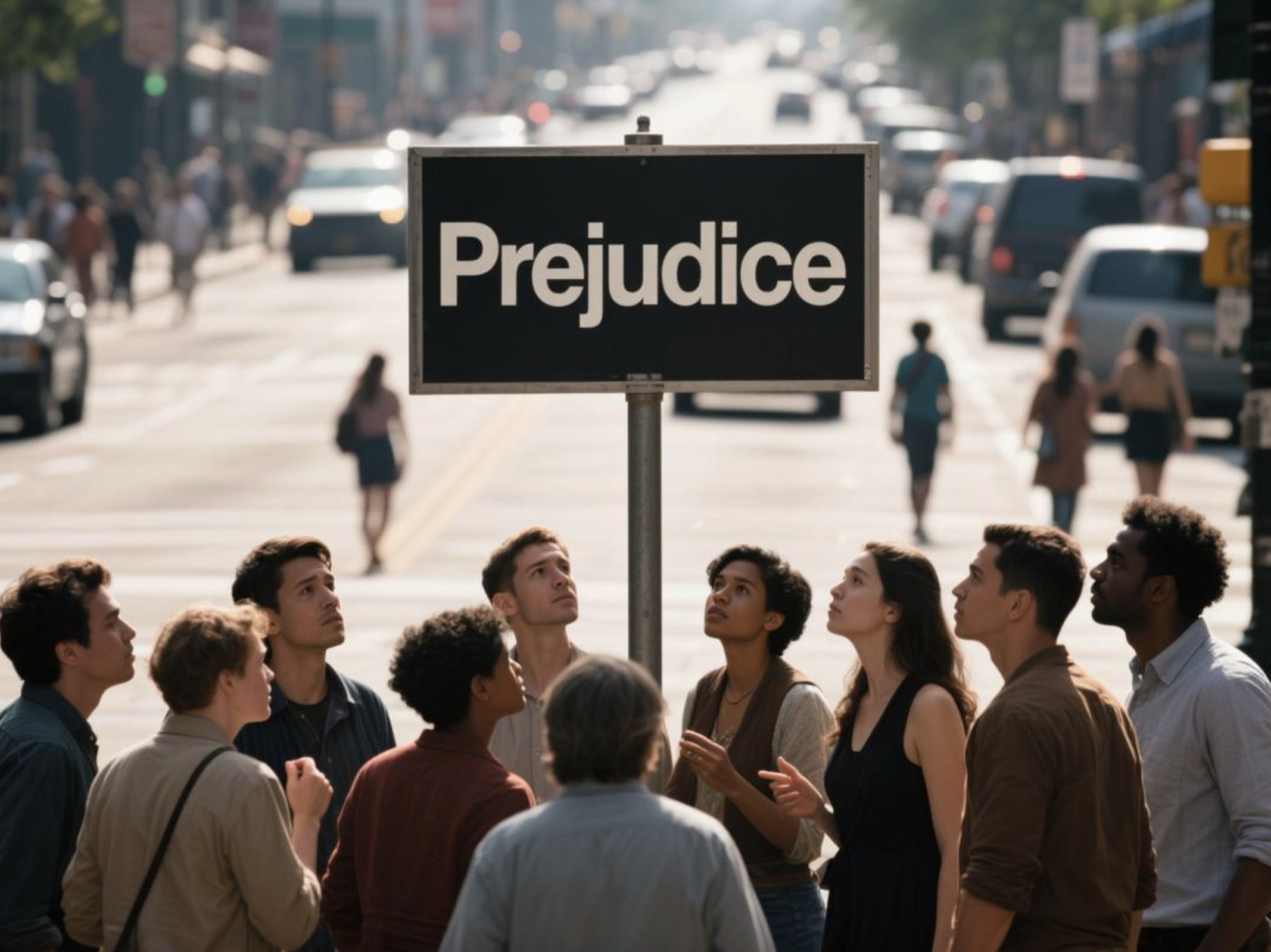
One important point about any prejudgement is that it stems from a desire to short-circuit the learning and acceptance process relating to others, especially when they are perceived to be irrelevant or inferior; when we cannot be bothered to discover the facts for ourselves; when we are in denial about our attitude to others who do not act like us; when we need to boost our ego at their expense; and when we regard them as scapegoats. We also prejudge when we lack the confidence in ourselves to accept others as they are, and wish them to conform to our expectations for us to feel in control, and when we fear any competition against us. We are then likely to make assumptions about people based primarily on our own ignorance and fear of them: assumptions regarding their beliefs, abilities, identities, and expressions; placing any blame squarely upon them as the origin of all our innermost fears and anxieties.
It is important to note that there is no such thing as 'false' perception (which is usually an attempt by others to impose their perception in place of another). Every perception is real and genuine for each of us, because it constructs our everyday reality, enabling us to see life only from a personal view point. When two or more perceptions are similar, because of a shared experience or ideology, individuals are then able to relate to each other, or empathise more sincerely, and that new reality becomes more defined and systematic.
That is how institutional bias and prejudice (like sexism) is created and maintained: through a shared or common perception of what constitutes reality. If there is little or no shared experience, there is likely to be no understanding, or appreciation, of another person's situation or outlook, and each context will be approached by the participants from different perspectives. That is because each perception relates entirely to the individual's personal knowledge and experience of what constitutes 'truth' for them, and their unique way of seeing the world. This factor often makes it hard to negotiate and be understood across different cultural experiences.
People might search eternally for a truth as they want to interpret it, or believe it should be, but there is no real 'truth' from personal viewpoints - only many different versions of what is perceived as truth. One version becomes universally accepted only when enough people share the same perception of that particular 'truth', as illustrated by the children's story about the emperor and his non-existent new clothes.
The emperor was able to remain naked because his subjects shared the 'truth' of the moment, his bold pretence that he was fully clothed. The pretence worked until a small innocent child, who was not old enough to participate in this conspiracy of 'truth', saw for himself that the emperor actually had no clothes on! His innocence and lack of adult experience prevented him from sharing their perception, thus enabling him to see beyond the pretence – a classic example of the fact that we can only appreciate life from our viewpoint, no one else's.
In summary, our eyes are like panoramic scanners, taking in everything we see before us, but our perception actually filters the images to be scanned through our culture, knowledge and experience, so that only what is relevant to our socialisation registers in our sight.
American writer Anais Nin captured this system of personal values dictating perception and human interaction when she said, "We don't see things as they are, we see them as we are."
• Like this post? Show your appreciation with a SUBSCRIPTION and even a TIP. Thanks for your support! •
SubscribeAbout the Creator
Elaine Sihera
British Life Coach & Consultant. Founder of LOVE & LIFE: The Growth Guide, for insights into managing challenging life issues. Author of books on Confidence, Relationships & Wellbeing. Graduate/Doctor of Open Univ; Postgrad Cambridge Univ.
Enjoyed the story? Support the Creator.
Subscribe for free to receive all their stories in your feed.
Comments
There are no comments for this story
Be the first to respond and start the conversation.