
The Hidden Problem With Patient Empowerment
My experience navigating neurological symptoms, medication decisions, and the difference between being supported and being left to decide alone


For years I searched for a doctor who would listen... I mean, really, actively listen.
Jonathan Townend
Fruitlessly searching, for a doctor who would believe what had happened to me, from way back in 1972...
That had been the year when Brain Stem Cancer struck me at the tender age of three... a mere toddler. 1972 surgical treatment for Brain Stem Cancer was very much in its experimental stages, and at the same moment, so still, was Radiotherapy, post-operatively.
A small introduction of Radiotheray treatment (early 1970s)
After a childhood brain tumour, surgery at three years old, with months of radiotherapy as follow-ups, these tumours in children had already been recognised as a distinct clinical problem; early descriptions date back to the late 19th and early 20th and decades spent adapting to the quirks and limitations of a damaged nervous system.
'Mary Catterall and others from the Fast Neutron Clinic at the Hammersmith Hospital (London, UK) investigated the clinical effect of fast neutron treatment in August 1971 (Catterall, Rogers, Thomlinson and Field BJR 1971.) Fast neutrons had first been used in treatment in the early 1940s but had been abandoned because of late damage to normal tissues. Many of the patients in the early studies of fast neutrons had advanced tumours however he reported that in some studies the patients treated with fast neutrons had a higher number of serious complications compared to the photon treated group. Data courtesy of the British Institue of Radiology (BIR.) Copyright © British Institute of Radiology 2026 Registered Charity Number: 215869.'
Today, at the 'well-seasoned' age of 56, I now understand how that surgery & those post-Radiotherapy sessions has severely affected my body, in ways many doctors still struggle to understand and accept. Yet I know my body better than anyone else ever could.Yet it still took many further years of worsening tremors, physical difficulties, and needing a wheelchair to get about in when going anywhere outside, before somebody finally stopped, listened, and took my concerns seriously.
That massive gap, those endless wasted appointments in surgeries, where a mountain of mis-diagnosed 'problems' took place, can only be blamed fairly and squarely, at the doors of the National Health Service (NHS) itself.
"Why do I say that?"
Jonathan Townend
I can hear you all asking, as you read this, and the answer is just too simple.
It comes under Section 5 (5.3) of the NHS (Digital)Policy: 'The management of records when the minimum retention period is reached.' otherwise known as the 'Destroying and deleting records' to include the 'Destruction of paper records.'
That minimum retention period is reached when the patient (or, as in my case, a three year old toddler) meant that "my Cancer surgery and post-operative treatment records were destroyed when I reached my 25th birthday..." (Data is courtesy of the British Medical Association (BMA.)
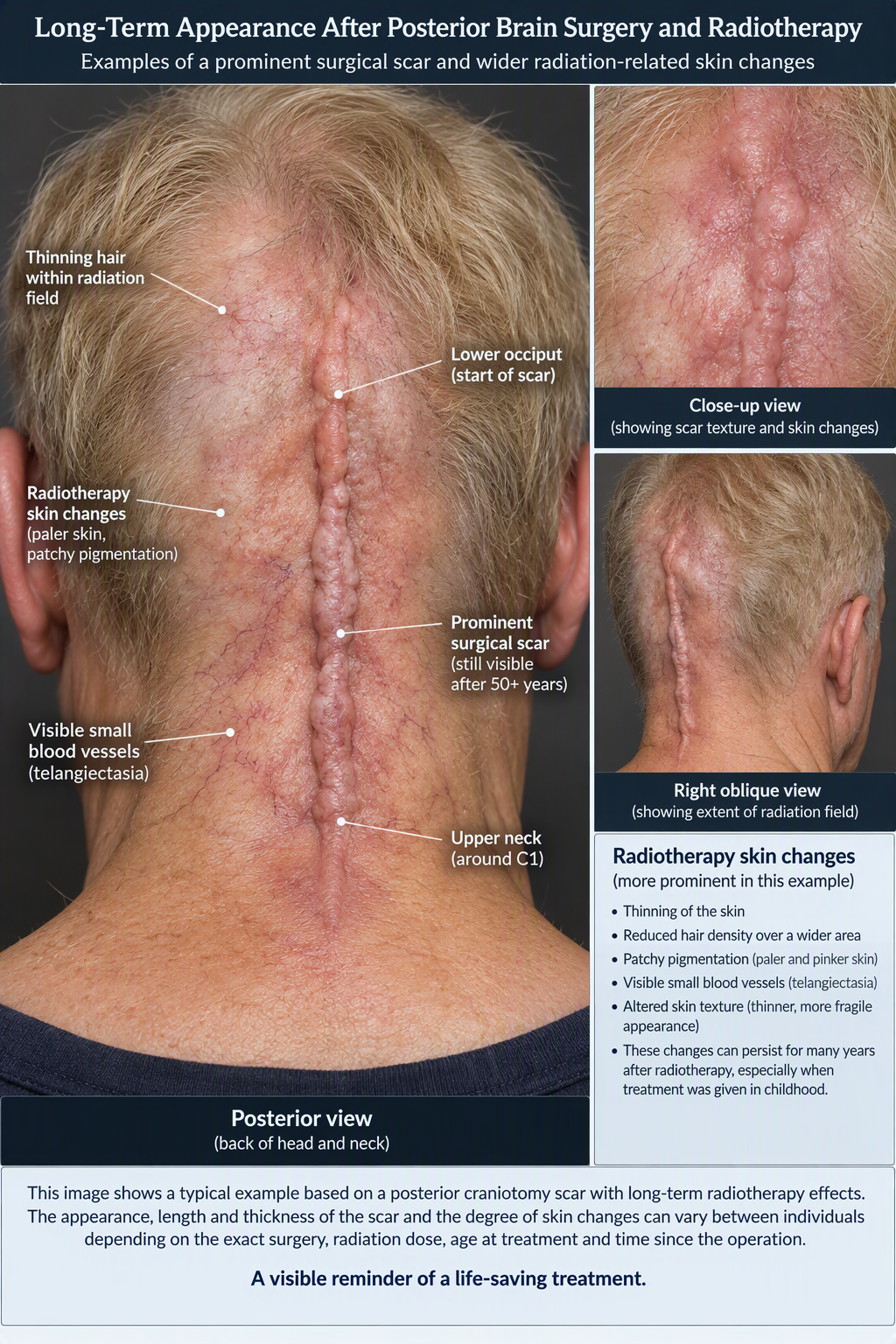
This first image, and description, is courtesy of the Neurological unit, of what anyone would have seen if walking behind me when I was going through an all-boys, private secondary school, where you would have imagined would have been more caring of how my neck and hair looked, particulary as it was a Roman Catholic school run by Priests, but sadly no, that's where I got my nickname of 'Frankenstein' unfortunately.
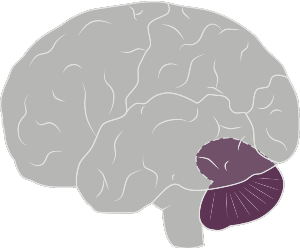
This second screenshot is of a typical human brain, with the position of the Cerebellum (highlighted in purple.)
This third screenshot is again, of a typical human brain, with the position of the Brain Stem (highlighted in yellow) so that you can begin to see the close proximity of the two major organs in the lower section of our brain.
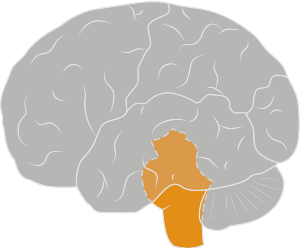
A portion of my Brain Stem was removed, along with some degree of damage to my Cerebellum caused, in in order to fully remove the large Glioma wrapped tightly around my Brain Stem when I was that toddler.
Radiotherapy being in its infancy at the point of my 1970s treatment, was high dose and wide field exposure. If my parents were alive today, along with Mr Jason Giles Brice F.R.C.S Consultant Neurosurgeon (retired) Wessex Neurological Centre (who peacefully passed away on October 1st, 2015, who I will always remember fondly of as a highly respectful and honourable gentleman who performed that ground-breaking neurosurgery.)
Meaning that, long time post radiotherapy effects eventually, and cruelly set in with me in 2020, which meant that early retirement on medical grounds was vital, due to consistent shortness of breath, low immunity, very poor balance, coordination, and gait, irregular blood pressure, fatigue, eyesight disturbances, severe hearing loss in both ears, and eventually needing the use of a wheelchair and adaptations in our home: Learning throughout school was extremely difficult, when I look back, along with never having been able to successfuly ride a bike of any kind.
So, when this particular doctor a few years following my forced retirement, did fully listen to me after so many others ignored me and passed me off as a 'hypochondriac,' with one doctor who even called me 'theatrical,' it felt like a breakthrough (though that word does not seem powerful enough to explain how she made me feel.)
But, it must be said that if it had not also been for my wife who we've been married to each other for 28 years (and who has been my registered carer too, since 2020) who literally 'read the riot act' to this particular doctor, and made her sit upright, and who then genuinely began researching past Cancer survivorship rates and mortalities, the NHS would not be investigating my problems now to this day.
Jonathan Townend
My wife, that person who stood up to that doctor, and who has always loved and believed in me to this day: Carol Ann Townend.
Investigations were arranged.
MRI scans were requested.
New medications were prescribed.
At last, there was movement, instead of dismissal.
But then came the irony.
The pramipexole was straightforward: take it at night. The clonazepam was different. The dose was gradually increased until I was taking three 0.5mg tablets each day.
Then came the instruction that left me scratching my head: "Take them whenever you feel is best."
So, I sat there wondering whether I had somehow missed several years of medical school. Because while I may be the world's leading expert on what it feels like to inhabit this body, I am not a specialist in neurology, pharmacology, drug interactions, titration schedules, or symptom management. That is why patients seek medical advice in the first place.
Modern medicine often speaks about empowering patients, and rightly so. But somewhere along the way, empowerment can become something else entirely: the transference right back from the professional responsibility onto the shoulders of the person already carrying the illness.
A patient should never be treated as a passive bystander in their own care. But equally, a patient should not be expected to become their own doctor. Yet again though, the NHS should have had the common sense to not destroy highly important patient records either.
The moral is simple:
Listening, and I mean 'actively listening' to patients is a medical skill.
Guiding them is one too.
A doctor who does only one half of the job has not truly finished the consultation.
As I left the surgery, prescription in hand and uncertainty slowly filling my pocket, I found myself reflecting on a question larger than my own circumstances. Trust in medicine is built on a partnership between experience and expertise. The patient brings a lifetime of symptoms, struggles, and observations. The clinician brings training, evidence, and judgement (or, they are suppossed to.)
When either side is missing, the partnership is weakened.
And perhaps that is the real lesson.
Patients spend their lives learning how to live with disease. Doctors spend years learning how to treat it. The wisest healthcare happens when neither is asked to do the other's job.
Jonathan Townend
And, as I stated earlier, if the NHS had not destroyed vital medical and surgical records in the first place... none of this history of mine would have needed to have been fought for... would it?
About the Creator
Jonathan Townend
Book Author. I came to value writing as a portal to express my thoughts. My stories grow from seeds in my mind. Writing's my escape, my tiny space of mindful freedom. Stop by. Have a read; see what I come up with.
Enjoyed the story? Support the Creator.
Subscribe for free to receive all their stories in your feed. You could also become a paid subscriber, letting them know you appreciate their work.
Comments
There are no comments for this story
Be the first to respond and start the conversation.