

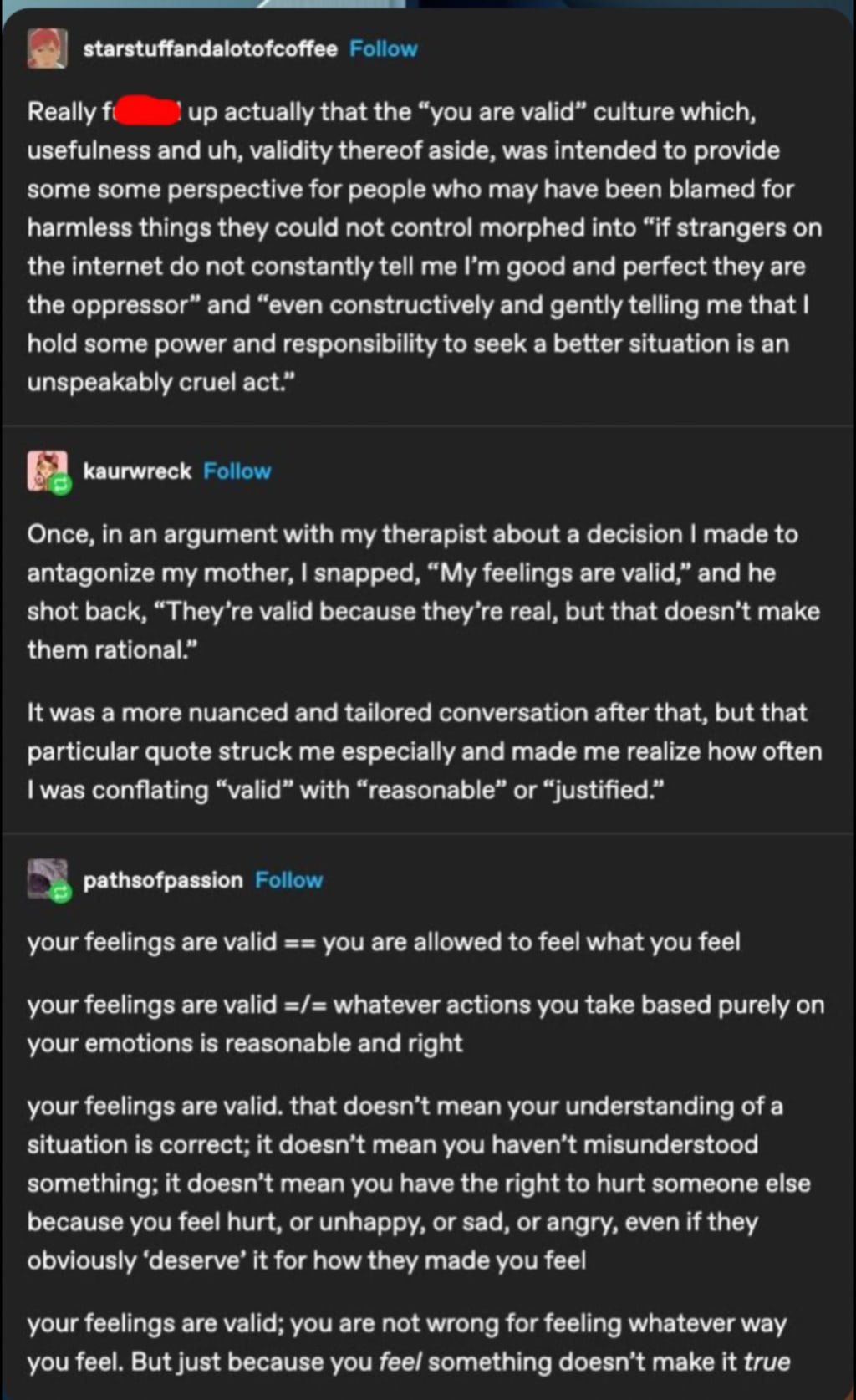
Your feelings can be valid and also unhelpful.
You can't always control your feelings, but you can (and arguably must) control your actions.
There seems to be a growing trend, particularly in internet spaces, that if something makes you uncomfortable, it must be inherently bad. Sometimes it's true, in the niggling way that you feel discomfort when some loud asshole blames immigration for their inability to get a job, or claims that [insert Minority Demographic Here] is ruining the country. For more often, that discomfort is something that merely questions your view of the world, and that is initially uncomfortable while you unpack it.
It could be something that you hadn't considered before, or something that you had encountered, but never examined in depth. No truth is pure black-and-white, and there can be truths within truths.
Feelings are helpful in identifying a conflict in your life, but you have to pick them up and examine why the conflict makes you feel those things, in order to solve it.
Do you feel guilt and shame over an argument because you were in the wrong, or because you know you could have done something different to de-escalate? What does that indicate about the relationship dynamics? What is something different you could try going forward? Is this an isolated instance or a pattern?
None of those are comfortable questions to ponder, but they're essential to consider when building a healthy relationship, whether platonic, familial or romantic.

"Your feelings are valid" began as something to say to victims of emotional abuse and gaslighting, who no longer trusted their own feelings, as a way for them to begin to trust themselves again.
People who have been consistently told that their feelings are wrong, or they don't know what they're feeling, (that they can't trust their emotions), often need that validation. Later on in the therapeutic process, they can progress from identifying and validating emotions to the more complex What and Why of those emotions, but it starts with validation. But the therapist has to be careful not to let validation become a crutch.
"My emotions are valid" can become a slippery slope to discarding and discounting opinions or facts that disagree with your emotions, and that's not just unhelpful, it can become dangerous.
Because people recovering from abuse also deal with things like difficulty regulating impulses, regression and an excessive craving for validation. Not all impulses are good or safe to actually do. Demanding unconditional validation or that someone take over decision making for you risks alienating your support group when they burn out.
All victims deserve and need support, but part of the recovery process is relearning and regaining independence. It's not a quick or easy process, but it is important, because relying too much on others creates a vulnerability that is easy for abusers to exploit.
Validation of feelings cannot come at the expense of facts, or taking responsibility, or in place of self-reflection. Your feelings are real, but that doesn't mean that they are helpful, or rational, or even true.
Emotions are just that: emotions. You are better served by considering why you have this emotional reaction, and what you can do about it, than you are insisting that this is the only correct way to feel.
Your feelings are valid to you, but that doesn't make them valid to everyone. It is not oppression to say that you need to examine your feelings before they lead you somewhere unfortunate. It is not cruelty for someone to say that your valid feelings do not excuse the actions you took as a result of those feelings.
Your feelings are valid. It's how you handle them that matters.
About the Creator
Natasja Rose
I've been writing since I learned how, but those have been lost and will never see daylight (I hope).
I'm an Indie Author, with 30+ books published.
I live in Sydney, Australia
Enjoyed the story? Support the Creator.
Subscribe for free to receive all their stories in your feed. You could also become a paid subscriber, letting them know you appreciate their work.
Comments
There are no comments for this story
Be the first to respond and start the conversation.