
Nothing to Look At: What the Desert Might Do to a Tired Mind
Egypt's first monks went into the desert for silence. Psychology has spent forty years measuring what a walk in the park does to attention. It has barely tested the desert.


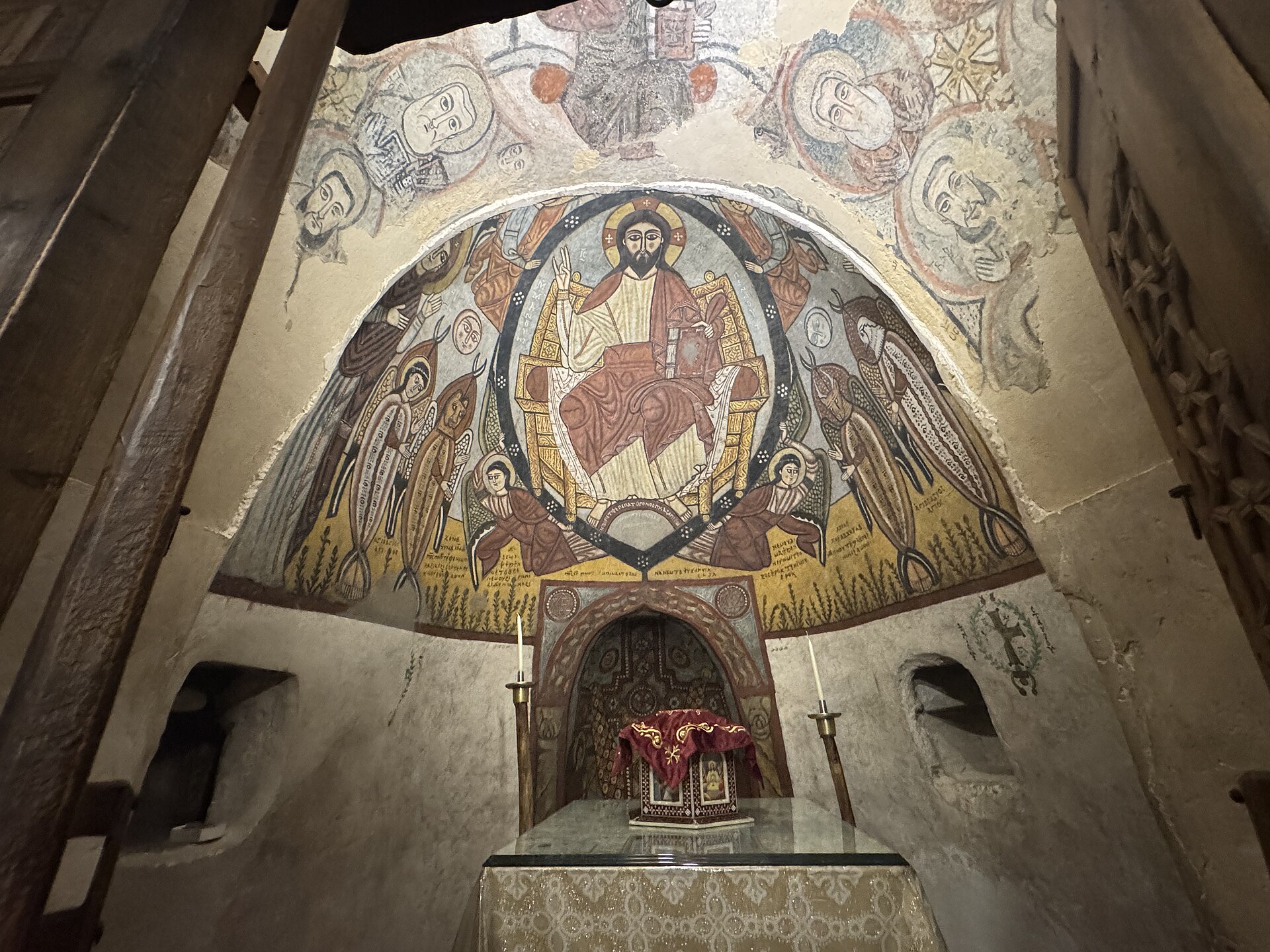
Some time in the fourth century, the bishop of Alexandria wrote a line about the Egyptian desert that still reads like a property developer's dream. "The desert was made a city by monks," Athanasius says in his Life of Antony. A young man from a village in Middle Egypt had given away his family's land and walked out to live alone. Others followed him, then many more, until by Antony's death in 356 the emptiness he went looking for was crowded with people looking for the same thing. The monastery that bears his name still stands at the foot of his mountain near the Red Sea, its church painted in the 1230s with warrior saints and long-bearded hermits that conservators cleaned of centuries of soot in the late 1990s.
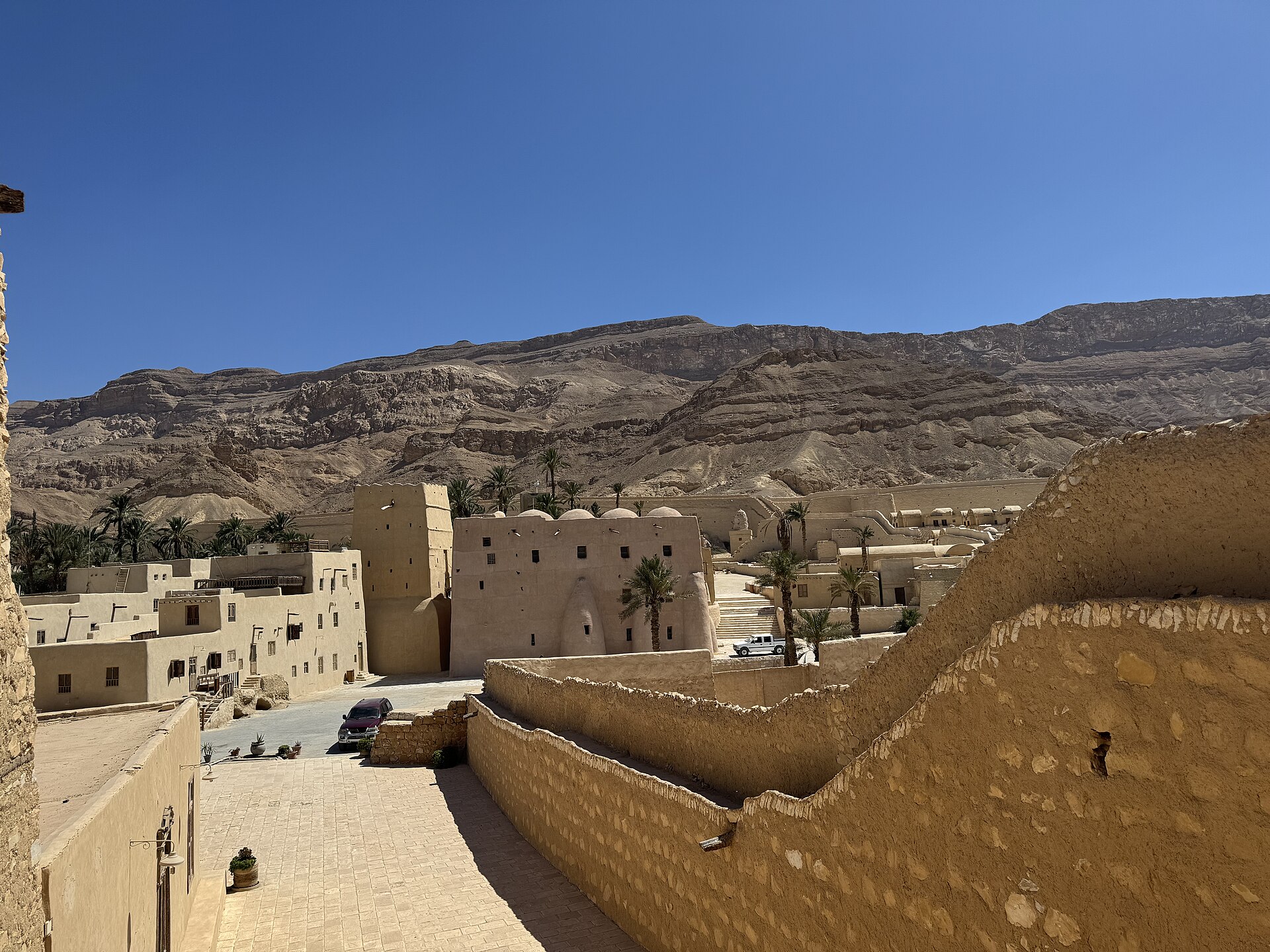
I've photographed a few desert monasteries myself. I also have a habit I used to think was mine alone. When my list of things to see runs out, I go out into the desert and look at nothing for an hour. Sand, a ridge, the line where the ground gives up and the sky begins. Then I come back to whatever I was stuck on and it tends to move.
I filed this under personal quirks for years, until psychology lectures handed me a theory built around exactly this feeling and a body of research that almost never went anywhere near a desert.
Clouds, sunsets, snow, leaves
The theory belongs to Rachel and Stephen Kaplan, two psychologists at the University of Michigan, who set it out in The Experience of Nature in 1989. Stephen Kaplan sharpened it in a 1995 paper the field still leans on.
It starts with the attention you hold on purpose. Reading a contract in your third language. Merging into Cairo traffic at six in the evening. Not listening to the couple arguing at the next table while you finish an email. Kaplan called it directed attention and argued that it wears out with use, leaving you irritable, careless and rereading the same sentence three times.
What lets it recover, in his account, is a place that feels like being away, that has enough extent to get lost in, that suits what you came to do and that offers fascination: attention something takes from you without asking. Hard fascination grabs you whole, like a football match. Soft fascination holds you lightly, keeping the eyes busy while the mind wanders off on its own business. His examples were clouds, sunsets, snow patterns and the motion of leaves in the breeze.
Read that list from anywhere south of Cairo. Clouds come and go. Snow is a rumour outside a few Sinai peaks. Trees are not what a desert is made of. Nothing in the theory shuts the desert out, since shadows sliding down a dune or light moving across rock could hold the eye just as softly. Nobody has written it in, though.

A window, a walk, four days without a phone
In 1984 Roger Ulrich went through the records of a suburban Pennsylvania hospital and compared 46 patients recovering from gallbladder surgery. Half had a window onto a small stand of trees. Half faced a brick wall. The tree-view patients went home sooner, asked for fewer strong painkillers and earned fewer gloomy remarks in the nurses' notes, although nothing in the study measured attention as such.
In 2008 Marc Berman, John Jonides and Stephen Kaplan sent 38 Michigan students on two walks of about fifty minutes, a week apart: one through the Ann Arbor arboretum, one through downtown. Before and after, each student heard strings of digits and had to say them back in reverse, a task that falls apart quickly when your attention is spent. Scores rose after the trees and not after the traffic. The authors found that neither mood nor the weather on the day accounted for the difference.
In 2012 Ruth Atchley, David Strayer and Paul Atchley tested 56 people on Outward Bound expeditions in Alaska, Colorado, Maine and Washington, trips where phones stayed behind. Hikers who sat a creativity test on the fourth day scored about 50 per cent higher than those tested before setting off. Landscape, exercise, company and silence all came on the same trip, so the study can't say which of them did the work.
Fewer certainties
Pooled together, the results are more modest. A 2016 review led by Heather Ohly at the University of Exeter found statistically significant gains on only three of thirteen attention measures, the backwards digit span among them. The authors blamed small samples and inconsistent methods for much of the rest. A 2018 review by Matt Stevenson, Theresa Schilhab and Peter Bentsen narrowed the claim to working memory, cognitive flexibility and attentional control. Yannick Joye and Siegfried Dewitte went further and titled their critique "Nature's broken path to restoration".
What struck me more than the size of the effect was the scenery. Pennsylvania, Michigan, Alaska, Colorado, Maine, Washington. Paper after paper I opened was set among forests, city parks, lakesides and campus gardens, so that "nature" in this literature tends to mean trees with water somewhere nearby.
The desert turns up rarely. A 2025 paper interviewed twelve teenagers aged 15 to 18 after therapeutic desert walks; they spoke of calm, safety, time to think and closeness to the people around them. That tells us how the desert felt. In my own searching I didn't find a controlled experiment that took people into the desert and tested their attention before and after.
It's a curious gap for a kind of landscape that covers roughly a third of the planet's land, only a fifth of it sand. It's a stranger one in the region where Christian monasticism began, some seventeen hundred years before anyone thought to measure what the desert does to a mind.
Too big to read
My own hunch, untested, starts with a difference in grain. A forest is busy with small things: leaves, flickering light, birds. Open desert has fewer of them and far more scale. In 2003 the psychologists Dacher Keltner and Jonathan Haidt described awe as a response to vastness combined with the need to stretch your picture of the world to fit what you are seeing. Grand landscapes were among their examples. Twenty years earlier Kaplan and Janet Frey Talbot had read the journals of young people on a wilderness programme in Michigan's Upper Peninsula and found awe and wonder all over the pages.
Perhaps the desert works less by giving the eye something gentle to rest on and more by making whatever you brought with you look smaller. Whether that also rests working memory is a separate question, one awe research hasn't answered. The desert isn't automatically kind either. Heat, glare, wind and the knowledge that water is far away can make the same horizon frightening, which any fair experiment would need to account for.
A spiral made to disappear
Artists have worked with that scale for decades. In 1997 three Greek women working as D.A.ST. Arteam, the artist Danae Stratou, the industrial designer Alexandra Stratou and the architect Stella Constantinides, made Desert Breath near El Gouna on Egypt's Red Sea coast: two interlocking spirals of sand cones and matching hollows across about 100,000 square metres, built to be worn away by the wind. Most people know it from aerial photographs, where it looks like a message left for satellites.
The artists made it about time and erosion. I can't say they had attention in mind. Still, on the ground the pattern only slowly assembles itself around you as you walk, which makes it a fair model of the question in this piece.
An hour, before anyone checks
Antony didn't go into the desert to rest his working memory. He went for prayer, discipline and a long fight with his own temptations. The monks who followed him built cells, a church, a bakery and a garden fed by a spring that monks still tend today. Theirs is a way of understanding the desert that is older than psychology and not answerable to it.
The rest of us can try something smaller. Find a long horizon. Leave the phone in the car. Don't photograph anything for the first twenty minutes, which is surprisingly hard. Then look again at the problem you brought and see whether it has changed shape.
If it has, write it down. For now, notes like that are most of the evidence there is.
About the Creator
Alena Belova
Researcher and writer on how people perceive, remember and trust information, from art and cultural heritage to search and online reputation. Co-founder of Exhibo and partner at BARS Agency. Lives between Doha, Dubai and Egypt.
Enjoyed the story? Support the Creator.
Subscribe for free to receive all their stories in your feed.
Comments
There are no comments for this story
Be the first to respond and start the conversation.