
MEN DON'T CRY: BUT THEY BREAK. EVERY SINGLE DAY.
He goes to work. He laughs with his friends. He tells his family that he is perfectly fine. But when the house goes completely quiet and the lights turn off, he sits in the dark with his head in his hands, drowning in a silent scream that nobody else can hear.

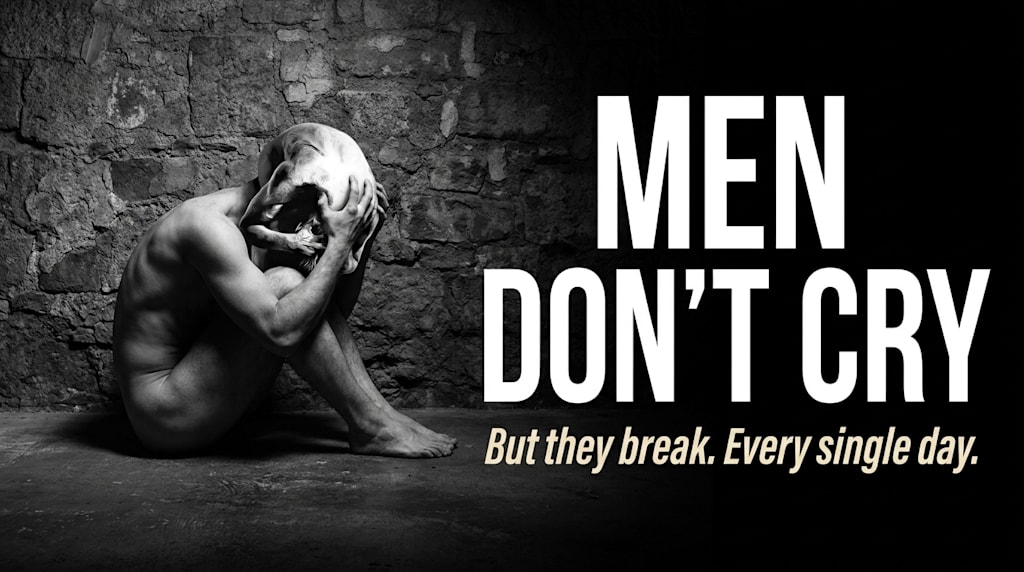
Look at the image of the man huddled against that cold stone wall. Stripped bare, curled into himself, clutching his head in absolute despair. You probably don’t see this man when you walk down the street. You don't see him at the office, or at the family dinner table, or laughing at the local coffee shop.
But he is there. He is the man sitting right next to you.
Every morning, he wakes up and performs a perfectly rehearsed routine. He splashes cold water on his face, looks at the tired eyes staring back at him in the mirror, and forces a smile. He walks out the front door and puts on a suit of invisible armor. When people ask him, "How are you doing?" he doesn't miss a beat. "I'm fine," he replies. "Just tired."
But at night, when the world stops demanding things from him and everyone else is asleep, the armor falls off. He sits on the edge of the bed or the floor of the shower, head buried in both hands, and he simply shatters. There are no tears. There is no sound. There is just a crushing, suffocating emptiness.
The Poison We Feed Our Boys
This silent suffering doesn't happen by accident. It is systematically taught.
When a little girl falls down and cries, society rushes to comfort her. We validate her pain. But when a little boy scrapes his knee and his eyes well up with tears, the reaction is entirely different. "Stop crying," he is told. "Be a man. Boys don't cry."
That isn't just a harsh sentence. It is a slow-acting poison passed down from generation to generation. At school, if he shows vulnerability, he is mocked by his peers. As he grows into an adult, the expectations only become heavier. He is told to carry the financial and emotional burden of his family without ever cracking under the pressure. He is taught that displaying weakness is the ultimate failure of masculinity.
And so, the boy learns. He learns remarkably well. He learns how to swallow his tears. He learns how to bury his hurt beneath a calm exterior and a polite smile. He locks his pain in a box deep inside his chest—until one day, there is no more room left, and he becomes completely hollow inside.
What Male Depression Actually Looks Like
When we think of depression, we usually picture someone who can't get out of bed, weeping softly in a dark room. Because of this stereotype, male depression frequently goes completely unrecognized by friends, wives, and doctors.
Men's depression wears a different mask. It doesn't always look like sadness. Very often, it looks like anger.
He snaps at his kids over tiny, irrelevant things. He loses his temper in traffic. His loved ones whisper that he has just become bitter or hard to be around. But in reality, he is desperately trying to release a massive build-up of inner agony through the only emotional channel that society has permitted him to use: aggression.
Sometimes, his depression looks like a 60-hour work week. He completely buries himself in his job, rarely coming home. People praise his ambition and his work ethic, completely blind to the fact that he is working himself into the ground because stopping means he has to think. And if he stops to think, he knows he will fall apart.
Things that used to bring him immense joy now feel like heavy chores. He slowly stops calling his friends. He isolates himself. But because he is still showing up to work and paying the bills, nobody stops to look him in the eye and ask, "Are you actually okay?"
The Fatal Cost of Silence
This forced silence is literally killing men.
The statistics are not just numbers on a page; they are a devastating reality check. Globally, 1 in 8 men suffers from a mental health disorder. But far more terrifying is the fact that men are 3.5 times more likely to die by suicide than women.
This isn't just a statistic. This is the beloved father who was always the life of the party, who made everyone laugh, and then one Tuesday, quietly took his own life. This is the strong, dependable older brother who always said "everything is under control," until the day it suddenly wasn't.
The relentless pressure to always appear in control takes a brutal toll. The pain doesn't just evaporate because a man refuses to speak about it. It moves from his mind and descends directly into his physical body. It becomes chronic high blood pressure. It becomes heart disease. It becomes a heart attack at age forty-five.
Redefining What Makes a Man Strong
We have gotten the definition of strength completely, tragically wrong.
Strength is not the ability to endure endless amounts of pain without ever breaking. A stone doesn't break until it is smashed, but a stone is dead. Human beings are meant to feel. True strength is the ability to rise after you have been broken—but to do that, you first have to be brave enough to admit that you are breaking.
Asking for help is not a surrender. It is arguably the most courageous, masculine thing a human being can do. Looking someone in the eye and saying, "I am drowning, and I need help," takes infinitely more bravery than hiding behind a fake smile.
Before You Break Completely
If you are a man reading this, and you felt a heavy knot in your chest because this sounds exactly like your life—please listen carefully.
You do not need to carry the weight of the entire world on your shoulders alone. You do not need to pretend to be unbreakable. You are allowed to be exhausted. You are allowed to be terrified. You are allowed to hurt.
You just need to tell one person. You don't need a long speech. Just four simple words:
"I am not okay."
That is not defeat. That is the moment you finally start to win your life back. Speak up, before the silence takes you entirely.
About the Creator
Wellova
I am [Wellova], a horror writer who finds fear in silence and shadows. My stories reveal unseen presences, whispers in the dark, and secrets buried deep—reminding readers that fear is never far, sometimes just behind a door left unopened.
Enjoyed the story? Support the Creator.
Subscribe for free to receive all their stories in your feed.
Comments
There are no comments for this story
Be the first to respond and start the conversation.