
Ketamine Therapy in Rockland County Is Getting More Attention. Here's What Patients Should Know
I have noticed more people asking about ketamine therapy. Many are looking for another treatment option worth understanding after previous treatments have not been enough.

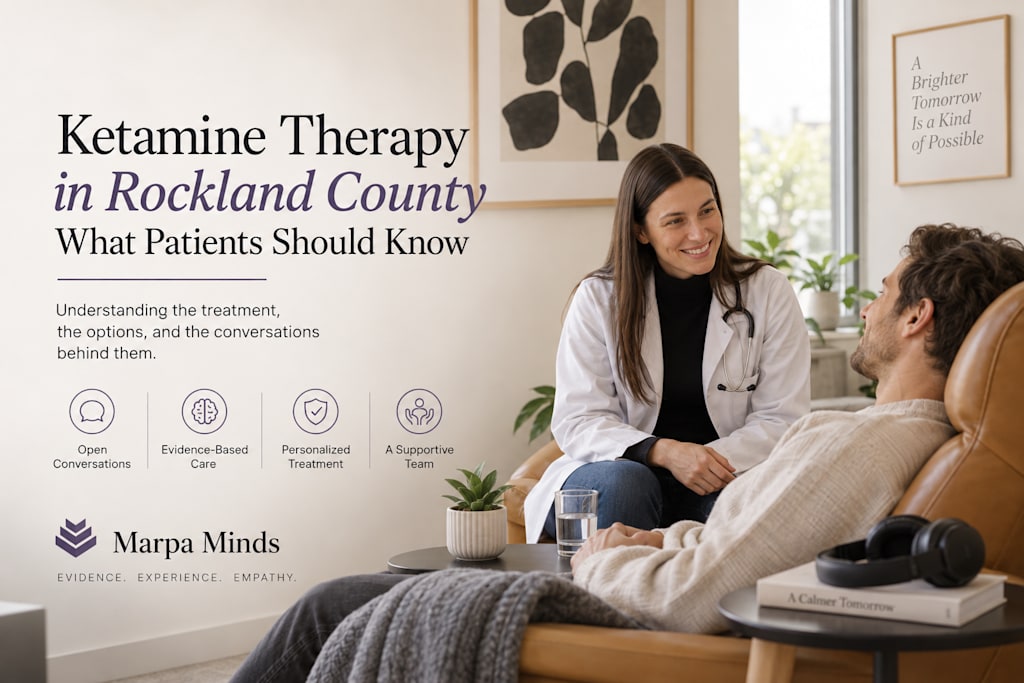
One thing I've noticed is how often the conversation around depression begins with the same sentence:
"I've tried a lot of things."
Sometimes that means two medications. Sometimes it means several more.
There may have been therapy, medication changes, dose adjustments, months of waiting, periods of improvement followed by another difficult stretch, and eventually the feeling that the options are becoming harder to find.
That's often when ketamine enters the conversation.
Not because someone suddenly became interested in psychedelic medicine.
Because they are tired of feeling stuck.
That is part of why ketamine therapy in Rockland County is getting more attention. People are hearing about treatments that work differently from traditional antidepressants, and they understandably want to know what those treatments actually are, what the experience involves, and where they fit into modern depression care.
Ketamine Therapy Is Not Just One Treatment
This is probably the first thing that gets confusing.
When patients ask for ketamine therapy, they can be talking about several different forms of treatment.
There is ketamine itself, which has been used in medicine for decades, including as an anesthetic. There is also esketamine, the medication used in Spravato®, which has its own FDA approval and safety requirements.
IV ketamine, for example, may be prescribed off-label for depression. Spravato is different. It is a prescription nasal spray containing esketamine and is FDA-approved for adults with treatment-resistant depression, either on its own or alongside an oral antidepressant. It is also approved, in conjunction with an oral antidepressant, for depressive symptoms in adults with major depressive disorder who have acute suicidal ideation or behavior.
Those distinctions matter because the treatment experience, regulatory requirements, clinical evidence, and insurance considerations are not identical.
I've written more about the differences between Spravato and Ketamine Infusion treatments because it is one of the first things people tend to ask when they start researching ketamine.
Why Has Ketamine Become Part of the Depression Conversation?
For a long time, the conversation around depression treatment was largely centered around traditional antidepressants and psychotherapy.
Those treatments remain important. But they do not work sufficiently for everyone.
Treatment resistant depression is generally understood as depression that has not responded adequately to two or more antidepressant treatments. For someone who has spent months or years trying different approaches, hearing that definition can feel less like a medical term and more like an explanation for what they've already been living through.
Ketamine has attracted attention partly because it works differently from many conventional antidepressants and can produce antidepressant effects more quickly in some patients. Research supported by the National Institute of Mental Health has helped drive interest in rapid acting treatments for people whose depression has been difficult to treat. At the same time, ketamine comes with important safety considerations, which is why the clinical setting matters.
The important part is that "different" does not mean "right for everyone."
It simply means there is another part of the treatment conversation worth understanding.
What Does Spravato Have to Do With Ketamine?
A lot of people looking for ketamine treatment in Rockland County eventually come across Spravato.
That can be confusing at first because Spravato is closely related to ketamine, but it is not the same thing as receiving an IV ketamine infusion.
Spravato contains esketamine and is administered as a nasal spray in a certified clinical setting. Because of the medication's potential effects, including sedation, dissociation, dizziness, nausea, and increases in blood pressure, patients are monitored after administration. The FDA prescribing information requires at least two hours of observation after treatment, and patients should not drive or operate machinery until the next day after a restful sleep.
So when someone says they are looking into "ketamine therapy," the next question is often:
Which ketamine based treatment are we actually talking about?
That question clears up a lot.
What Does a Spravato Visit Actually Look Like?
This is another thing people want to know long before they ever walk into a clinic.
The treatment itself is relatively straightforward. The medication is administered as a nasal spray under clinical supervision. The rest of the appointment is largely about allowing the medication to take effect while the clinical team monitors the patient.
The experience can vary from person to person.
Some people describe changes in perception or a feeling of detachment. Some experience dizziness or sleepiness. Others mainly notice a quieter mind or a shift in how they are experiencing their symptoms.
There is not one universal description of what a session feels like.
And I think that is worth saying because there is a lot of dramatic language surrounding ketamine online.
A treatment session does not need to be dramatic to be meaningful.
Sometimes people notice a clear shift. Sometimes changes are more subtle. Sometimes the most important part becomes clearer only after the session.
That is one reason the setting and the people providing the care matter just as much as the medication itself.
The Other Side of Treatment Resistant Depression
This is the part of the conversation that gets left out most often.
By the time someone is searching for ketamine therapy, they may have already spent years trying to feel better.
They've had appointments where they hoped the new medication would finally be the one.
They've waited through side effects.
They wondered whether they were being impatient.
They've tried again.
After enough of those cycles, people can become very careful with hope.
I've seen that happen.
Someone may be interested in a new treatment while also quietly preparing themselves for another disappointment.
That is why I don't think conversations about ketamine should be reduced to whether it is "the future of depression treatment" or whether it is going to change someone's life overnight.
Those claims make for good headlines.
They don't tell you much about the person sitting in front of you.
What Ketamine Treatment Looks Like in Rockland County
As a mental health practice serving Rockland and Westchester counties in New York, Marpa Minds has had countless conversations with people looking for new approaches to depression treatment. Those conversations have shaped the way we approach care.
Our Medical Director, Dr. Benjamin Medrano, is a board certified psychiatrist whose work has focused heavily on ketamine assisted therapy and integrative psychiatry. Before joining Marpa Minds, he held medical leadership roles in large ketamine treatment programs and has continued teaching and speaking in the field.
Our Clinical Director, Amy Della Rocca, MSN, MPH, PMHNP-BC, has more than 25 years of mental health experience and has overseen or delivered more than 5,000 ketamine and Spravato sessions.
That experience matters because patients rarely arrive with a simple question.
They bring a treatment history.
They bring medications they've already tried.
They bring concerns about side effects, cost, scheduling, insurance, and what the experience itself might feel like.
At Marpa, the clinical conversation begins with understanding that history. Spravato may become part of the discussion for someone who is an appropriate candidate, while another treatment approach may make more sense for someone else.
What I Hope Patients Take Away From This
This may be the most important thing I can share with someone reading this.
There is a growing amount of research around ketamine and esketamine, and there are more treatment options available to people with difficult to treat depression than there were years ago.
But every person brings a different history into the room.
One person may have had little response to several antidepressants.
Another may have experienced partial relief but continued to struggle with significant symptoms.
Someone else may be dealing with a completely different set of circumstances.
The treatment conversation has to leave room for those differences.
For patients in Rockland County who are hearing about ketamine treatment for the first time, I think that is where the most useful information begins. Not with promises, and not with the assumption that a newer treatment must automatically be a better one.
It begins with understanding what the treatment is, where Spravato fits, and what the clinical process involves. At Marpa Minds, we recognise that each person's treatment history is different, and those differences matter when discussing the options available.
Depression can make the future feel very small.
Sometimes, simply knowing there are still options to explore can make that future feel a little more open.
About the Creator
Chesky Breuer
Founder of Marpa Minds. Writing about mental health, treatment-resistant depression, ketamine-assisted psychotherapy, and the science behind innovative approaches to emotional wellness.
Enjoyed the story? Support the Creator.
Subscribe for free to receive all their stories in your feed.
Comments
There are no comments for this story
Be the first to respond and start the conversation.