
Borrowed Worth
Why we look outside ourselves to feel who we are

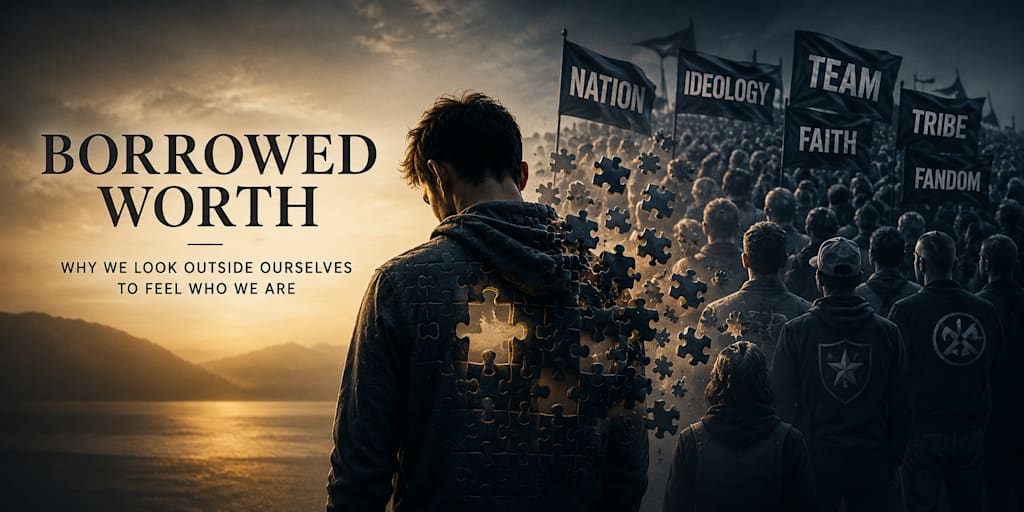
When someone feels insecure about who they are, they start borrowing worth from the groups they belong to.
Core personal identity can become shaky through failure, uncertainty, trauma, or modern life’s atomization. People shift from “I am valuable because of what I do, create, or stand for” to “I am valuable because of who we are.” This is borrowed worth, or reflected glory. It works in the short term, but it’s fragile.
Why it happens
Social Identity Theory (Tajfel & Turner): People will discriminate against out groups even on arbitrary distinctions, like “Klee painters” vs. “Kandinsky painters,” just to boost self esteem. The drive for positive distinctiveness is powerful.
Evolutionary wiring: Humans are ultra social. For most of history, lone individuals did not survive. Group membership signaled safety and value. Insecurity turns this ancient circuit up.
Modern amplifiers: Social media, economic precarity, and the erosion of traditional markers of achievement, stable careers, family formation, rites of passage, make individual self worth harder to sustain. The result? Louder team jerseys, political, racial, gender, subcultural, corporate, athletic.
Common patterns
The insecure nationalist whose personal dignity rests entirely on “my country’s greatness.”
The chronically online person whose entire self concept is their fandom, ideology, or victim status inside a group.
Corporate strivers who draw worth from company prestige instead of their own craft.
Positive versions exist too: deep identification with family, craft communities, or sports teams during hard times.
Even secure people temporarily lean harder on belonging during periods of grief, instability, failure, trauma, or major life disruption. Humans stabilize through connection. In tough times we need something outside ourselves to hold onto. Hard periods pull people toward belonging but it gets dangerous when there is nothing underneath anymore.
Some group identities also stay healthier than others. Family, close friendships, and craft communities tend to anchor identity in real relationships, reciprocity, and contribution. More abstract identities, ideology, politics, massive fandoms, online subcultures, can become more prosthetic because they create significance without the same accountability or friction.
This often fuels zero sum thinking. Elevating “my group” starts requiring someone else to sit lower. Criticism of the group feels personal, which explains a lot of the defensive tribal rage we see online and off.
People protecting a borrowed identity often do not realize they are doing it. It feels real. It feels moral. It feels like defending truth, defending history, defending what matters. That is part of why group attachment becomes so emotionally charged. When identity fusion happens, disagreement feels like disrespect. Rejection feels like erasure. Losing status inside the group can feel like losing yourself.
Healthier path
More secure people do the reverse. They lend worth to their groups through competence, character, and contribution instead of extracting it. Personal agency, skills, virtues, and real relationships become internal ballast. You can belong without fusing your identity to the group. Secure self attachment makes group membership additive, not substitutive.
This dynamic is not inherently evil. Humans are groupish by nature. But left unchecked, it creates brittle people and brittle societies. Therapy, philosophy, mastery, and honest feedback can help rebuild internal worth. The Stoics and existentialists were circling this distinction in different ways: live from within, not from the echo of the crowd.
Group identification becomes toxic mainly when it is compensatory rather than complementary. Secure people use groups as places to express and contribute. Insecure people use them as prosthetic egos.
A strong identity is not the absence of belonging. It is the ability to belong without disappearing into what you belong to. To take pride in a group without needing it to carry your entire weight. To lose status, approval, or membership and still know who you are.
About the Creator
Annam M Gordon
My books and writing focus on real people. These stories come from lived experience. I collaborate with individuals and mental health professionals. https://muckrack.com/annammgordon https://app.qwoted.com/sources/annam-m-gordon?
Enjoyed the story? Support the Creator.
Subscribe for free to receive all their stories in your feed. You could also become a paid subscriber, letting them know you appreciate their work.
Comments
There are no comments for this story
Be the first to respond and start the conversation.