
Accepting Myself as a Thirty-Three Year Old Elder Queer
An Artifact For Our Queer Youth

A friend, one of my roommates in that monastery in China, recently had gender-affirming surgery. When I messaged to congratulate them on this beautiful and complex milestone, they thanked me, referring to me as an "elder queer."
At that moment, I fawned at the perceived compliment. I still take it as one, but I have spent the last several days considering what it has taken for me to be seen as such. As is usually the case, it is as much a personal journey as a political one.
When I say this, I imply the myriad trials I have survived to be here today, a thirty-three-year-old, visible trans-masculine, non-binary person. I also mean to point to the systemic erasure and eradication of queer people throughout our colonial history.
I am an elder queer because we don't have very many surviving older queer people left. The government let us die.
Are you old enough to remember the AIDS crisis in the 80s? I'm not quite, but I'm old enough to have lived through that time's political atmosphere and aftershocks. I was born in 1990 when the Americans With Disabilities Act (ADA) was passed. A crucial policy that protects individuals living with disabilities, as well as those diagnosed or suspected of having HIV/AIDS. This was groundbreaking, yet a year later, the CDC reported that a million Americans were infected with HIV. One hundred fifty-six thousand one hundred forty-three people were dead. The crisis continued.
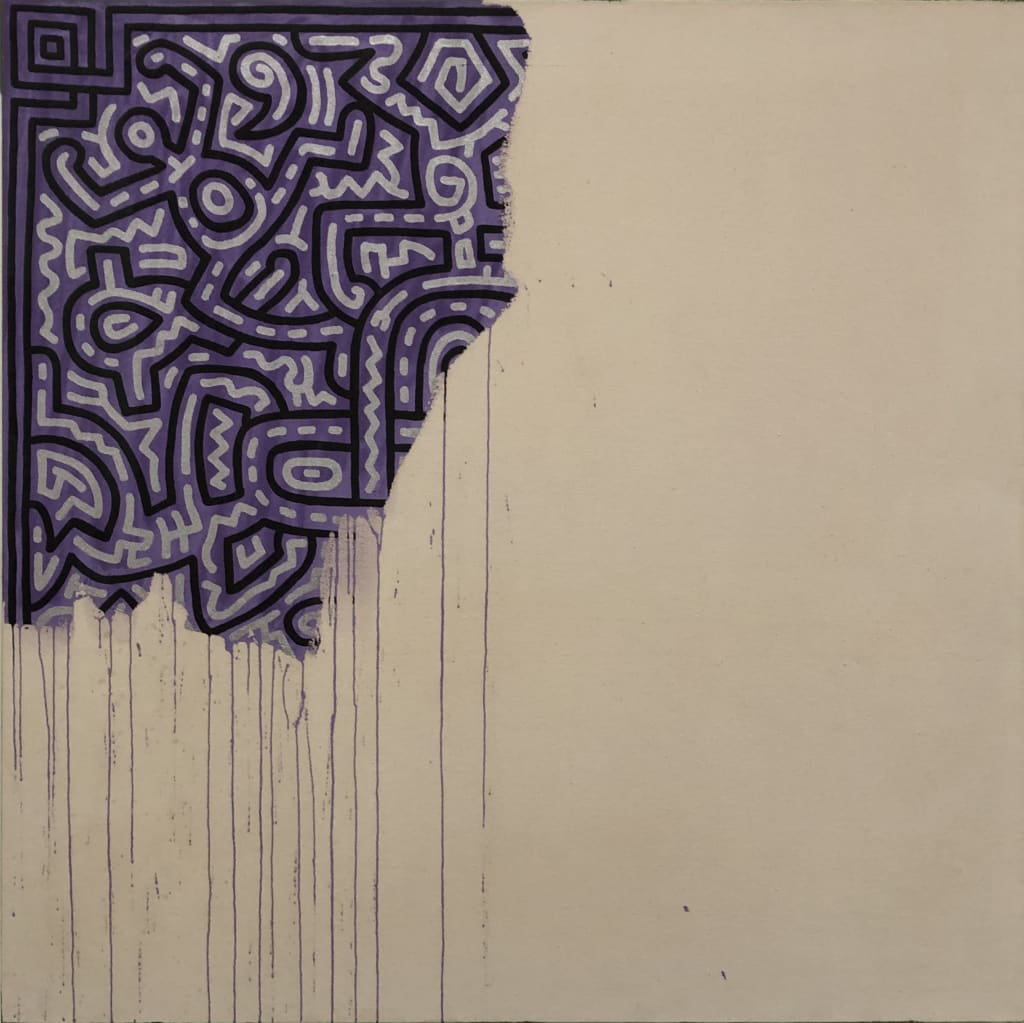
Keith Haring, the artist behind the image I selected for this essay, died in February of 1990–eight months before I was born and five months before the passage of the ADA. He completed his work, titled "Unfinished Painting," a year before his untimely death due to complications from the disease. The work is meant to represent the hundreds of thousands of unfinished lives lost to AIDS. He was only thirty-one when he died.
What I knew of the AIDS crisis by the mid-to-late 90s was one thing, rather, one person: Ryan White, the child with hemophilia, kicked out of school for contracting AIDS from blood transfusions. He died in 1990 at the age of eighteen.
His name was synonymous with the disease in my early years of public school. Formal education taught me that he lived during a time of great misunderstanding. That the system failed him because they didn't know enough about HIV or AIDS at the time. What I didn't realize is that the "time of great misunderstanding" was only eight to ten years prior, and the little understanding he was afforded in death was due to his heterosexuality. However, I remember some classmates comfortably slinging homophobic slurs after that first health class lesson about him. Social education taught me that the queer community suffering from this devastating disease was still misunderstood or, worse, targeted.
By 2004, the number of Americans dead had climbed to five hundred twenty-nine thousand one hundred thirteen people. I turned fourteen that October.
Being fourteen and a freshman in high school is a trying time for any youth. Add in the fact that it was the early aughts, and coupled with a queer identity, it becomes nearly untenable. I wasn't out in my childhood. I didn't tell anyone about my queerness until I had almost graduated, and even then, it was only to a few close friends. The gravitational pull of "acting normal," which I later learned is called compulsory heterosexuality, was flattening me.
I knew I was queer, that wasn't a question. The only thing I had left to discover was whether or not I could maintain the facade of straightness or for how long.
I thought about Matthew Shepard quite a bit during this time. He was murdered in October of 1998, but the heinousness of his death shocked and frightened me deeper into the closet for years after. I studied my family, peers, and strangers with the same scrutiny and distrust, looking for signs of violence against queer people–signs that they might murderously hate me if I showed any hint of my true self. I suffered from profound depression, dysphoria, and internalized homophobia, and any excuse to hide seemed like a good one. Mornings, I awoke feeling only what I could describe as "horribly wrong," though later I came to understand this dysphoria better. Afternoons were spent distracting myself from suicidal ideation, and evenings, I slept with the shame of my fantasies. "Self-preservation," I thought, not realizing the harm I inflicted on myself.
There's a great deal I would say to that closeted child these days. They are things I would say to any child, queer or otherwise. Hell, I should say these things to my current adult self.
Your life matters.
You may be scared or confused, but things become easier to navigate as you age and your community grows.
When you sleep, allow yourself to dream.
When you wake, keep the dream close.
Remember, there is love in the world for you.
No matter how hard people may try, nothing can erase the beauty and sacredness of your existence.
Let yourself cry.
Let yourself grieve.
Let yourself be soft.
But do not let yourself be overcome.
Someday, you will understand that your survival is the question, the answer, and the key. Our future relies on the thriving intersections of all marginalized identities.
Your difference is your strength. Lean into it.
Without support, anyone falters. Be present for people.
Do not forget that you and your comrades are forged in the same fires. Trauma can inform, and the collective can heal.
Keep going.
The world has changed dramatically since the 1980s and 1990s—well, mostly. I remember in 2008, the news of "The Berlin Patient" shifted the narrative of HIV being incurable. After that, it seemed like a landslide of change. New policies, cultural compassion, and medical research became the top priorities. The tireless work of artists, activists, the ill, or all of the above was finally being considered. Our elder queers are to thank for our survival, and I do not take the passage of that torch lightly.
The final definitive numbers I can find are for 2018, which state that more than seven hundred thousand people have died of AIDS since the start of the crisis. The data gets spotty after this, and COVID-19-related deaths skew the available information even further. Take that how you please.
All I know is there is so much more work to be done, and I have some rather large shoes to fill.
About the Creator
kp
I am a non-binary, trans-masc writer. I work to dismantle internalized structures of oppression, such as the gender binary, class, and race. My writing is personal but anecdotally points to a larger political picture of systemic injustice.
Enjoyed the story? Support the Creator.
Subscribe for free to receive all their stories in your feed. You could also become a paid subscriber, letting them know you appreciate their work.
Comments
There are no comments for this story
Be the first to respond and start the conversation.