
The Nagoya Asian Games Podium Was Staffed by Retirees. That’s Not a Gimmick. That’s Japan.
A volunteer shortage, a super-aged society, and a budget four times over plan put silver-haired volunteers on the world stage.
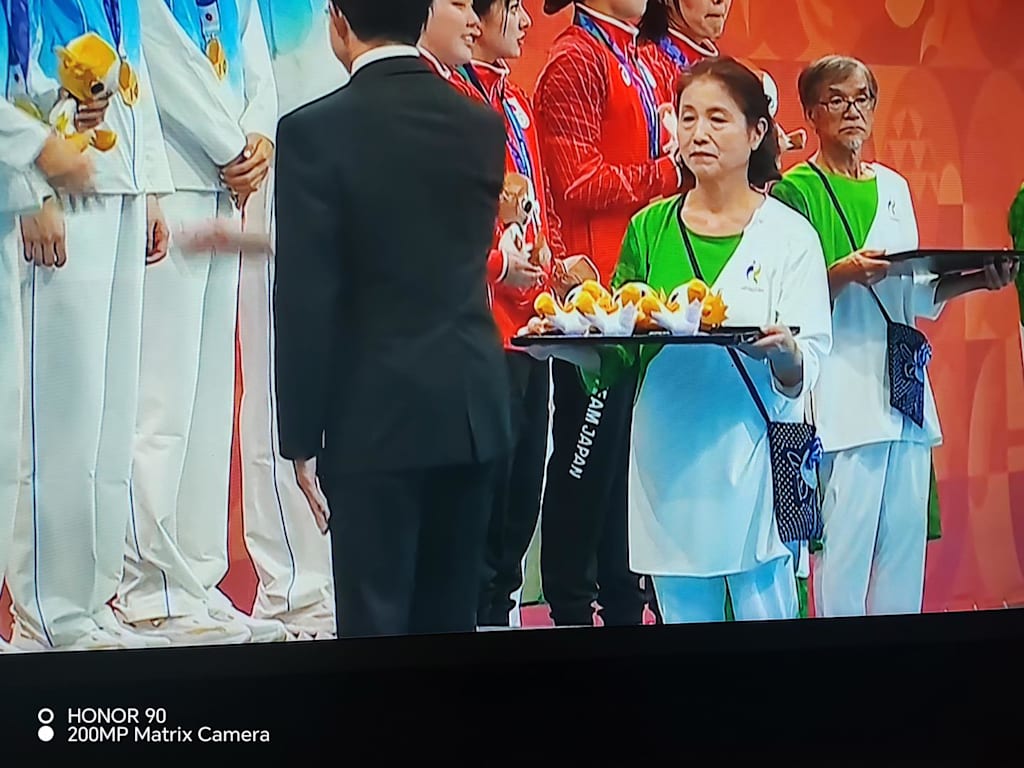
Silver trays: a footnote on Japanese society from the Nagoya Asian Games podium
On September 20, 2026, inside the Nagoya Asian Games swimming venue, three staff members walked out from the side of the stage before the women’s 4×100-meter swimming relay medal ceremony. Each carried a tray with medals to be awarded. They wore the same light-blue volunteer vests. Their hair was gray. Their steps were not quick, but the trays were perfectly steady. The woman at the front wore a volunteer credential on her chest. In the ID photo, she looked many years younger.
The medals were handed to the presenters one by one. The ceremony ran smoothly. There were no mistakes. It was only when the champion team stepped onto the highest podium and the camera swept past them that people on social media noticed: everyone carrying the trays was elderly.
“It used to be young, pretty girls,” one comment read. It received thousands of likes.
But Yoshiki Sawada, the volunteer department chief of the Nagoya Asian Games organizing committee, later said something more accurate in an interview: “We did not deliberately arrange for older people, and we did not deliberately exclude young people. We simply placed the people who could come into the roles that suited them.”
I. A plan for 40,000, a reality of just over 10,000
The problem began with a number.
The organizing committee initially planned to recruit about 40,000 volunteers. That figure followed the conventions of previous large-scale events. The Beijing Olympics mobilized around 100,000 volunteers, and the Tokyo Olympics recruited about 80,000. When the Nagoya committee launched recruitment in 2024, its confidence was not low.
But by the time the Games opened in 2026, only just over 10,000 volunteers had actually been deployed. The shortfall was not 10 percent or 20 percent. It was close to three-quarters.
The committee did not fail for lack of effort. It held recruitment sessions at universities across the country, ran advertisements on social media, and even worked with some universities to offer academic credit for volunteer service. In the end, however, student volunteers made up only one-third of the total.
The gap had a simple cause. Games volunteers receive no salary, only meals and transportation allowances. The work requires long shifts over consecutive days. Medal ceremony roles may not involve long hours on any single day, but the Games span weeks, and volunteers must be present at fixed times. For Japanese young people burdened by academic pressure and often working part-time jobs to make ends meet, setting aside consecutive full days is nearly impossible.
The obstacle is time poverty, not attitude. When a job offers no pay and demands a large amount of time, it naturally excludes anyone with a full-time job or full-time studies. And young Japanese people are among the most time-poor groups in the country.
II. Whoever has time comes
The people with time were retirees.
The committee’s recruitment criteria required only that applicants be at least 18 years old. There was no upper age limit. On paper, this looked open. In practice, it meant retired people became the only group capable of participating in volunteer service on a large scale.
The age range of volunteers at these Games ran from 18 to 91. The oldest volunteer, Hirokuni Anraku from Tokai City in Aichi Prefecture, was assigned to operational support for kabaddi. He went to watch a match early just so he could understand the rules. He said he had been retired for years, had missed the Tokyo Olympics, and now wanted to “do something for an international tournament one more time.”
There was also Reiko Iida, a 66-year-old Nagoya resident. She had applied to volunteer for the Tokyo Olympics but could not take part because of the pandemic. This time, she finally got her wish. She was assigned to the medal ceremony team, responsible for carrying trays. She said she had practiced holding a tray in front of a mirror at home for a long time. “I could not let the medals fall.”
Reiko Iida’s story is not an isolated case. According to the Japanese Cabinet Office’s Annual Report on the Aging Society, about 70 percent of people in their 60s still work or participate in volunteer activities, and about 50 percent of those over 70 remain active. In Japan, retired people participating in large city events and public service volunteering is already very common. They are the main force in local volunteer activities.
So a spontaneous process of filling the gap took place: young people could not come, so older people came. The committee did not deliberately assign elderly volunteers to medal ceremony posts, but role allocation was adjusted according to applicants’ wishes and actual needs. Sawada said some volunteers could not handle heavy lifting but were suited to ceremonial roles. Carrying a medal tray does not require much physical strength, but it does require familiarity with procedure and emotional steadiness. Those qualities often suit older people with life experience and patience.
III. The numbers on the budget sheet
Beyond the labor shortage, there was another layer: money.
When the bid was made in 2016, Aichi Prefecture and Nagoya City estimated the organizing burden for the Asian Games at 85 billion yen. But by the end of 2025, Aichi Prefecture announced that the latest direct Games budget had reached 298 billion yen. If the broader expenditures borne by host cities are included, such as venues, transportation, and infrastructure, the total cost is about 370 billion yen, roughly four times the original plan.
There were many reasons for the overrun. The number of competition categories rose from 36 to 41. The price level of 2016 was no longer comparable to that of 2026, with construction materials and labor costs rising sharply. Sponsorship and ticket revenues both fell short of expectations. When Aichi Governor Hideaki Omura was asked about the budget at press conferences, he repeatedly used the word “severe.”
Under such pressure, the committee tried to save in every possible area. Using unpaid volunteers is the lowest-cost staffing method for a major event. If medal ceremony staff were replaced by a professional hired team, it would mean paying market rates for ceremonial services. With the budget already stretched thin, that money was almost impossible to put on the books.
IV. Nearly three in every ten people are elderly
The podium scene reflects a larger demographic structure.
Around the opening of the Asian Games, Japan’s Ministry of Internal Affairs and Communications released its latest population estimate. As of September 15, 2026, the number of people aged 65 or older in Japan was about 36.24 million, accounting for 29.6 percent of the total population, a record high. That means nearly three out of every ten people in Japan are 65 or older. Among the 39 countries and regions with populations over 40 million, Japan has the highest level of aging.
Employment among older people continues to grow. In 2025, the number of employed people aged 65 or older in Japan was about 9.43 million, increasing for the 22nd consecutive year. The proportion of employed people aged 65 or older in the total working population was about 13.8 percent, also a record high. The Japanese government has long promoted delayed retirement policies. The 2021 revision of the Act on Stabilization of Employment of Elderly Persons requires companies to secure employment opportunities for willing workers up to age 70. From taxi drivers on the street to convenience store clerks, from park security to traffic guides, the figures of older people are everywhere in Japanese society.
The National Institute of Population and Social Security Research predicts that by 2040, the proportion of people aged 65 or older will rise to 34.8 percent. By then, the participation of older people in public services will only increase.
V. What is on the tray
Back to the podium.
When the young champion stands at the highest point, beside her is a face full of wrinkles, and in her hands is a heavy medal on a tray. The image drew discussion precisely because it broke the fixed imagination of what a “medal ceremony attendant” should be. In most people’s minds, ceremonial staff should be young and polished. What appeared on the Nagoya podium was older and unpolished.
Sawada said the committee set no age limit for ceremonial roles. It neither required young people nor deliberately assigned older volunteers in batches. His statement was simple: there was no arrangement, only a result.
The silver-haired volunteers were not “arranged” onto the stage. They were pushed there by the structural forces of a super-aged society. The absence of young people and the tight budget met the ample time and willingness of retired people. That combination produced what we saw on the Nagoya podium.
Reactions split between calling it shabby and calling it realistic. Another view is possible: these older people stood there, completed a series of trained ceremonial movements, kept the trays steady, and made no mistakes in the procedure. Many years after retirement, they still chose to stand at the service posts of an international event.
The trays held medals. The people carrying them were part of a demographic shift that is already visible across Japan.
Reiko Iida later said something in an interview. She said that at the moment she handed the medal to the athlete, she remembered her days working at a bank counter when she was young. “Your hands must be steady, your heart must be calm, and you must place the thing into the other person’s hands.” She said, “That principle is the same at any age.”
After the medal ceremony ended, the volunteers exited from the side of the stage. Reiko Iida returned her tray to the equipment team, picked up her cloth bag, and walked out of the swimming venue. The September evening in Nagoya was still a little muggy. She stood outside the venue waiting for the bus, beside a few other older people also wearing volunteer vests. They nodded to each other. They did not say much.
The bus came.
About the Creator
Jin
Writer of reamstories
https://reamstories.com/jin
Enjoyed the story? Support the Creator.
Subscribe for free to receive all their stories in your feed. You could also become a paid subscriber, letting them know you appreciate their work.
Comments
There are no comments for this story
Be the first to respond and start the conversation.