
Two surgeons, one operation: the model behind Catherine Hannan's practice
The Washington, D.C. plastic surgeon spent more than a decade in reconstructive surgery at the VA. Now she and her cofounder operate together, on the same patient, at the same time.


Catherine Hannan does something in the operating room that most plastic surgeons never do. She shares it. For major procedures at Washington Women Plastic Surgery, the Washington, D.C. practice she co-founded, Hannan scrubs in beside a second board certified plastic surgeon, Dr. Lauren Patrick, and the two operate on the same patient at once. One plans a contour while the other checks symmetry. One closes while the other reads proportion. In a specialty where the surgeon is almost always a solo act, that arrangement is close to unheard of.
The logic is not showmanship. Two experienced surgeons working at the same time can shorten an operation, which means less time under anesthesia, and it puts a second trained eye on every decision about symmetry and contour while there is still room to change course. It is a strange thing to build a cosmetic practice around. It makes more sense once you know that Catherine Hannan came up on the reconstructive end of the specialty, the part with no marketing budget: veterans, skin cancer, wounds that refused to close.
A biology and music major who chose surgery
Hannan grew up in Rockaway Beach, New York, and finished first in her class at the Convent of the Sacred Heart School in Manhattan. At Yale she did something few aspiring doctors attempt, majoring in both biology and music while also studying art history and architecture. It is an odd transcript for a future surgeon, and also a revealing one. Proportion, structure, the way parts resolve into a whole: these are architectural concerns as much as surgical ones, and she was thinking about them years before she picked up a scalpel.
She earned her medical degree from Georgetown University School of Medicine in 2005 and stayed for its integrated plastic surgery residency, a six year program that was then the only one of its kind in Washington, D.C. During those years she trained under Dr. Scott L. Spear, the longtime chair of Georgetown's plastic surgery department and one of the most influential figures in modern breast surgery. Hannan contributed to early research with Spear on nipple sparing mastectomy, work that helped shape how surgeons preserve a patient's appearance during breast reconstruction. That grounding in symmetry and long term results still runs through everything she does.
A decade of reconstruction at the DC VA
After finishing residency in 2011, Hannan joined the Washington DC Veterans Affairs Medical Center, and from 2014 to 2025 she led its plastic and reconstructive surgery division. The caseload was not cosmetic. She operated on patients who needed breast and general reconstruction, skin cancer removal, complex wound care, and limb preservation, the kind of surgery measured in function restored rather than appearance refined. She became board certified by the American Board of Plastic Surgery in 2012, and she is a Fellow of the American College of Surgeons and a member of the American Society of Plastic Surgeons, The Aesthetic Society, and the International Society of Aesthetic Plastic Surgery.
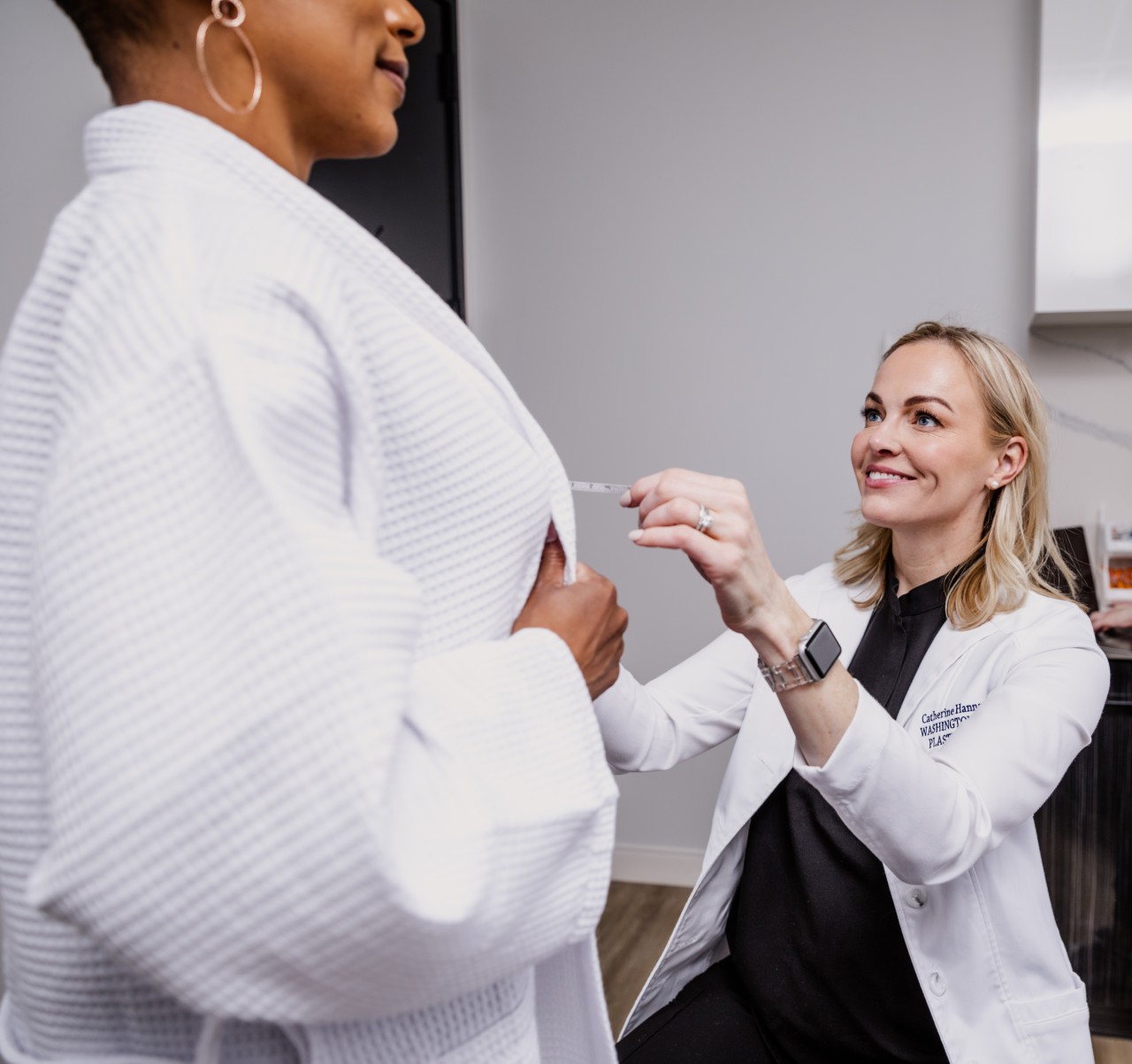
Catherine Hannan has also coauthored roughly a dozen peer reviewed studies, including a 2021 national guideline on reconstruction following skin cancer, and she has reviewed medical content for Healthline since 2017. From 2017 to 2024, alongside her hospital work, she also saw cosmetic patients at West End Plastic Surgery, the private side of a career that had so far been built on rebuilding.
The case for two surgeons in one room
Hannan and Patrick first met as trainees at Georgetown, and later worked together as reconstructive surgeons at the DC VA, where both taught residents as assistant professors of clinical plastic surgery. They came out of the same program with the same surgical vocabulary, which is what makes their two surgeon models work rather than turn into a debate over the patient. In major cases they plan, operate, and refine together, each checking the others read on contour, symmetry, and technical detail throughout the procedure.

"Working together as two board certified plastic surgeons is truly a unique model," Hannan says. "Together we create more than either of us could alone."
There is a quieter reason patients respond to the pairing. Between them, Hannan and Patrick have five children, and both have lived the physical changes of pregnancy that bring many of their patients through the door. That shows up in how they talk a woman through what surgery can and cannot do.
Teaching the next surgeons, and the ones after them
Hannan has not left the training world behind. She is an assistant professor of clinical plastic surgery at Georgetown and directs an affiliated site for the university's plastic surgery residency, which means the residents rotating through her practice are learning from a surgeon who came up in the same program. She pays particular attention to the women entering the field, a group still outnumbered in plastic surgery's operating rooms. Her peers have taken notice: she has been named a Castle Connolly Top Doctor and a Washingtonian Top Doctor every year since 2017.
The work extends past paying patients. Hannan has provided free surgical care through Catholic Charities and has traveled to Ecuador on reconstructive surgical missions with Medical Ministry International, operating on people who would otherwise go without.
The throughline
What ties it together is a conviction that surgery is safer and sharper when it is witnessed. Catherine Hannan spent years rebuilding what injury and disease took from veterans, and she carried that seriousness into a field that does not always demand it. The two surgeon rooms at Washington Women Plastic Surgery is the clearest expression of it, a standing argument that a second set of trained hands and eyes is worth the cost and the coordination it takes to put them there. The patients booking a consultation get a cosmetic surgeon, but they also get a reconstructive one, and the residents she trains are watching how she holds both at once. If she has her way, the next generation of women in plastic surgery will operate the way she does: rarely alone.
Comments
There are no comments for this story
Be the first to respond and start the conversation.