
The Food Your Grandmother Cooked Was Medicine. Here Is the Science That Finally Proves She Was Right.
She Didn't Have a Nutrition Degree, a Meal Plan, or a Supplement Stack. She Had Knowledge That Took Humanity Thousands of Years to Build — and Modern Science Decades to Rediscover.

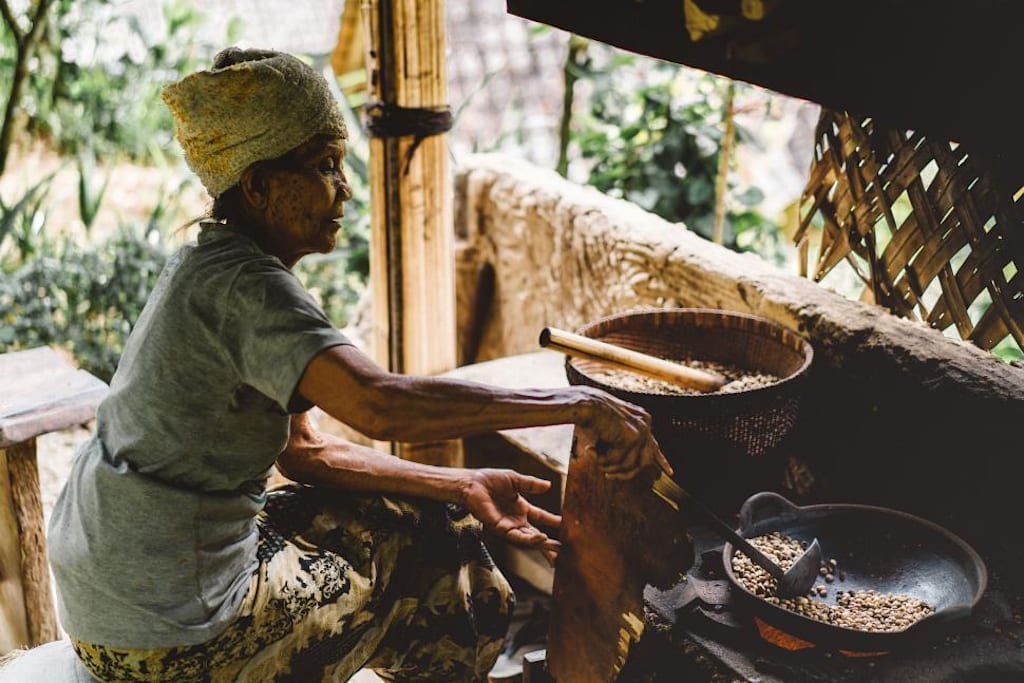
She didn't measure anything.
There were no macros, no calorie counts, no food scales on her counter. No subscription meal kits. No wellness app pinging her about her omega-3 ratio. She cooked by feel, by smell, by the wisdom passed down from her mother, who learned from hers, in an unbroken chain of kitchen knowledge that stretched back further than any of us can trace.
She threw turmeric into everything without knowing the word curcumin. She simmered bones for hours without having heard of collagen peptides. She fermented, she sprouted, she soaked her legumes overnight, she insisted on eating bitter greens that nobody else at the table wanted — not because a nutritionist told her to, but because some deep, inherited intelligence said: this is what a body needs.
You probably thought she was just old-fashioned. You probably smiled politely and ate what she put in front of you, maybe even rolled your eyes at some of the rituals. The warm milk with turmeric before bed. The bitter gourd she swore was good for your blood. The bone broth she ladled out at the first sign of illness. The way she insisted that food made with love tasted different — and healed differently — than food made any other way.
Here is what modern science has spent the last three decades and billions of research dollars discovering:
She was right. About almost all of it.
And the implications of that belated vindication — for how we eat, how we treat disease, and how catastrophically we abandoned the food wisdom of our ancestors in the name of modernity — are more profound than most people yet understand.
When We Traded the Kitchen for the Laboratory — and Lost Everything
To understand why your grandmother's food healed, you first have to understand what we replaced it with.
The second half of the twentieth century brought an extraordinary transformation in how human beings relate to food. Industrial food processing, the rise of convenience culture, the dismantling of multi-generational households, the entry of more women into the workforce without any restructuring of domestic labor — all of it converged to hollow out the kitchen. Cooking from scratch became a lifestyle choice rather than a cultural inheritance. The knowledge that grandmothers carried — which plants reduced inflammation, which cooking methods preserved nutrients, which combinations of ingredients created something greater than the sum of their parts — did not get written down. It got discarded.
Into that vacuum walked the food industry, with its fortified cereals and its low-fat promises and its engineered hyperpalatable products designed to satisfy without nourishing. And alongside it walked a nutritional science establishment that, for much of the twentieth century, reduced food to its component parts — vitamins, minerals, macronutrients — and largely dismissed the complex, synergistic, culturally embedded food traditions that had sustained human health for millennia.
The results of that exchange are visible in the chronic disease data of every Westernized nation on earth. Obesity, type 2 diabetes, cardiovascular disease, inflammatory bowel conditions, autoimmune disorders, metabolic syndrome — these are not ancient afflictions. They are, by and large, modern ones. They correlate, with uncomfortable precision, to the timeline of industrial food's displacement of traditional cooking.
Your grandmother didn't live in a nutritional paradise. She had her own hardships, her own deprivations, her own dietary limitations. But she cooked food that her body recognized, in ways that preserved its healing properties, according to a logic that modern science is only now beginning to fully decode.
The Turmeric She Used Every Day
Let's start here, because the story of turmeric and curcumin is perhaps the most emblematic case study in the science of traditional food wisdom.
For thousands of years, turmeric has been a staple of South Asian, Middle Eastern, and African cooking — and a cornerstone of Ayurvedic and traditional Chinese medicine. Grandmothers across those cultures prescribed it for joint pain, digestive trouble, skin conditions, respiratory illness, and wound healing. Western medicine, for most of its modern history, regarded these uses with polite skepticism.
Then researchers began studying curcumin — the primary bioactive compound in turmeric — and the results were remarkable enough to generate over 12,000 published studies in peer-reviewed journals. Curcumin is now understood to be one of the most potent natural anti-inflammatory compounds identified in any food substance. It inhibits NF-κB, a molecule that travels into the nuclei of cells and activates genes related to inflammation — the same molecular pathway implicated in heart disease, cancer, Alzheimer's disease, and a host of metabolic conditions.
Curcumin has demonstrated, in laboratory and clinical research, the ability to match the anti-inflammatory efficacy of some pharmaceutical drugs — without the side effect profiles. Studies have shown meaningful benefits for osteoarthritis pain, inflammatory bowel disease, depression, and metabolic syndrome markers. Research published in the American Journal of Geriatric Psychiatry found that curcumin supplementation significantly improved memory and attention in older adults and reduced brain amyloid and tau signals — proteins associated with Alzheimer's disease.
Your grandmother didn't know any of this. She just knew turmeric went in the milk when you were sick, in the curry when the joints ached, in the paste when the wound needed closing. She had clinical trial data. It was just stored in a different format: in practice, in memory, in love.
The Bone Broth She Made When You Were Ill
When your grandmother made bone broth — simmering joints, knuckles, and marrow bones for hours with vegetables and herbs — she was performing a kind of alchemy that modern nutritional biochemistry has now fully mapped.
The long, slow cooking of collagen-rich bones releases gelatin, which in the gut breaks down into specific amino acids — particularly glycine, proline, and hydroxyproline. These are the primary building blocks of the intestinal lining. Research in the field of gut health — which has exploded over the past twenty years into one of the most consequential areas of medical science — has established that the integrity of the gut lining is foundational to systemic health. A compromised gut lining, sometimes called "leaky gut," allows partially digested food particles and microbial compounds to cross into the bloodstream, triggering inflammatory cascades linked to autoimmune disease, depression, anxiety, metabolic dysfunction, and chronic fatigue.
Glycine, abundant in bone broth, is also essential for producing glutathione — the body's master antioxidant — and plays a critical role in regulating the nervous system, improving sleep quality, and reducing neuroinflammation. The cartilage in those simmered bones releases compounds like glucosamine and chondroitin, now sold in expensive supplement form to support joint health, at a fraction of the cost and in a food matrix that the body recognizes and absorbs far more efficiently than an isolated pill.
She didn't know the words for any of this. But when you were sick, she made broth. And you got better.
The Fermented Foods Nobody at the Table Understood But Her
Across almost every traditional food culture on earth — Korean kimchi, German sauerkraut, Indian idli and dosa batter, West African fermented locust beans, Eastern European kefir, Japanese miso and natto, Ethiopian injera — fermentation was a culinary constant. Grandmothers made it, served it in small quantities alongside meals, and insisted on it for digestion, for energy, for what they might have called "balance."
Modern gut microbiome science now understands exactly why.
The human gut hosts approximately 38 trillion microorganisms — bacteria, fungi, viruses — that collectively perform functions critical to immunity, metabolism, mental health, and systemic inflammation. The composition of that microbiome is shaped profoundly by what we eat. Fermented foods are dense with live beneficial bacteria — probiotics — that seed, diversify, and fortify the gut ecosystem. Research published in Cell in 2021 found that a diet high in fermented foods increased microbiome diversity and decreased markers of systemic inflammation more effectively than a high-fiber diet alone.
Microbiome diversity is now understood to be one of the strongest single predictors of long-term health outcomes. It is inversely correlated with obesity, type 2 diabetes, inflammatory bowel disease, cardiovascular disease, depression, and all-cause mortality. The people with the most diverse gut microbiomes, research consistently shows, are the healthiest. And the people eating the most diverse array of fermented, traditional, whole foods are the ones with the most diverse microbiomes.
Your grandmother's insistence on a spoonful of fermented something at every meal wasn't superstition. It was, we now know, one of the most evidence-based dietary practices a human being can perform.
The Bitter Greens She Ate That Nobody Else Wanted
Bitter foods have been progressively engineered out of the modern diet. Food manufacturers know that the human palate, given unlimited choice, gravitates toward sweet, salty, and fatty — and they have obliged that preference comprehensively. The result is a food supply stripped almost entirely of the bitter compounds that traditional diets — and traditional grandmothers — prioritized.
Those bitter compounds have a name: phytonutrients. Specifically, flavonoids, polyphenols, glucosinolates, and alkaloids — secondary metabolites that plants produce to defend themselves against insects, fungi, and UV radiation. When human beings consume these compounds, something remarkable happens: they activate pathways in our cells that mimic, at low intensity, the effect of mild stress — triggering repair mechanisms, antioxidant defenses, and anti-inflammatory responses that strengthen cellular resilience over time.
This phenomenon has a name: hormesis. It is the principle by which small doses of a stressor make biological systems stronger. The bitter compounds in dandelion greens, arugula, bitter gourd, fenugreek, neem, and the dozens of other bitter foods that traditional grandmothers included in their cooking are essentially cellular exercise — stressing the body gently into greater resilience.
Research links high dietary polyphenol intake to reduced risk of cardiovascular disease, neurodegenerative disease, several cancers, and metabolic syndrome. Cruciferous vegetables — broccoli, cauliflower, Brussels sprouts, kale — contain glucosinolates that activate the Nrf2 pathway, a master regulator of the body's antioxidant and detoxification systems. Quercetin, found in onions, apples, and capers — common in traditional cooking across many cultures — has demonstrated in research the ability to reduce systemic inflammation, improve blood pressure, and inhibit the replication of several viruses.
Your grandmother ate bitter things and lived long. That is not a coincidence.
What the Science Is Really Telling Us
Taken together, the research emerging from nutritional biochemistry, microbiome science, epigenetics, and chronic disease medicine is telling us something that should reorganize our entire relationship to food:
The most sophisticated nutritional technology in human history was not invented in a laboratory. It was developed over thousands of years of lived human experience, encoded in cultural food traditions, and transmitted through grandmothers.
Traditional diets — not any one of them, but the common principles they share: whole foods, fermented foods, bitter foods, slow-cooked foods, seasonal foods, diverse foods eaten in community — systematically address the biological mechanisms underlying modern chronic disease. They feed the microbiome. They manage inflammation. They support the gut lining. They deliver phytonutrients in bioavailable combinations that no supplement has yet replicated. They nourish the nervous system and regulate the stress response.
We abandoned this inheritance in a generation. We are now paying for that abandonment in chronic disease rates that are unprecedented in human history, in a supplement industry worth hundreds of billions of dollars trying to replicate in pill form what grandmothers put on the table every evening, in a nutritional science establishment slowly, humbly circling back to conclusions that traditional food cultures had already reached.
The Most Important Thing Her Kitchen Ever Taught You
There is one finding in the science of traditional food and healing that no supplement can bottle, no laboratory can synthesize, and no meal kit can deliver.
Research on food, stress, and health has consistently found that meals eaten in community — shared, unhurried, prepared with intention — are metabolized differently than meals eaten alone, quickly, in distraction. The social and emotional context of eating activates the parasympathetic nervous system, the rest-and-digest state that allows nutrient absorption to proceed efficiently. The stress of hurried, isolated eating does the opposite.
Your grandmother cooked for you. She fed you in a context saturated with belonging, with care, with the implicit message that you were worth the time it took to make something real. That was not incidental to the healing properties of her food. It was part of them.
Modern science is only beginning to quantify what she already knew: that nourishment is not just chemistry. It is relationship. It is memory. It is the act of one human being saying to another — I made this for you, with everything I know, because you matter.
That is why her food healed you.
And why nothing we have built since has quite managed to replace it.
About the Creator
Soibifaa
Public Health Practitioner | Cobbler | Content Creator ✨
Blending health, creativity & craftsmanship to inspire purposeful living and meaningful connections. Passionate about storytelling, people, and creating impact one step at a time.
Enjoyed the story? Support the Creator.
Subscribe for free to receive all their stories in your feed.
Comments
There are no comments for this story
Be the first to respond and start the conversation.