
The Brain May Be Organizing Itself Into Thought
A new theory argues that cognition isn't just wired into the brain — it may be assembled, moment by moment, by traveling electrical waves

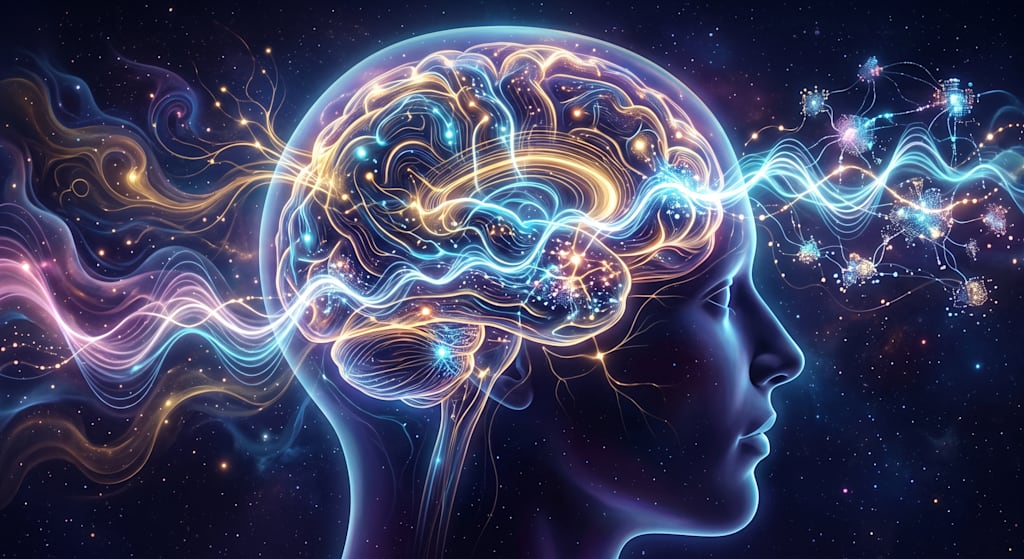
Right now, without any physical change to your brain, you are doing several incompatible things at once. You are reading these words in order, holding the beginning of this sentence in mind while you reach its end. Somewhere in the background, a memory from yesterday is available to you, uncalled but not forgotten. If a door slams in another room, your attention will dart there and then return, unassisted, to this paragraph. None of this required your brain to grow a single new connection. It happened with the same neurons, the same synapses, the same physical hardware you had an hour ago.
That should be strange. The standard way of picturing the brain — as a wiring diagram, a vast switchboard of neurons connected by synapses — explains how information could move along fixed pathways. It does not, by itself, explain how the brain decides, in a fraction of a second, which pathways matter right now, out of the millions available. The brain cannot depend on physically restructuring its synaptic architecture every time attention shifts or a new thought takes priority. Cognition can reorganize far faster than that.
A new theoretical paper from three neuroscientists at MIT's Picower Institute for Learning and Memory takes this mismatch seriously. Earl K. Miller, Scott L. Brincat, and Jefferson E. Roy argue, in a review published in The Journal of Neuroscience, that the brain's synaptic architecture is necessary but not sufficient to explain fast, flexible cognition. Something else has to be doing the organizing — and they propose that the something else is the brain's own electrical waves.
A brain with too many jobs per neuron
The starting point for the theory is a finding that has been building in neuroscience for well over a decade: individual neurons, especially in the prefrontal cortex, rarely do just one job. A single cell might respond to a certain color, but only when a certain rule is in effect, and only in combination with a particular remembered location — a tangle of conditions that shifts from moment to moment. Neuroscientists call this "mixed selectivity," and a landmark 2013 study by Mattia Rigotti, Miller, and colleagues showed that this apparent messiness is not a design flaw. Neurons with mixed selectivity give the brain access to far more possible combinations of information than neurons with single, clean assignments would allow, which is part of why the prefrontal cortex can support such open-ended behavior.
But there's a cost. If the same neurons are doing different jobs in different contexts, something has to determine, from one moment to the next, which job a given population of neurons is currently doing — otherwise you would get crosstalk, not cognition. The wiring diagram alone can't answer that question, because the wiring diagram doesn't change fast enough to keep up with a train of thought.
Waves as an organizing signal
This is where brain waves enter the story. Waves — the rhythmic, coordinated fluctuations of electrical activity produced when large groups of neurons fire in relation to one another — have been measured for close to a century, but their function has remained genuinely contested. Miller's lab has spent much of the last decade building a case that specific frequencies of these waves play specific organizing roles.
The picture that has emerged, based on recordings from the prefrontal cortex during working-memory tasks, is that slower rhythms in the alpha and beta range (roughly 10 to 30 cycles per second) tend to carry information about goals, rules, and the general shape of a task, while faster gamma-range oscillations are more closely tied to the moment-to-moment expression of sensory content — the actual stuff being remembered or perceived. A 2016 study from Miller's group, led by Mikael Lundqvist, found that gamma bursts accompany the encoding and recall of specific items held in working memory, while beta bursts reflect something more like a default, rule-governed state that gamma has to break through. Together, these patterns are consistent with a control-like relationship in which slower rhythms help establish conditions under which faster gamma activity expresses task-relevant content.
Cortex as a surface, not just a circuit
The next layer of the theory, called "spatial computing," proposes that these alpha/beta rhythms don't just vary over time — they also vary across the physical surface of the cortex, forming shifting spatial patterns that behave something like stencils. Where alpha/beta power is strong, sensory information expressed by neural spiking tends to be suppressed; where it's weak, spiking carrying that content is freer to occur. A large 2023 study led by Lundqvist, and a more recent empirical test led by Zhen Chen and published in Current Biology, recorded both spikes and local field potentials from the prefrontal cortex of monkeys performing several working-memory and categorization tasks. The predictions of spatial computing largely held up: alpha/beta patterns carried task rules, were organized into spatial patches that shifted with task demands, and predicted, on a trial-by-trial basis, whether the animal would perform correctly or make a mistake.
Crucially, these waves don't sit still. Other work from the lab has shown that they travel — sweeping across patches of cortex rather than switching on and off in unison everywhere at once — and that after a distraction, a rotating traveling wave appears to help steer ongoing neural activity back toward the state it was in before the interruption, with the completeness of that rotation predicting whether the animal recovers its train of thought or makes an error. Miller and his coauthors describe this combination of temporal and spatial control as "spatiotemporal computing": the brain using not just which neurons fire, and not just when, but where on the cortical surface, as an additional organizing dimension.
There is also a more mechanistic thread to the story. Work led by Dimitris Pinotsis and Miller has presented evidence consistent with ephaptic coupling — the possibility that electric fields generated by neural populations can influence nearby neuronal activity. In this view, waves may not simply be a readout of what neurons are doing; they may also help shape what neurons do next, suggesting a loop between spiking and field rather than a one-way relationship.
What "analog computation" is actually claiming
It's tempting to reach here for a computer metaphor, and the researchers do invoke one, carefully. A digital computer solves problems by stepping sequentially through discrete logical operations. The theory Miller, Brincat, and Roy propose suggests that the brain does at least part of its work differently: when traveling waves of different frequencies and origins overlap on the cortical surface, they can add, subtract, and interfere with one another the way physical waves do — a continuous, parallel process rather than a sequence of on/off switches. That interference pattern, the theory holds, is itself doing computational work, shaping which neural populations become active where and when.
This is not a claim that synapses or spiking are unimportant. The authors are explicit that synaptic connections store the brain's representations — the raw material of memories, categories, and learned associations. The proposal is narrower and, in a sense, more structural: synapses may supply the content, while wave dynamics help determine which of that content is active and coordinated at a given instant. Put differently, the wiring diagram may be more like a library than a set of instructions, and the waves may be closer to whatever it is that decides which books get pulled off the shelf right now.
Consciousness and the anesthesia clue
The paper's most ambitious claim extends this idea from cognition to consciousness itself. Miller and his coauthors propose that consciousness emerges when wave dynamics succeed in bringing the cortex into an organized, globally integrated state — one where activity in far-flung regions becomes linked rather than isolated. This is a hypothesis about a necessary condition for unified awareness, not a claim to have located or defined consciousness itself.
The most concrete evidence offered in its support comes from studies of general anesthesia conducted by Miller with Emery N. Brown, an anesthesiologist and Institute Professor at MIT. Propofol, ketamine, and dexmedetomidine act on entirely different molecular targets in the brain — one boosts a major inhibitory neurotransmitter system, another blocks a specific excitatory receptor, a third acts on receptors involved in arousal and sleep. A 2026 study from the Miller and Ila Fiete labs, led by Adam Eisen, found that despite these different mechanisms, all three drugs produced a strikingly similar disruption of the brain's dynamic stability — its capacity to absorb a perturbation and settle back to a normal operating range — as animals lost consciousness. A related study found another form of convergence: ketamine and dexmedetomidine altered cortical phase relationships in similar ways, decreasing phase alignment between neighboring prefrontal areas while increasing alignment between corresponding regions across the two hemispheres.
The interesting inference here is not that any one drug proves anything about consciousness. It's that convergence itself is informative: if chemically distinct drugs acting on different molecular targets nevertheless converge on disruptions of large-scale neural dynamics during anesthetic-induced unconsciousness, that pattern points toward the organization of activity — rather than any particular molecular target — as the more relevant variable. It is an argument by convergent evidence, not a demonstration of mechanism.
It's worth being precise about what this evidence does not show. It does not show where consciousness "lives," what consciousness fundamentally is, or that electric fields have been proven to generate subjective experience. It does not resolve the philosophical puzzle, often called the hard problem, of why any physical process should be accompanied by felt experience at all. Losing consciousness alongside a disruption in wave organization is consistent with wave organization mattering to consciousness; it is not proof that wave organization produces it.
A theory that says so itself
To their credit, the paper's authors are unusually direct about the limits of what they've shown. The central mechanism they propose — that interfering waves perform genuine analog computation, in the sense of transforming information through continuous physical interference rather than discrete operations — has not yet been directly demonstrated. It is, at this stage, an interpretation that organizes a large body of existing findings coherently, not a result with its own dedicated experiment behind it. Miller has said plainly that the next step for his lab is to go looking for direct signatures of analog computation within brain-wave patterns, treating the theory as something to be tested rather than something already confirmed.
That kind of honesty is worth sitting with, because it clarifies exactly what has and hasn't been established. What has been shown, across a substantial and growing body of experimental work, is that alpha/beta and gamma rhythms are associated with distinguishable kinds of information; that oscillatory activity can be organized across both space and time; that traveling-wave patterns occur across cortex; that evidence supports interactions between neural electric fields and neuronal activity; and that multiple anesthetics with different molecular mechanisms produce convergent changes in large-scale neural dynamics during anesthetic-induced unconsciousness. What remains theoretical is whether these dynamics constitute analog computation in the specific sense the authors propose — and whether such computation provides part of the mechanism underlying consciousness.
What follows from taking waves seriously
For the better part of a century, mapping the brain's wiring has understandably absorbed enormous scientific attention, and for good reason: the wiring is real, and it matters. What this theory adds is a question about what happens on top of that wiring — whether understanding cognition requires understanding not just which connections exist, but the fast-changing electrical patterns that move through them and determine, from one instant to the next, which connections are actually doing anything.
The possibility on offer, then, is not simply that the brain contains information. It may have to continually organize that information into something usable, over and over, thousands of times an hour, without ever pausing to rewire itself. And somewhere inside that ceaseless organizing — still unproven, still being tested — may lie part of an answer to why billions of separately firing neurons sometimes add up to something that feels, from the inside, like one thing: a thought, a decision, a memory, a moment of simply being aware.
References
Miller, E. K., Brincat, S. L., & Roy, J. E. (2026). Analog Cognition and Consciousness. The Journal of Neuroscience, 46(33), e0711262026. https://doi.org/10.1523/JNEUROSCI.0711-26.2026
Rigotti, M., Barak, O., Warden, M. R., Wang, X.-J., Daw, N. D., Miller, E. K., & Fusi, S. (2013). The importance of mixed selectivity in complex cognitive tasks. Nature, 497(7451), 585–590. https://doi.org/10.1038/nature12160
Lundqvist, M., Rose, J., Herman, P., Brincat, S. L., Buschman, T. J., & Miller, E. K. (2016). Gamma and beta bursts underlie working memory. Neuron, 90(1), 152–164. https://doi.org/10.1016/j.neuron.2016.02.028
Lundqvist, M., Brincat, S. L., Rose, J., Warden, M. R., Buschman, T. J., Miller, E. K., & Herman, P. (2023). Working memory control dynamics follow principles of spatial computing. Nature Communications, 14(1), 1429. https://doi.org/10.1038/s41467-023-36555-4
Chen, Z., Brincat, S. L., Lundqvist, M., Loonis, R. F., Warden, M. R., & Miller, E. K. (2026). Oscillatory control of cortical space as a computational dimension. Current Biology, 36(2), 402–414.e5. https://doi.org/10.1016/j.cub.2025.11.072
Batabyal, T., Brincat, S. L., Donoghue, J. A., Lundqvist, M., Mahnke, M. K., & Miller, E. K. (2025). State-space trajectories and traveling waves following distraction. Journal of Cognitive Neuroscience. https://doi.org/10.1162/JOCN.a.2410
Pinotsis, D. A., & Miller, E. K. (2023). In vivo ephaptic coupling allows memory network formation. Cerebral Cortex, 33(19), 10353–10365. https://doi.org/10.1093/cercor/bhad251
Pinotsis, D. A., & Miller, E. K. (2026). Ephaptic coupling can explain variability in neural activity. Cerebral Cortex, 36(6), bhag098. https://doi.org/10.1093/cercor/bhag098
Eisen, A. J., Bardon, A. G., Ballesteros, J. J., Bastos, A. M., Donoghue, J. A., Mahnke, M. K., Brincat, S. L., Roy, J. E., Ishizawa, Y., Brown, E. N., Fiete, I., & Miller, E. K. (2026). Similar destabilization of neural dynamics under different general anesthetics. Cell Reports, 45, 117048. https://doi.org/10.1016/j.celrep.2026.117048
Bardon, A. G., Ballesteros, J. J., Brincat, S. L., Roy, J. E., Mahnke, M. K., Ishizawa, Y., Brown, E. N., & Miller, E. K. (2025). Convergent effects of different anesthetics on changes in phase alignment of cortical oscillations. Cell Reports, 44, 115685. https://doi.org/10.1016/j.celrep.2025.115685
Eisen, A. J., Kozachkov, L., Bastos, A. M., Donoghue, J. A., Mahnke, M. K., Brincat, S. L., Chandra, S., Tauber, J., Brown, E. N., Fiete, I., & Miller, E. K. (2024). Propofol anesthesia destabilizes neural dynamics across cortex. Neuron, 112(16), 2799–2813.e9. https://doi.org/10.1016/j.neuron.2024.06.011
About the Creator
Khali Sollis
Khali Sollis is a writer and independent researcher exploring the science of the human mind and behavior. Her work examines questions at the intersection of neuroscience, psychology, cognition, mental health, and everyday human experience.
Enjoyed the story? Support the Creator.
Subscribe for free to receive all their stories in your feed.
Comments
There are no comments for this story
Be the first to respond and start the conversation.