
The 3 AM Trial: When Your Brain Becomes the Judge, Jury, and Prosecutor
Why our minds reopen old cases in the middle of the night, and what psychology says about the midnight inner critic

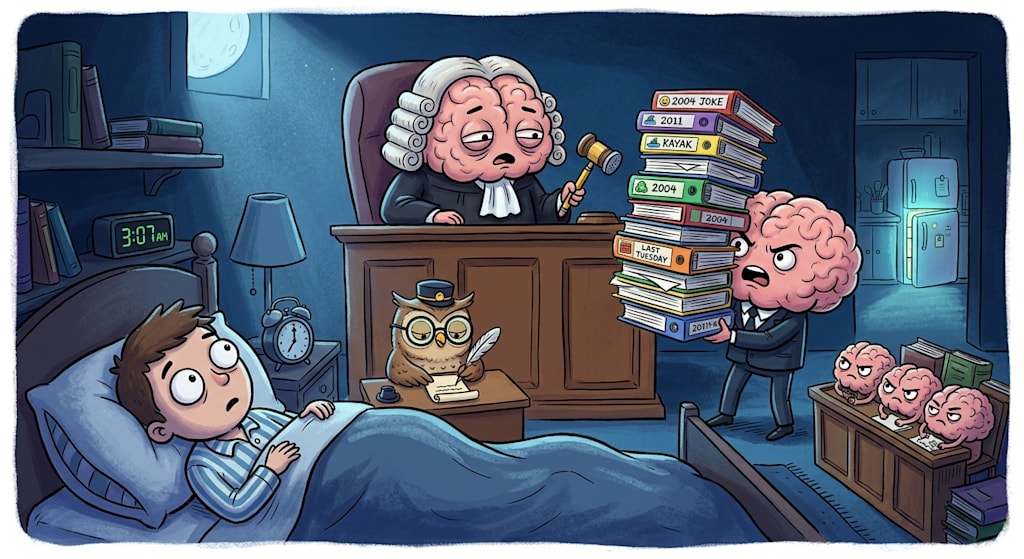
Court Is Now in Session. It Is 3:07 AM
You wake up for no reason. The room is dark, the house is silent, and somewhere in the kitchen the refrigerator hums with the serenity of an appliance that has never once embarrassed itself at a party.
No problem, you think. Back to sleep in two minutes.
Then someone bangs a gavel.
“All rise.”
You do not rise. You are horizontal. The clerk reads the docket anyway.
Item one: a party in 2004, where you told a joke, received total silence, and then explained the joke. Twice. Slower the second time.
Item two: 2011, when you dated someone mostly because they owned a kayak.
Item three: a job interview in which you were asked where you saw yourself in five years, and you said, “Honestly? Here,” and pointed at the chair.
Item four: last Tuesday, when the cashier said, “Have a great day,” and you replied, “I will.” The prosecution intends to argue that this was arrogant.
Items five through 412 concern events that no other living person remembers.
“Objection,” you whisper. “None of this is relevant.”
“Overruled.”
“Can I at least go back to sleep?”
“The defendant will remain conscious for the duration of these proceedings.”
The prosecutor approaches with a binder roughly the size of a microwave. Four hundred pages, color-coded by decade. You look around for your defense attorney. Nobody. Apparently, they’re asleep. Must be nice.
If you’re nodding right now, congratulations: your brain runs this court too.
Why Does the Brain Schedule Its Worst Meetings at Night?
No competent manager books a performance review at 3 AM. Your brain does it anyway, without sending an agenda.
In 2022, sleep researchers Andrew Tubbs, Elizabeth Klerman, and colleagues published a short review with a title worthy of a late-night horror film: “The Mind After Midnight.” Their argument is that circadian rhythms tune the human brain to be asleep during the biological night. Stay awake through it, and your mind may be working the graveyard shift.
The research they reviewed suggests that circadian timing shapes how we feel. On average, positive mood tends to dip during the biological night, roughly 1 to 4 AM for typical sleepers, while negative feelings become more prominent. Sleep loss and nighttime circadian timing have both been linked to weaker emotion regulation and reduced cognitive control, the mental machinery that ordinarily says, “Let’s not catastrophize.” The authors propose that when these changes overlap, attention can narrow toward the negative, and thinking can turn ruminative and self-focused.
Now the fine print, which matters. The Mind After Midnight is a hypothesis, a framework for future research, and the authors say plainly that every part of it still needs testing. Much of the supporting evidence comes from sleep-deprivation studies, not from people who simply woke up at 3 AM. The mood patterns are averages across studies, not a forecast for every person staring at the ceiling tonight. Nobody is claiming your prefrontal cortex clocks out at midnight like a disgruntled employee. Circadian timing, accumulated sleep loss, stress, and individual differences all interact.
And waking up in the night is not a diagnosis. It’s Tuesday.
Still, the picture is useful: at 3 AM, the colleague in charge of perspective is exhausted, and the colleague in charge of alarm bells has the floor.
The Cow Inside Your Head
The psychological term for this nighttime replay is rumination, from the Latin ruminare: to chew over again.
Cows deserve credit here. A cow swallows grass, sends it to a multi-chambered stomach, brings it back up as cud, and chews it again. After hours of patient re-chewing, the cow extracts nutrients from food most animals couldn’t digest at all.
Humans tried the same technique on emotions.
You spend two hours re-chewing a conversation from 1998, and what do you extract? Nothing. Except, perhaps, the realization that it’s now 5 AM.
The cow has a digestive system. You have a standing committee.
In 2008, psychologists Susan Nolen-Hoeksema, Blair Wisco, and Sonja Lyubomirsky reviewed the research on rumination, and their findings are not flattering to the committee. Rumination, which means dwelling repeatedly on distress along with its causes and consequences, tends to deepen negative thinking, weaken problem-solving, make it harder to act, and wear down social support. The cruel trick: rumination has the posture of problem-solving without the results.
That doesn’t make all repetitive thinking harmful. Psychologist Edward Watkins reviewed evidence that going over things repeatedly can be constructive, helping people plan ahead and recover from upsetting events, or unconstructive. One key difference is the level of the thinking. Abstract questions like “Why am I like this?” tend to loop. Concrete ones like “What happened, and what would I do differently next time?” tend to lead somewhere.
Also, the cow eventually swallows. That’s the step we keep skipping.
Why Does the Brain Keep Receipts?
Your brain cannot tell you where you put your car keys fifteen minutes ago.
But it can retrieve a single awkward sentence from a dinner party seventeen years ago, in high definition, with facial expressions, lighting, and a director’s commentary track.
This is less a malfunction than a feature with poor customer service. Memory researcher Daniel Schacter famously described “seven sins” of memory, and one of them is persistence: the unwanted return of memories we’d prefer to forget, especially emotionally charged ones. Schacter argues that these sins are side effects of a system that is mostly doing its job. A memory that flags painful moments is, in principle, trying to keep you from repeating them.
The catch is that vivid is not the same as accurate. Memory is constructive: each time you recall an event, you rebuild it, and the rebuild can be shaped by how you feel right now. That doesn’t make every embarrassing memory a fabrication. But rumination research suggests that dwelling on things in a low mood tends to make negative memories easier to reach.
So on a bad night, the 3 AM archivist may not be screening the original footage. It can feel more like a remastered edition: darker color grading, ominous soundtrack, and an audience reaction that, in all likelihood, nobody at that dinner party actually had. Most of them were thinking about dessert.
The Secret Society of People Who Thought They Were the Only Ones
This essay started with an Instagram video about nighttime self-criticism. The video was funny. The comments were something else: a long, scrolling chorus of strangers saying some version of “Wait. I thought I was the only one.”
Stranger after stranger, each privately certain that they alone host a midnight tribunal.
We compare our private insides to other people’s public outsides. You see your coworker’s composed face at the 9 AM meeting. You don’t see their docket from six hours earlier.
Research supports this blind spot. In a set of studies titled “Misery Has More Company Than People Think,” Alexander Jordan and colleagues found that people saw their negative emotions as more hidden than their positive ones, and underestimated how often their peers went through negative experiences. Those who underestimated others’ struggles also tended to report more loneliness and more rumination, though that link was correlational. Psychologists call the broader pattern pluralistic ignorance: everyone hides the same thing, so everyone concludes they’re unusual.
A comment section isn’t scientific data, of course. But the pattern fits.
So consider this your official notice: you are not the only one. You belong to an enormous secret society that meets every night, separately, in the dark.
How to Fire Your Brain’s Nighttime Prosecutor
The obvious move is to file a complaint with Human Resources.
Unfortunately, your brain also runs HR. Your complaint has been received, reviewed, and scheduled for a hearing at 3:45 AM.
A better strategy starts with psychologist Allison Harvey’s 2002 cognitive model of insomnia. Harvey proposed that worrying about sleep, and about how wrecked you’ll be tomorrow, drives up arousal and distress. That anxious state pulls attention toward threats like the glowing clock, which leads you to overestimate how badly you’re sleeping, which fuels more worry. Before long, the trial about your past has spawned a second trial about your sleep.
So the first motion is simple: stop checking the clock. Nothing on it will help your case.
Next, ask whether a thought is reflection or rumination. Is it heading toward a concrete next step, or just circling? If it’s actionable, write it down in one line on a notepad by the bed and close the notebook. The matter has been entered into the record. If it isn’t actionable tonight, it doesn’t need an emergency hearing. The prosecutor can wait until morning.
It also helps to treat 3 AM thoughts as testimony, not verdicts. “Noted. The court will review this in daylight.” Complex problems deserve your full staff, and your full staff clocks in after breakfast.
Cognitive behavioral therapy for insomnia, or CBT-I, turns ideas like these into structured techniques. One of them, stimulus control, is for the moment when you can’t get back to sleep and frustration starts building: leave the bed for a while, do something quiet in dim light, and return when sleepiness does. The goal is for your bed to stay associated with sleep rather than litigation.
And when the prosecutor gets loud, try curiosity instead of agreement. “Interesting. Why this case? Why tonight?” Curiosity is surprisingly hard to cross-examine.
None of this guarantees an uninterrupted night, and brief awakenings are a normal part of sleep. But persistent sleep disruption can have many causes, including stress, pain, medications, breathing problems, and mood changes, and it’s worth raising with a doctor or sleep specialist.
Closing Argument
Viewed generously, the prosecutor isn’t a villain. It’s an overzealous employee trying to keep you safe: flagging old mistakes so you won’t repeat them, scanning the past for threats.
But remembering a mistake is not the same as serving a sentence for it. Learning from 2004 requires one review, not four hundred hearings.
American courts generally won’t try a person twice for the same offense. Your brain has tried you for the kayak at least sixty times.
So the next time the gavel comes down at 3:07, try a different plea. Not guilty. Not innocent. Just: “Your Honor, this case was closed years ago.”
Then roll over. The prosecution can file its paperwork in the morning.
It never does.
References and Further Reading
Harvey, A. G. (2002). A cognitive model of insomnia. Behaviour Research and Therapy, 40(8), 869–893. https://doi.org/10.1016/S0005-7967(01)00061-4
Jordan, A. H., Monin, B., Dweck, C. S., Lovett, B. J., John, O. P., & Gross, J. J. (2011). Misery has more company than people think: Underestimating the prevalence of others’ negative emotions. Personality and Social Psychology Bulletin, 37(1), 120–135. https://doi.org/10.1177/0146167210390822
Nolen-Hoeksema, S., Wisco, B. E., & Lyubomirsky, S. (2008). Rethinking rumination. Perspectives on Psychological Science, 3(5), 400–424. https://doi.org/10.1111/j.1745-6924.2008.00088.x
Schacter, D. L. (1999). The seven sins of memory: Insights from psychology and cognitive neuroscience. American Psychologist, 54(3), 182–203. https://doi.org/10.1037/0003-066X.54.3.182
Tubbs, A. S., Fernandez, F.-X., Grandner, M. A., Perlis, M. L., & Klerman, E. B. (2022). The Mind After Midnight: Nocturnal wakefulness, behavioral dysregulation, and psychopathology. Frontiers in Network Physiology, 1, 830338. https://doi.org/10.3389/fnetp.2021.830338
Watkins, E. R. (2008). Constructive and unconstructive repetitive thought. Psychological Bulletin, 134(2), 163–206. https://doi.org/10.1037/0033-2909.134.2.163
About the Creator
Khali Sollis
Khali Sollis is a writer and independent researcher exploring the science of the human mind and behavior. Her work examines questions at the intersection of neuroscience, psychology, cognition, mental health, and everyday human experience.
Enjoyed the story? Support the Creator.
Subscribe for free to receive all their stories in your feed.
Comments
There are no comments for this story
Be the first to respond and start the conversation.