
Sixteen Years After Scientists Warned About Endocrine Disruptors in Plastic Bottles, What Does the Evidence Actually Say?
What sixteen years of research confirmed, complicated, and failed to prove

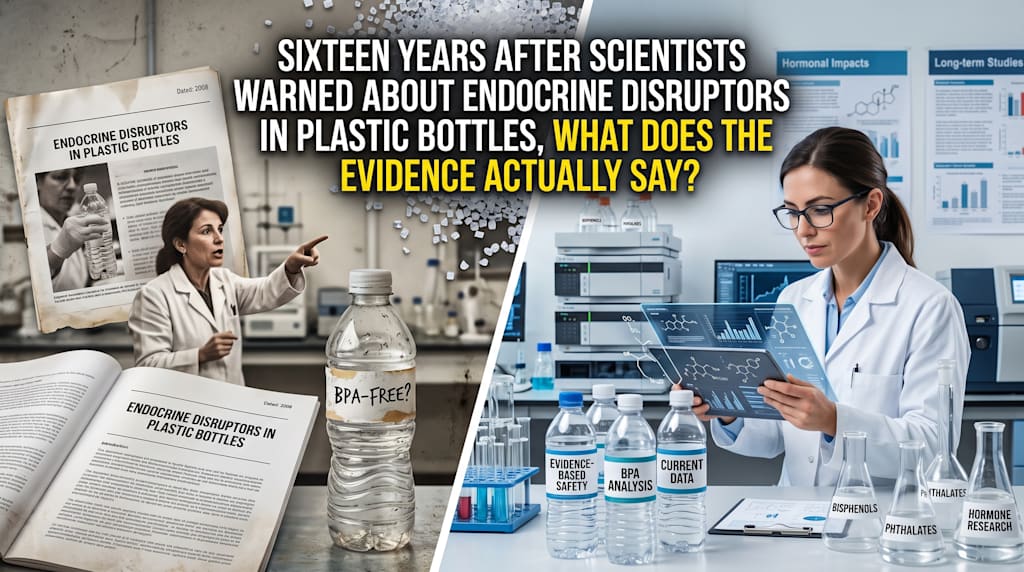
In 2010, a physician named Leonard Sax published a two-page commentary in a peer-reviewed environmental health journal, and it has been quietly fueling water-bottle anxiety ever since. The paper, "Polyethylene Terephthalate May Yield Endocrine Disruptors," didn't report an experiment. Sax ran no lab work of his own. What he did was lay out a hypothesis: that PET — the clear, lightweight plastic used in most disposable water bottles — might leach chemicals capable of interfering with the body's hormones. He pointed to a handful of early studies on phthalates and antimony, cited a striking 2009 finding on mud snails, and closed with a sentence that got left behind as the idea spread: "More research is needed."
Sixteen years is a long time in science. It's long enough for a hypothesis to be tested, argued over, replicated, contradicted, and specified into something much more precise than its original form — and that is roughly what happened here. The honest answer to "was Sax right?" is neither yes nor no. It's: about one thing, largely; about another, not really; and about a third, nobody has settled it yet, including researchers actively working on it in 2025.
What Sax Actually Said — and What He Didn't
It's worth being precise about this, because the commentary gets flattened in retelling. Sax cited earlier detections of phthalates and antimony in PET-bottled water, and a 2009 study by Martin Wagner and Jörg Oehlmann showing that water stored in PET bottles caused a sensitive freshwater snail, Potamopyrgus antipodarum, to produce more embryos than water stored in glass — a sign, potentially, of estrogenic activity. From this, Sax inferred that PET containers might be leaching endocrine-disrupting chemicals into consumer products, that heat and storage time might make it worse, and that this deserved investigation. He was explicit that the mechanism was unclear — including, notably, whether any phthalates detected in PET-bottled products were coming from the PET itself.
That last hedge turned out to matter more than anything else in the paper.
The Industry Rebuttal, and the Point Sax Actually Conceded
A few weeks after publication, Ralph Vasami, writing on behalf of the North American PET Resin Association, published a rebuttal. His argument was narrow and, it turns out, correct: phthalate ester plasticizers are not used in the manufacture of PET. PET is a polyester made from terephthalic acid and ethylene glycol — chemically unrelated to phthalates, which are a class of plasticizers used mainly in PVC, the flexible plastic in things like vinyl tubing and shower curtains. It is not chemically plausible, Vasami wrote, for PET to produce phthalate esters.
Sax's reply is where the actual scientific position landed, and it's more careful than either "Sax was right" or "Sax was debunked" gives him credit for. He agreed with Vasami on the chemistry: "I never suggested," he wrote, "that virgin PET gives rise to phthalate esters via degradation of PET itself." What he'd cited were detections of phthalates in the contents of PET bottles — and he floated several non-PET explanations: contamination from recycled PET feedstock, sorption from other phthalate-containing products bottled in PET (like shampoo), or leaching from caps and liners made of other plastics.
Sixteen years of subsequent chemistry has landed almost exactly where that exchange left off. A 2012 review in Water Research and a 2013 experimental study — PET bottles held at 40, 50, and 60°C — both found the same thing: no phthalates in the water, "in accordance with the chemical formulations specified for PET bottles." When phthalates do turn up in things sold in PET containers, the literature traces it to contamination pathways, not to the polymer.
This is one of the article's central findings, and an underreported one: the phthalate question survived, but not as a simple story of PET producing phthalates. Ortho-phthalates are not constituents or degradation products of virgin PET. When they are detected in products sold in PET containers, the evidence points instead toward contamination elsewhere in the packaging, processing, or recycling chain.
What Did Hold Up: Antimony, and Why Heat Matters (But Not the Way You've Heard)
Antimony is a different story. It's used as a catalyst in PET manufacturing and remains in the finished bottle wall in trace amounts — and unlike phthalates, it does measurably migrate into bottled contents. A 2008 study out of Arizona State University found antimony rising over six months of room-temperature storage; a separate 2007 study found the same thing, with striking brand-to-brand variation — one bottle brand tested in Hong Kong versus Europe showed roughly a two-fold difference in starting concentration. Heat accelerates the migration. A 2023 Spanish study examining the factors that govern antimony migration found that storage at elevated temperatures for extended periods could push antimony concentrations past EU and US regulatory limits — but described the process as a genuine "puzzle," heavily dependent on the specific bottle, beverage matrix, and duration, not a clean, universal function of heat alone.
Which brings us to one claim the evidence does allow us to reject outright: the idea, repeated in a viral video that seems to be the proximate cause of a lot of renewed interest in this topic, that leaving a water bottle somewhere above 110°F (43°C) triggers sudden, meaningful chemical leaching. There is no primary source for this. Migration studies show a continuous relationship between temperature, time, and concentration — more heat, more time, more migration — not a threshold or a switch. The 110°F figure appears to be an informal extrapolation from experiments that used far more extreme conditions (up to 60°C, sustained for days or weeks) than a bottle briefly sitting in a hot car. At typical room-temperature storage, antimony levels generally stay well below the WHO's drinking-water guideline of 20 micrograms per liter and the EU's food-contact migration limit of 40 micrograms per kilogram. Under sustained heat over long periods, some — not all — studies find levels approaching or exceeding those limits. That's a real finding. It is not the same as the video's claim.
The Question Nobody Has Actually Settled: Does PET Water Show Estrogenic Activity?
Here is where the article has to resist the temptation to pick a winner, because the scientific record genuinely hasn't picked one.
Wagner and Oehlmann's 2009 mud-snail finding wasn't a one-off; they followed it with a 2011 study using a different assay (the E-Screen, a standard human-cell estrogen bioassay) and found estrogenic activity again. But there's a wrinkle even inside their own original paper that rarely makes it into summaries: the estrogenic signal showed up in both PET and glass-bottled water in their German sample — 78% of PET brands, but also 33% of glass brands — which raises the possibility that at least some of what they were detecting traces to the source water or the bottling process generally, not the PET material specifically.
Meanwhile, other well-designed studies have found nothing. A 2013 French study exposed PET-bottled water to sustained heat (40–60°C) and ran it through genotoxicity and hormone-receptor bioassays specifically designed to catch estrogenic or anti-androgenic activity. The result: no cytotoxic, genotoxic, or endocrine-disrupting activity detected, even under thermal stress. Other labs using other extraction methods have landed on similarly negative results. A review surveying this literature noted plainly that some study clusters find nothing while others — Wagner and Oehlmann among them — find activity "some at very high levels," and that the authors of the positive findings have themselves acknowledged how sensitive the results are to methodology.
That's not a controversy waiting to be resolved by better journalism. It's an unresolved methodological disagreement: different assays, different extraction protocols, and possibly different background contamination in different water sources are producing genuinely different answers from serious labs. The honest sentence here is not "PET bottled water has been shown to contain estrogenic compounds," and it's not "PET bottled water has been shown to be free of them." It's that the question remains open, and anyone telling you otherwise — in either direction — is overstating the record.
The Bigger Picture: Phthalates, Just Not From PET
Step back from PET specifically, and there's a much stronger, much better-replicated body of evidence linking phthalate exposure in general to male reproductive health. A 2018 systematic review from EPA and academic researchers, examining human epidemiological studies going back decades, found "robust evidence" linking exposure to two specific phthalates — DEHP and DBP — to altered semen parameters and lower testosterone in adult men. This is one of the more solid findings in the whole endocrine-disruptor literature.
But DEHP and DBP are PVC plasticizers, not PET constituents. This is the same distinction that ran through the Sax-Vasami exchange sixteen years earlier, and it's worth being blunt about it now: this evidence is real, and it says essentially nothing about drinking from a PET water bottle. It says something about flexible vinyl products, certain cosmetics, and other sources of phthalate exposure that have nothing to do with the bottle in your bag.
Has Testosterone Actually Declined? In Some Populations, Yes — and Obesity Doesn't Explain It All
A well-cited 2007 study tracking men in Massachusetts over roughly two decades found testosterone levels dropping about 1.2% per year — a decline steeper than aging alone would predict, and one the researchers explicitly said they could not fully explain through known confounders like obesity or smoking.
That's genuinely interesting, and here's a wrinkle worth flagging because it gets misused: a separate 2013 study, using two decades of data on US Air Force veterans, is frequently cited as evidence that rising obesity explains the testosterone decline. It's the opposite. That paper's own authors write that they "exclude increasing obesity as a sufficient or primary explanation" — because even men who held their weight steady or lost weight over the study period showed comparable testosterone declines to those who gained. The secular decline in testosterone appears to be real, in at least some cohorts. Its cause is not resolved. Endocrine-disrupting chemicals, as a broad category, remain a plausible contributing factor among several competing explanations — but no study in this evidence base isolates PET or bottled water as a driver.
Sperm Counts: The Debate Currently Happening in Real Time
This is the most current, least settled piece of the whole story, and it deserves to stay unsettled in this article rather than get resolved for narrative convenience.
In 2017, and again in an updated 2023 analysis, a team led by Hagai Levine published large meta-regression analyses concluding that sperm concentration among men in North America, Europe, and Australia had declined substantially since the 1970s — with, in the 2023 update, no sign of the decline leveling off. These are the studies public figures have cited when claiming sperm counts have collapsed.
Then, in a 2024/2025 paper in Fertility and Sterility, a different research team — led by Kieran Lewis, spanning Ohio and Texas institutions — ran a systematic review focused specifically on fertile American men: 58 studies, nearly 12,000 men, 1970 to 2023. Their finding: no statistically significant decline in sperm concentration once you account for US region. A modest decline only reached statistical significance in a model that adjusted for both region and fertility status simultaneously — a much narrower, more conditional result than "sperm counts are falling."
There's also a methodological critique worth naming — not a third competing trend estimate, but a challenge to how the trend estimates themselves should be read — from a Harvard-based research group led by Marion Boulicault, arguing that sperm count varies naturally across a wide, largely non-pathological range, and that the Levine-style meta-regressions may be reading too much clinical significance into population-level statistical trends.
It's worth being precise about what this disagreement is and isn't. Levine's team looked at global data; Lewis's team looked specifically at fertile American men — not identical populations, so this isn't a clean head-to-head contradiction. But taken together, these findings leave considerably more scientific uncertainty than the familiar "sperm counts are collapsing" headline suggests. That's a more interesting story than picking whichever finding fits a pre-existing narrative — because it's a live example of exactly what science does over sixteen years: not settle everything, but get more precise about what remains unsettled and why.
Puberty, Wildlife, and Two Pieces of Real Evidence That Don't Belong to PET
Two more findings round out the picture, and both are worth including for what they actually show — which is not what they're often used to imply.
Girls are reaching puberty earlier. A 2020 meta-analysis in JAMA Pediatrics, pooling 38 studies across four decades, found the average age of breast development dropping by about three months per decade since 1977. That's a real, well-documented trend. The leading explanations in the literature are childhood obesity and nutritional transition; endocrine-disrupting chemicals as a broad class are discussed as a plausible contributor, not a demonstrated primary cause — and nothing in this literature isolates PET specifically.
And there's the landmark 2007 Canadian whole-lake experiment showing that a synthetic estrogen, added to a real lake at concentrations of just 5–6 nanograms per liter over seven years, drove a wild fish population to near-collapse. It's one of the most rigorous demonstrations that trace-level endocrine disruption is not a laboratory abstraction — it can restructure an ecosystem. But the chemical in question was 17α-ethynylestradiol, the synthetic estrogen in oral contraceptives, entering the lake through municipal wastewater. It has no chemical or mechanistic relationship to PET, antimony, or phthalates. It belongs in this story only as proof that low-dose endocrine disruption is a real phenomenon worth taking seriously in general — not as evidence about plastic bottles specifically.
Where Regulators Stand in 2026
The regulatory picture hasn't dramatically shifted, but it hasn't stood still either. In May 2026, the FDA released a scientific evaluation proposing to group four ortho-phthalates — DEHP, DCHP, DIOP, and DINP, all PVC-related plasticizers, not PET constituents — for a future cumulative risk assessment. It's a procedural step, not a ban, and it arrives alongside FDA's own testing data showing phthalates are already largely absent from newer food-contact materials as manufacturers substitute them out. In the EU, the antimony migration limit for food-contact plastics remains 40 micrograms per kilogram, and a 2025 literature review commissioned under the EU's food-risk-assessment framework — more current than anything else in this space — continues to frame antimony exposure from packaging as low relative to regulatory thresholds under normal conditions, while flagging the same heat-and-duration sensitivity found throughout the migration literature.
So What Does the Evidence Actually Say?
Not what either side of the internet argument wants it to say.
Sax didn't invent a myth in 2010, and he wasn't vindicated, either. He asked a reasonable question whose mechanisms turned out to be more complicated than the original evidence could resolve. Ortho-phthalates are not products of PET resin — a distinction Sax himself explicitly made in his reply to industry criticism, and one subsequent chemistry has repeatedly confirmed. What did hold up is narrower and less dramatic: PET is not perfectly inert, antimony does migrate, and migration is heat- and time-dependent, without any evidence for the specific "sudden threshold" claims that circulate online. Whether PET-bottled water shows real biological estrogenic activity remains a genuinely open, contested question among serious labs using different methods — not a settled yes or a settled no. And the population-level trends people actually worry about — falling testosterone, falling sperm counts, earlier puberty — are real in some populations, contested in others, multi-causal where they are real, and not specifically pinned to PET or bottled water by any study in this evidence base.
Sixteen years did not turn Sax's warning into either a vindication or a debunking. It did something science often does instead: it made the question more specific. PET does release measurable chemicals, but the clearest case is antimony, not phthalates. Heat matters, but there is no magic temperature at which a bottle suddenly becomes hazardous. Phthalates matter to human reproductive health, but PET is not their demonstrated source. Estrogenic activity remains disputed. And population trends in testosterone, sperm concentration, and puberty cannot be traced back to bottled water by the evidence we have.
The question Sax asked in 2010 survived. The simple story built around it did not.
Selected References
Sax, L. "Polyethylene Terephthalate May Yield Endocrine Disruptors." Environmental Health Perspectives 118, no. 4 (2010): 445–448.
Vasami, R. "Polyethylene Terephthalate and Endocrine Disruptors," with author reply by Sax, L. Environmental Health Perspectives 118, no. 5 (2010): A196–197.
Bach, C., Dauchy, X., Chagnon, M.C., and Etienne, S. "Chemical Compounds and Toxicological Assessments of Drinking Water Stored in Polyethylene Terephthalate (PET) Bottles: A Source of Controversy Reviewed." Water Research 46, no. 3 (2012): 571–583.
Bach, C., Dauchy, X., Severin, I., Munoz, J.F., Etienne, S., and Chagnon, M.C. "Effect of Temperature on the Release of Intentionally and Non-Intentionally Added Substances from Polyethylene Terephthalate (PET) Bottles into Water." Food Chemistry 139, nos. 1–4 (2013): 672–680.
Carneado, S., López-Sánchez, J.F., and Sahuquillo, Á. "Antimony in Polyethylene Terephthalate-Bottled Beverages: The Migration Puzzle." Molecules 28, no. 20 (2023): 7166.
Wagner, M., and Oehlmann, J. "Endocrine Disruptors in Bottled Mineral Water: Total Estrogenic Burden and Migration from Plastic Bottles." Environmental Science and Pollution Research 16, no. 3 (2009): 278–286.
Wagner, M., and Oehlmann, J. "Endocrine Disruptors in Bottled Mineral Water: Estrogenic Activity in the E-Screen." Journal of Steroid Biochemistry and Molecular Biology 127, nos. 1–2 (2011): 128–135.
Radke, E.G., Braun, J.M., Meeker, J.D., and Cooper, G.S. "Phthalate Exposure and Male Reproductive Outcomes: A Systematic Review of the Human Epidemiological Evidence." Environment International 121, pt. 1 (2018): 764–793.
Travison, T.G., Araujo, A.B., O'Donnell, A.B., Kupelian, V., and McKinlay, J.B. "A Population-Level Decline in Serum Testosterone Levels in American Men." Journal of Clinical Endocrinology & Metabolism 92, no. 1 (2007): 196–202.
Mazur, A., Westerman, R., and Mueller, U. "Is Rising Obesity Causing a Secular (Age-Independent) Decline in Testosterone among American Men?" PLoS ONE 8, no. 10 (2013): e76178.
Levine, H., Jørgensen, N., Martino-Andrade, A., et al. "Temporal Trends in Sperm Count: A Systematic Review and Meta-Regression Analysis of Samples Collected Globally in the 20th and 21st Centuries." Human Reproduction Update 29, no. 2 (2023): 157–176.
Lewis, K., Cannarella, R., Liu, F., et al. "Sperm Concentration Remains Stable among Fertile American Men: A Systematic Review and Meta-Analysis." Fertility and Sterility 123, no. 1 (2025): 77–87.
Boulicault, M., Perret, M., Galka, J., et al. "The Future of Sperm: A Biovariability Framework for Understanding Global Sperm Count Trends." Human Fertility 25 (2021): 888–902.
Eckert-Lind, C., Busch, A.S., Petersen, J.H., et al. "Worldwide Secular Trends in Age at Pubertal Onset Assessed by Breast Development among Girls: A Systematic Review and Meta-Analysis." JAMA Pediatrics 174, no. 4 (2020): e195881.
Kidd, K.A., Blanchfield, P.J., Mills, K.H., et al. "Collapse of a Fish Population after Exposure to a Synthetic Estrogen." Proceedings of the National Academy of Sciences 104, no. 21 (2007): 8897–8901.
About the Creator
Khali Sollis
Khali Sollis is a writer and independent researcher exploring the science of the human mind and behavior. Her work examines questions at the intersection of neuroscience, psychology, cognition, mental health, and everyday human experience.
Enjoyed the story? Support the Creator.
Subscribe for free to receive all their stories in your feed.
Comments
There are no comments for this story
Be the first to respond and start the conversation.