
Situational Awareness: The Skill That Saves Lives
A practical guide to reading your environment, spotting danger early, and staying safe in a chaotic modern world.
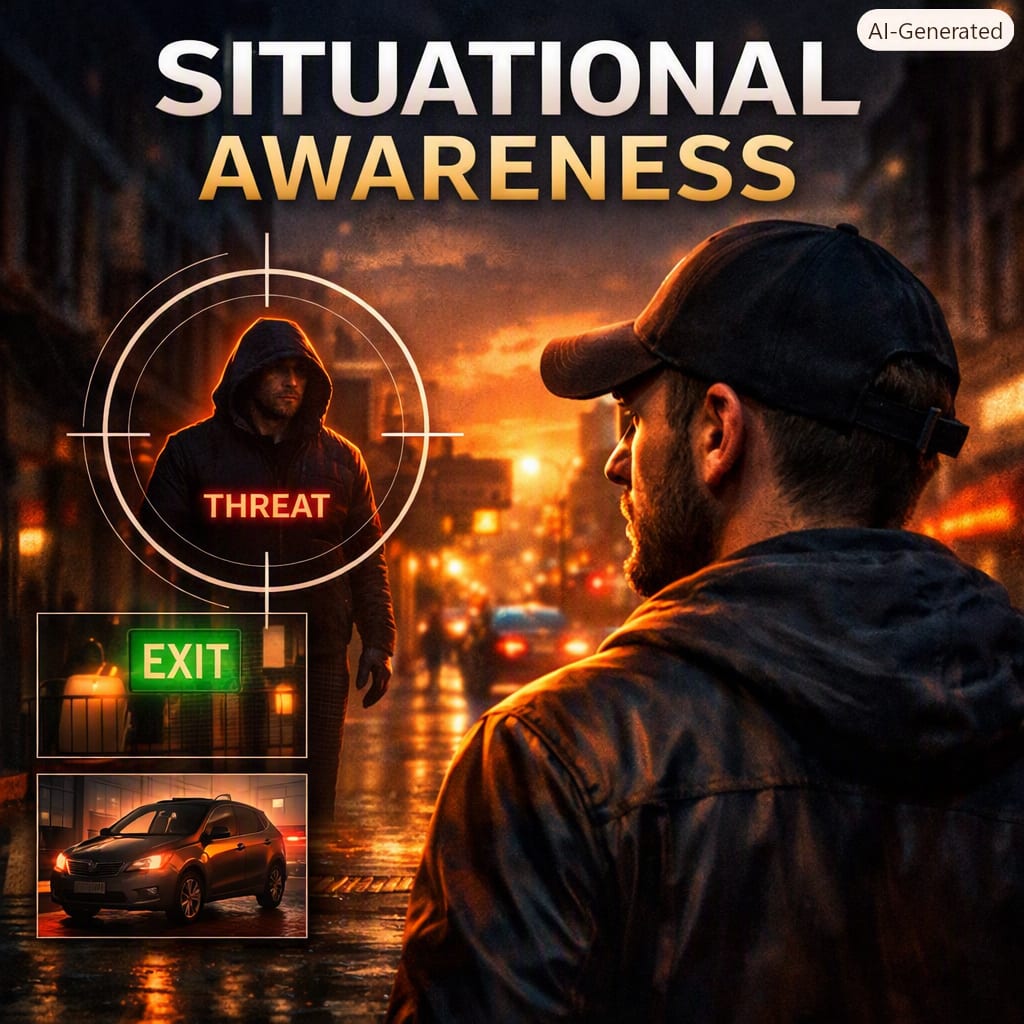
Introduction: The Danger You Never See
Most people imagine danger as something loud — a scream, a punch, a sudden explosion of violence.
But in reality, danger is usually quiet.
It approaches slowly, disguised as everyday life:
a stranger walking a little too close,
a car slowing down near you,
a shift in someone’s posture,
a shadow moving where it shouldn’t.
Most people never notice these signals.
Not because they’re careless or weak, but because they were never taught the one skill that separates survivors from victims:
Situational awareness — the ability to see danger before it becomes danger.
This article explores why situational awareness is the most important self‑defense skill you can develop, how predators choose their targets, and how you can train your mind to detect threats long before they reach you.
1. The Invisible Layer of Reality
Situational awareness isn’t paranoia or fear.
It’s clarity — the ability to see the world as it truly is.
Most people move through life in a mental fog: distracted, tired, stressed, focused on their phone, or lost in thought.
Predators rely on this fog. They don’t attack strong people — they attack unaware people.
Awareness cuts through that fog and brings your mind back into the present moment, where danger actually exists.
2. The Predator’s Checklist: How Attackers Choose Their Victims
Violent individuals don’t choose victims randomly.
They follow a psychological checklist, often without even realizing it.
They look for people who are distracted, isolated, predictable, hesitant, or visibly compliant.
Predators don’t want a fight — they want an easy target.
When you look alert, move with purpose, and scan your environment, you immediately become a high‑risk choice.
Most predators will avoid you.
3. The Three Levels of Awareness
Situational awareness exists on three levels:
Level 1: Unaware — distracted, mentally absent.
Level 2: Aware — present, observant, noticing details.
Level 3: Tactical Awareness — analyzing patterns, predicting behavior, identifying threats early.
You don’t need to live in Level 3.
Your goal is to stay in Level 2 and shift into Level 3 only when something feels off.
4. The 5‑Second Scan: Your New Habit
Awareness doesn’t require hours of training.
It requires one simple habit:
Every time you enter a new environment, perform a quick 5‑second scan.
Look for exits, unusual people, hidden hands, strange movement, and obstacles.
This tiny habit can save your life.
It’s the difference between being surprised and being prepared.
5. The Art of Reading Micro‑Behaviors
Predators reveal themselves through small, subtle signals — micro‑behaviors most people never notice.
Targeting glances, directional intent, hidden hands, pre‑attack posture, and sudden attempts to close distance are all early warnings.
If you learn to spot these cues, you can detect danger seconds before it happens.
And those seconds matter.
6. The Freeze Response: Your Biggest Enemy
When danger appears, most people freeze.
Not because they’re cowards, but because their brain is overwhelmed.
Situational awareness reduces freezing by giving your brain context.
If you already noticed the threat, the danger is no longer “sudden.”
Expected danger is easier to handle.
Unexpected danger causes panic.
Awareness is a psychological shield.
7. The Rule of Distance: Your Safety Bubble
Distance is life.
When a threat is far away, you have time, options, and clarity.
When a threat is close, you have panic, limited movement, and reduced reaction time.
Professionals call this the Reactionary Gap — the space you must protect.
If someone crosses it without reason, you act: reposition, create space, change direction, or leave.
Distance is the simplest form of self‑defense.
8. The Power of Positioning
Where you stand determines whether you survive.
Avoid corners.
Don’t let people circle behind you.
Stay on the edges in crowded areas.
Shift diagonally when someone approaches.
Positioning isn’t about fighting — it’s about not needing to fight.
9. The Awareness Loop: How Professionals Think
Elite protectors use a mental loop:
Observe → Orient → Decide → Act
This loop runs quietly in the background.
The more you practice noticing details, predicting behavior, and scanning hands, the faster your loop becomes.
Eventually, it becomes instinct.
10. Everyday Situations Where Awareness Saves Lives
Awareness isn’t just for dangerous streets.
It applies everywhere:
parking lots
public transport
ATMs
night walks
social interactions
driving
home security
Situational awareness is not a combat skill.
It’s a life skill.
11. Awareness Exercises You Can Start Today
Here are simple exercises to sharpen your awareness:
The Color Code (White, Yellow, Orange, Red)
The People Count
The Exit Game
The Hands Check
The Shadow Test
These exercises turn awareness into a habit.
12. The Truth: Awareness Is More Powerful Than Any Technique
Most people think self‑defense is about fighting.
It’s not.
It’s about not needing to fight.
Awareness prevents ambushes, robberies, assaults, manipulation, intimidation, and escalation.
It is the first line of defense — and the most important.
If you master situational awareness, you reduce your risk of violence dramatically.
Conclusion: Awareness Is the Skill That Saves Lives
Danger is real.
Violence is real.
But so is your ability to detect it before it reaches you.
Situational awareness is not paranoia.
It’s clarity, presence, and survival.
If you learn to see the world as it is — not as you hope it is — you become someone predators avoid.
Not because you’re strong, but because you’re aware.
If this article helped you see self‑defense differently, share it — someone you know might need it someday.
Internal Link (Vocal‑Friendly)
If you want to explore the psychology behind fast reactions and pre‑conflict awareness, you can read my related story:
The Silent Threat — Why Most People Lose a Fight Before It Even Begins
https://vocal.media/longevity/the-silent-threat-why-most-people-lose-a-fight-before-it-even-begins-and-how-to-stop-it
Cover image generated with AI.
About the Creator
abidi
I write about practical preparedness and everyday safety with a human, down‑to‑earth voice. More of my work here: https://linktr.ee/hnajet32
Enjoyed the story? Support the Creator.
Subscribe for free to receive all their stories in your feed.
Comments
There are no comments for this story
Be the first to respond and start the conversation.