
I Weighed Myself Before and After Pooping. The Scale Didn't Care.
A 90-gram explanation of rounding, water weight, and why a normal bathroom scale can ignore a perfectly normal bowel movement.
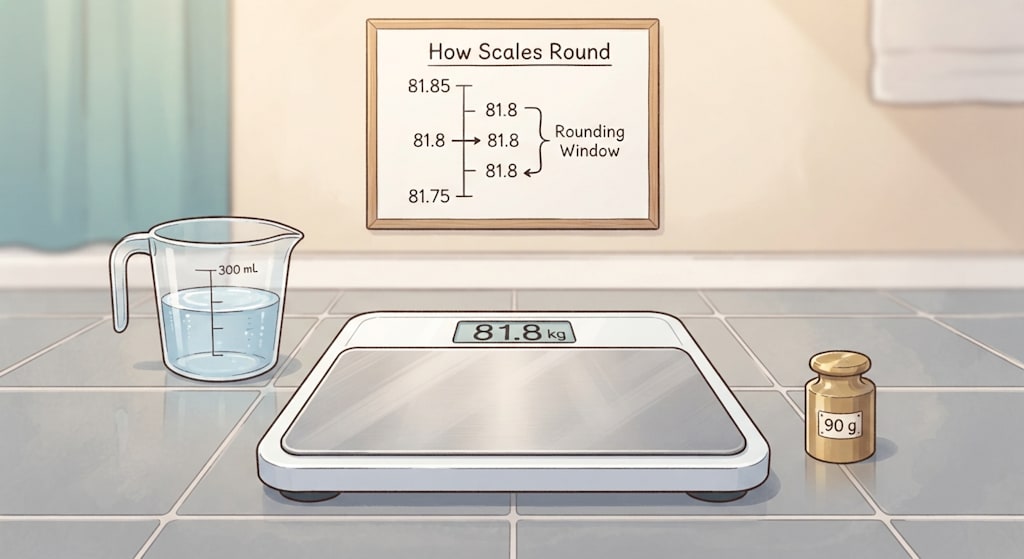
You step on the scale. You note the number. You do the thing. You step back on. The number is identical. For a second, your body feels like it has violated physics. It has not. The scale is not broken. Your bowel movement was not imaginary. The number did not move because the scale rounds, and your 90-gram contribution may have landed inside the same displayed tenth of a kilogram.
Start with the jump rule. Many home scales display weight to 0.1 kg and round. Suppose you weigh 81.84 kg. The display shows 81.8 kg. Suppose you weigh 81.75 kg. The display also shows 81.8 kg. Now suppose your bowel movement weighs 0.09 kg, or 90 g. Afterward your weight is 81.84 minus 0.09, which equals 81.75 kg. The display still reads 81.8 kg. You lost 90 g. The display did not change. That is not a conspiracy. That is arithmetic with a coarse display.
A 0.1 kg display cannot show every 10 g or 20 g change. It shows a window. If your before and after weights fall inside the same window, the number stays put. A 90 g loss can be invisible at one starting weight and visible at another. If you started at 81.86 kg and dropped to 81.77 kg, the display might move from 81.9 kg to 81.8 kg. The same 90 g loss produces a different readout because the starting point sits near a rounding boundary. The scale is not judging you. It is snapping your weight to the nearest tenth.
Then the obvious objection: 90 g sounds small. Is a 90 g bowel movement unusually light? No. An older study weighed 8,267 consecutive stool samples from 115 healthy adult men. The mean single stool weight was 123.6 g, with a standard deviation of 40.2 g. That puts a typical range at roughly 80 to 165 g. A 90 g bowel movement sits inside that range. It is not a trophy. It is not a warning sign. It is a normal Tuesday. For scale, 90 g is about the weight of two medium eggs. You would not expect two eggs to rewrite a bathroom display, and you should not expect one ordinary bowel movement to do it either.
Why does a bowel movement look heavier than it is? Because it looks solid. It is mostly water. Normal stool is about 60% to 90% water. The rest is food residue, bacteria, shed intestinal cells, and gas from fermentation. The overall density is close to water, perhaps slightly higher. A thick log can look like a brick and weigh like a cup of water. The eye sees volume. The scale sees mass. The bathroom scale sees mass only after rounding.
Urine offers the cleaner comparison. A single urination can weigh more than a single bowel movement. Adult bladder volumes are commonly around 200 to 400 mL per void, and a very full bladder can hold more. At a density close to water, 300 to 500 mL of urine weighs about 300 to 500 g. That is three to five times the 90 g bowel movement in the opening example. If you urinate 300 mL before weighing, the scale loses about 0.3 kg. That is large enough to cross a 0.1 kg rounding boundary. The display will move.
The practical test: do not weigh yourself before and after a bowel movement and expect a dramatic readout. If you want to see the scale move, empty your bladder first, then step on. Use the same scale, the same spot on the floor, the same time of day, and the same clothing. Better yet, do not treat a single reading as a verdict. Body weight moves with food, drink, salt, glycogen, hydration, and the last time you used the bathroom. A 90 g difference is noise. A 0.3 kg difference from urine is still small, but it is large enough for a 0.1 kg display to notice.
The next time the scale refuses to acknowledge your bowel movement, do not blame the bowel movement. Blame the rounding rule. Then pee first, step on, and watch the number finally move.
About the Creator
Jin
Writer of reamstories
https://reamstories.com/jin
Enjoyed the story? Support the Creator.
Subscribe for free to receive all their stories in your feed. You could also become a paid subscriber, letting them know you appreciate their work.
Comments
There are no comments for this story
Be the first to respond and start the conversation.