
I Slept Twelve Hours and Woke Up Exhausted. Here’s What Was Happening.
For overthinking INTPs, sleep can become a way to shut off a brain that won’t stop. Here’s how the loop works and how to break it.
1. Start with one afternoon
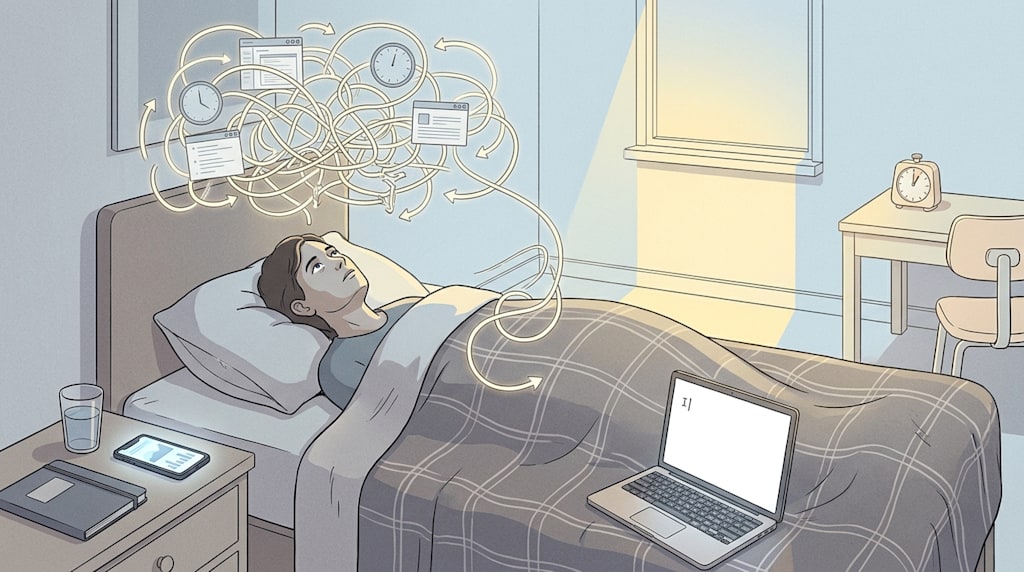
4:17 p.m. You wake up.
The curtain is partly open. A strip of light lies across the floor. Your phone lights up, then goes dark. You pick it up. Three unread messages, two alarm reminders, one document you left open yesterday. The cursor sits on the first line. The page is blank.
You lie back and pull the blanket to your chin. Three things run in your head: the work due tomorrow, the sentence you said wrong last week, and an embarrassing memory from five years ago that arrived without warning. You turn over. Ten more minutes.
Next time you wake, it is 6:30. The room is dark. You sit up. You are not hungry. You are not thirsty. Your first thought is: another day gone.
Nothing in this scene is laziness. A brain that will not switch off is using sleep to buy quiet.
2. Your tiredness comes from overload
Some tiredness does not go away after ten hours of sleep. You are not sleepy. Your brain has been running all day.
The INTP brain works like a machine with no off switch. Information keeps arriving. Logic keeps running. Why is this like this? Is there a hole in that plan? Would another approach work better? Someone says one sentence, and you unpack three layers of meaning. A project is still an idea, and you have already simulated ten paths, twenty failures, and thirty reasons to drop it.
You are not thinking about one thing. You are running many things at once.
That is why the tiredness feels mental rather than physical. Your body has not hauled bricks, but your working memory has. Your legs have not run a marathon, but your attention has. You think you rested all day. Your brain has been in meetings with no chair, no agenda, and no adjournment.
Normal sleep should be enough. When you are very tired, you sleep, and the next day you recover. Sleep stops being rest when it becomes avoidance.
3. Sleep becomes your smallest act of resistance
When you lie down, your brain is still auditing you. What did I do today? What progress did I make? Did the things I thought about land anywhere? The answer is usually no. So you turn over and tell yourself: I’m too tired. I need more sleep. Ti is good at rationalizing. It helps you explain everything away. I think too much. My nervous system gets tired easily. I just need rest.
The pattern behind hypersomnia-like avoidance often starts with low expectations for the waking world.
Deep down, you feel there is nothing worth getting up for. Ne shows you too many possibilities. Ti makes you analyze every one. After the analysis, none of them feels worth starting. So you lie back down.
Sleep becomes your smallest act of resistance.
You are resisting your own brain. When you are awake, Ti analyzes, Ne diverges, Si dredges up old accounts, Fe attacks you. When you are asleep, those voices go quiet. You stop thinking. You stop attacking yourself. You stop struggling.
You do not love sleep. You love the feeling of not having to think. Sleep is the only way you allow yourself to stop.
The problem returns when you wake up. Ti is still analyzing. Ne is still diverging. Si is still arguing to protect you. Fe is still attacking you. You slept through the day, so you hate yourself more. I wasted another day.
Then the loop closes. You use sleep to escape the problem. The escape creates a new problem. The more you sleep, the more guilty you feel. The more guilty you feel, the more tired you are. The more tired you are, the more you sleep. You think you are resting. You are slowly consuming yourself.
The glass of water by your bed is still yesterday’s. Your phone says 11 hours 42 minutes of screen time yesterday. Four of those hours were spent scrolling in bed. After scrolling, you felt more tired, and you did not know what to do.
4. You are waiting for a reason that will never come
The central problem for many INTPs fits in one sentence: too much thinking, too little doing, then self-hatred for doing too little, which produces more thinking.
Ti tells you: this should be done.
Ne tells you: there are 100 ways to do it.
Si starts protecting you: last time you did not do it well either, and you got hurt. Maybe skip it.
Your body makes a decision that feels rational: sleep. If you are asleep, you do not have to face it.
Laziness means you do not want to do it. This is different. You want to do it, but you do not know which step to start with, and you are afraid the result will not match the version in your head.
You want to write a series. The framework has been built and torn down in your head, then built and torn down again. You want to start a project. You have simulated the path many times, but you still have not opened the first document. You want to learn a skill. There are 20 tutorials in your bookmarks, several courses you bought, and no lesson one.
You are waiting for a launch reason that is logically consistent, emotionally safe, and fully controllable in outcome.
That reason will never arrive. Reality does not provide it.
Reality provides imperfect starts, clumsy first steps, 60-point deliveries, repeated iteration, feedback from other people, and the uncertainty of learning by doing. The 100 points in your head are an illusion built from infinite possibilities. Reality has no 100 points. It has work that has been done and iterated on, and blank space where nothing has been done.
5. Why this happens to INTPs
INTPs are sensitive to meaninglessness.
The moment you are awake, Ti starts auditing. What did I do today? What progress did I make? Did the things I thought about land anywhere? The process hurts because it does not accuse you. It states facts. You cannot accept the facts.
Other people can numb themselves with busyness. You cannot. Other people can fill time with noise and activity. You cannot. You need meaning, logic, and inner confirmation that the thing is worth doing. When Ne lays too many possibilities in front of you, and Ti analyzes every one, you become less able to act. Analysis is supposed to reduce uncertainty. It creates more.
Si comes out to protect you: last time you did not do it well either. What if you fail again? Fe comes out to attack you: everyone else is moving forward, why are you still here? Your body comes out to smooth things over: sleep. Sleep means you do not have to face it.
The pattern is not about a body that needs twelve hours of sleep. The waking world has no reason strong enough to pull you out of bed.
You are also good at rationalizing. You say: I think too much, I need more sleep. Ti helps you explain it away. You can package avoidance as recovery, incubation, or thinking. You know the difference. Rest helps you recover. Avoidance leaves you more tired, emptier, and more guilty.
6. Break the loop: get up and do one 60-point thing
If this has been your pattern for a long time, cursing yourself will not help. Forcing discipline will not help either. Change how the system runs.
Give Ti an external container.
When 100 thoughts are fighting in your head, open a document and let them pour out. No order. No logic. Let them flow. Afterward, you will feel lighter, and you will have material to review. Writing it out is not output. It is offloading working memory. Your brain is not a warehouse.Lower the launch threshold to 60 points.
Do not wait for 100. Pick one plan. Do it to 60 points. Ship it. Make a five-minute version first, then iterate. Action is not the enemy of thought. Action completes thought. Ti calibrates in action. Ne narrows options in action. You cannot walk the whole road inside your head. You adjust direction on the road.Give Ne a divergence deadline.
Divergence is a gift. Infinite divergence is a trap. Set an analysis window. Spend 20 minutes listing possibilities. When time is up, choose one plan. Choose the one you can start now, not the one that feels best. Good plans in reality grow out of action.Set a wake-up anchor.
Fix your wake-up time. Open the curtains. Get sunlight. Do a little physical activity. Do not rely on “I’ll get up after I’ve slept enough.” Avoidance sleep never feels like enough. Sleep hygiene needs stability, not willpower. You need stable wakefulness more than extra sleep.Separate rest from avoidance.
Rest leads to recovery. Avoidance leads to more tiredness and more guilt. If you hate yourself more after sleeping, that was avoidance. Next time you want to lie down, ask: am I tired, or am I avoiding the thing I could start at 60 points?Bring in external accountability.
INTPs audit themselves too hard. Light external deadlines and a witness help. Tell someone: I will deliver a 60-point version today. You are not asking for praise. You are giving the system an external container. Ti needs an outlet. Ne needs a convergence device. Action needs a deadline.
If this state lasts more than two weeks and clearly affects work, study, or life, or if it comes with hopelessness or thoughts of self-harm, seek professional help. This is a health issue, not a personality quirk.
7. End with one action
Understanding can come after you start. Start first. Do one 60-point thing. Let your brain complete itself in action.
Sleep can restore you. Avoidance keeps you tired. Thinking helps when it leads to action. It traps you when it replaces action.
Close this article. Open a blank document. Write the first line. Write about the strip of light you saw at 4:17 p.m., or the thing fighting in your head right now. Write for five minutes. After five minutes, you can stop.
Write those five minutes first.
About the Creator
Jin
Writer of reamstories
https://reamstories.com/jin
Enjoyed the story? Support the Creator.
Subscribe for free to receive all their stories in your feed. You could also become a paid subscriber, letting them know you appreciate their work.
Comments
There are no comments for this story
Be the first to respond and start the conversation.