
I Found a Stranger’s Blood in My Rideshare. The Police Said They Couldn’t Make Him Prove He Wasn’t Sick.
Here’s the law, the medical odds, and the tests that matter.
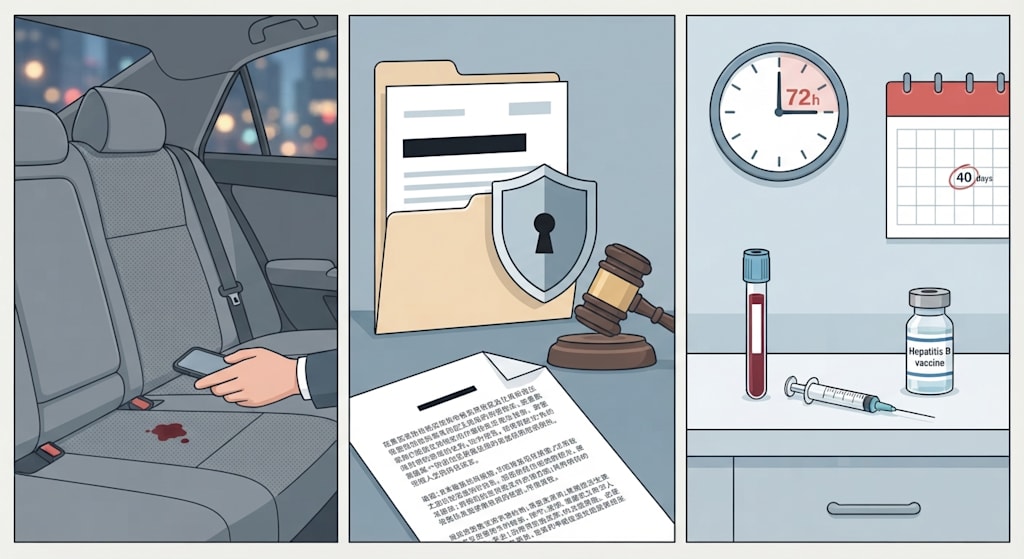
The police can’t force a stranger to prove he’s disease-free
Many people ask why the police won’t help. They think the police are passing the buck. They aren’t. If the police forced the previous passenger to disclose his test results, they could break the law.
The Law on Prevention and Control of Infectious Diseases, Article 16, paragraph 2, says no unit or individual may disclose personal privacy or personal information. The Regulations on the Prevention and Treatment of HIV/AIDS, Article 39, paragraph 2, goes further. Without consent, no one may disclose an HIV-positive person’s name, address, workplace, photo, medical history, or anything that could identify them.
The previous passenger’s health information is protected privacy. The police cannot force him to prove he is “disease-free” just because you were exposed. The rule protects everyone’s health information from being disclosed at will.
If the case involves intentional injury, assault, or other crimes, the police can investigate. But an investigation does not mean you get to see his medical records. Legal procedure has limits. Privacy has a hard line.
The “certificate of non-infectiousness” doesn’t exist
Even if the previous passenger wanted to help, he could not get the certificate you want.
First, doctors can only issue medical certificates to the person they examine. The Physicians Law says a doctor must personally examine and investigate before signing a medical certificate. The Regulations on the Administration of Medical Institutions say a hospital cannot issue a diagnosis or health certificate without a doctor’s exam. A doctor can give him a test result. A doctor cannot certify a state called “non-infectiousness.” That document does not exist.
Second, a negative test today does not prove he is negative. Every infectious disease has a window period. HIV nucleic acid testing takes about 1 week, p24 antigen about 2 weeks, antibodies about 3 weeks. Syphilis-specific antibodies take about 4 weeks. Hepatitis B surface antigen takes about 3 to 6 weeks. Hepatitis C antibodies take about 3 to 6 weeks, up to 12 weeks. A negative blood draw today says nothing about day 7 or day 14. He would need to test again and again. If he refuses, no one can make him.
Third, the previous passenger has no legal duty to cooperate with you. You are both equal civil parties. He has no statutory duty to test or disclose. Your demand that he prove he is disease-free has no legal basis. The police cannot force it.
The police’s “privacy” answer comes from law.
Bloodborne transmission needs three things at once
For hepatitis B, hepatitis C, HIV, or syphilis to enter your body, three things must happen at the same time:
The pathogen is alive.
The amount is enough.
There is an entry point.
If one is missing, infection is very unlikely.
HIV dies quickly outside the body. The needlestick infection rate in occupational exposure is about 0.3%. Mucosal exposure is about 0.09%. Blood on intact skin is not a major risk. There is no evidence of transmission from environmental surfaces. Those numbers come from CDC occupational exposure guidelines.
Hepatitis B is the opposite. It can live in dried blood for more than seven days. For the same needlestick, an unvaccinated person’s infection rate is about 6% to 30%. CDC and NIOSH data make hepatitis B the one to watch. In China, the hepatitis B surface antigen positive rate is about 5.86%. That is roughly one in twenty people.
Hepatitis C sits in the middle. A dried blood drop can stay infectious at room temperature for up to six weeks. The needlestick infection rate is about 1.8%. That comes from Paintsil et al., J Infect Dis, 2014.
Syphilis is fragile. The bacterium dies within minutes to hours when dried.
All these numbers depend on one thing: the blood has to get in. If your skin is intact, wash it off and change clothes. If your skin is broken, or blood touched your eyes, mouth, or genitals, the situation changes.
Your risk depends on your skin
Ask yourself:
Where did the blood touch?
Is your skin intact?
Is there a cut?
Did it touch your eyes, mouth, or genitals?
Was the blood fresh?
How much was there?
If your skin is intact, there is no cut, and no mucous membrane was touched, you do not need screening. Wash the area with soap and running water. Change any contaminated clothes. Intact skin is a barrier. Pathogens cannot pass through it.
If your skin is broken, or blood touched your eyes, mouth, or genitals, do not wait. Get medical care.
Step one: wash. Use soap and running water for 15 minutes. For mucous membranes, flush with a lot of saline or clean water.
Step two: go to a doctor. Go to infectious disease or emergency. Say the time, the place, whether your skin was broken, and how much blood touched you. Let the doctor decide about post-exposure prophylaxis.
Hepatitis B: if you are unvaccinated or your antibodies are low, try to get hepatitis B immune globulin and a vaccine within 24 hours.
HIV: if the doctor thinks there is a risk, PEP must start within 72 hours. Earlier is better.
Syphilis and hepatitis C: the doctor will assess and may arrange testing and follow-up.
Why “he tested negative” does not solve your problem
Many people think: just have him test. If he is negative, I can relax.
The window period makes a single negative test unreliable.
Current domestic standards are roughly:
HIV: nucleic acid about 1 week, p24 antigen about 2 weeks, antibodies about 3 weeks.
Syphilis-specific antibodies: about 4 weeks.
Hepatitis B: HBV-DNA about 1 to 2 weeks, surface antigen about 3 to 6 weeks.
Hepatitis C: RNA about 1 to 2 weeks, antibodies about 3 to 6 weeks, up to 12 weeks.
In plain language: a negative blood test today says nothing about seven days later. He would need to run back and forth for weeks to get a solid answer. That is only the technical side. Legally, the doctor can only give the result to him. On privacy, he can refuse to share it.
You cannot control his test results. You can control your own testing and prevention.
If your doctor thinks screening is needed, a four-item infectious disease panel about 40 days after exposure is fairly reliable. That time covers the main window periods for fourth-generation HIV, syphilis, hepatitis B, and hepatitis C. The four-item panel usually includes HIV antigen/antibody, syphilis antibody, hepatitis B surface antigen, and hepatitis C antibody. One blood draw.
If the 40-day result is negative, infection is basically ruled out. In rare cases, a doctor may suggest retesting hepatitis C after 3 months.
A better move than chasing a certificate
Check your own hepatitis B antibodies.
In China, the hepatitis B surface antigen positive rate is about 5.86%. That is roughly one in twenty people. No matter the risk from this exposure, check your hepatitis B surface antibodies. If you have none, get vaccinated. It is the cheapest, clearest protection you can get.
If this caused medical bills, lost wages, or you need mediation or compensation, talk to a lawyer. Protect yourself first. Do not post the other person’s information online. You do not want to turn from victim into infringer.
What you can do tonight
Do not wait for the other person to issue a certificate. Do not post his photo. Do not replay “did the blood touch me?” over and over.
Tonight, check your hepatitis B antibodies. If you have none, go to a community hospital tomorrow and get the vaccine.
That shot is more useful than waiting for a certificate.
If your skin was broken or a mucous membrane was touched, go to infectious disease or emergency now. Say the time, the place, and whether your skin was broken. Let the doctor decide about prophylaxis.
If your skin is intact, shower and change clothes. Then go on with your day.
About the Creator
Jin
Writer of reamstories
https://reamstories.com/jin
Enjoyed the story? Support the Creator.
Subscribe for free to receive all their stories in your feed. You could also become a paid subscriber, letting them know you appreciate their work.
Comments
There are no comments for this story
Be the first to respond and start the conversation.