
Difference between ADD and ADHD
For years, ADD was used to describe a certain condition of hyperactivity and inattention. Then, the definition expanded. Has ADHD totally replaced ADD?


Two Terms with the Same Meaning?
One of the most confusing and complex classification for a condition affecting students has to be the ADD/ADHD label. Over a short span of time (20 or more years) the criteria and the name itself has gone under numerous changes. In fact, Attention Deficit Hyperactivity Disorder (ADHD) can be considered “traditional ADD”, whereas Attention Deficit Disorder (ADD) is associated with “inattention ADD.”
After sorting out the confusing terminology, it can be agreed that the references to ADD and ADHD refer to different forms of an attention disorder. One involves hyperactivity while the other refers to inattention. To make this complexity easier to understand, the students will exhibit distinctive characteristics associated with the two conditions. And yet, students will will most likely be designated with one label.
What is ADD?
The term ADD can refer to all conditions of attention disorder. It can also refer to a sub-category within this classification. In the beginning, when attention disorders were being identified, the term ADD covered anything associated with it.
Classic or traditional ADD was given a new name, ADHD - with “H” standing for hyperactivity.
Even the American Psychological Association (ADA) defined the condition in their book, Diagnostic Statistical Manual For Mental Disorders –IV (DSM-IV) as being a psychological term currently applied to anyone who meets the DSM-IV diagnostic criteria for impulsivity, hyperactivity, and/or inattention (Born to Explore, 2010).
Over the years, however, a single definition for ADD was not enough. While it was commonly known that ADD students were hyperactive and very impulsive, there was a group of students who were impassive, inattentive, and appearing to be “day-dreaming.”
ADD Expands to ADHD
As a result, a new classification for ADD was created. Classic or traditional ADD was given a new name, ADHD - with “H” standing for hyperactivity. The new subcategory was given the name of ADD, considering that the main symptom was inattention.
The two types have very distinctive features. A person with ADHD will have the following conditions:
- Fidgetiness, or squirms a lot.
- Can’t stay in his/her seat.
- Runs or climbs excessively (or feeling of restlessness in older children).
- Difficulty playing quietly.
- Often “on the go” or acts as if “driven by a motor.”
- Excessive talker.
- Impatient or can’t wait in line or for his/her turn.
- Blurts out answers.
- Interrupts others or is nosey (Born to Explore, 2010).
A person with ADD, or inattentive ADD, will have the following symptoms:
- Fails to give close attention to details or makes mistakes in schoolwork.
- Difficulty sustaining attention in tasks.
- Seems not to listen.
- Fails to follow instructions or finish work.
- Unorganized (this includes schoolwork, folder and/or backpack).
- Difficulties with schoolwork or homework.
- Loses things like school assignments, books, or tools.
- Easily distracted by other students, events, noises or visual stimuli
- Forgetful about daily activities (Born to Explore, 2010).

ADD and ADHD are usually common in children and adults. Adults are affected by the symptoms as well; however, there are some variations of symptoms for adults, such as an adult with ADHD may experience restlessness instead of hyperactivity.
Becoming Separate Terms
The division between ADD and ADHD may become even more divided in the years to come. DSM-IV lists three categories for ADD/ADHD. According to WebMd, they are:
- ADHD Combined Type: person has inattention and hyperactivity symptoms.
- ADHD Predominately Inattentive Type: Inattention but not hyperactivity (current ADD).
- ADHD, Predominantly Hyperactive-Impulsive Type: Hyperactivity-impulsivity but now inattention symptoms (current ADHD).
More Subtypes
Also, Dr. Daniel G. Amen, a child, adolescent, and adult psychiatrist as well as director of the Amen Clinics in Western United States and Virginia, added the physical make-up of the brain (as revealed by SPECT brain scan of active areas of the brain) to the existing symptoms to come up with his own types of ADHD. For ADHD, he factored in short attention span, distractibility, disorganization, procrastination and poor internal supervision.
He’s come up with six types of ADD/ADHD which includes:
- Classic ADHD;
- ADD;
- Over-focused ADHD;
- Temporal Lobe ADHD;
- Limbic ADHD; and
- “The Ring of Fire" -a cross between ADHD and bipolar disorder.
It should be noted that Amen's definitions have been challenged and criticized by those in psychology and psychiatry.
...they will be labeled as ADHD no matter the severity or type of subgroup.
The definition between the two attention disorders differs by symptoms. ADD, as is currently being used, is more about inattentiveness, while ADHD refers to a person with hyperactivity or impulsiveness. These are the current differences for the time being. Who knows what types of changes will come in the next twenty years? A little patience – as agonizing as that may be for the student with ADD/ADHD – will have to be used.
Update: ADHD Wins Out
If there is one certain thing about learning disabilities, things change. Over the years, the term ADHD has become the umbrella term for this condition. Often, IEP (Individual Education Plan) for students with this condition are first labeled as OHI (other health impairment); however in psychological reports and in the eligibility page of the IEP, they will be labeled as ADHD no matter the severity or type of subgroups.
Even websites that traditionally used ADD in their names have switched to ADHD. In many respects, this change was made to the fact that ADHD simply covers all these conditions within its name.
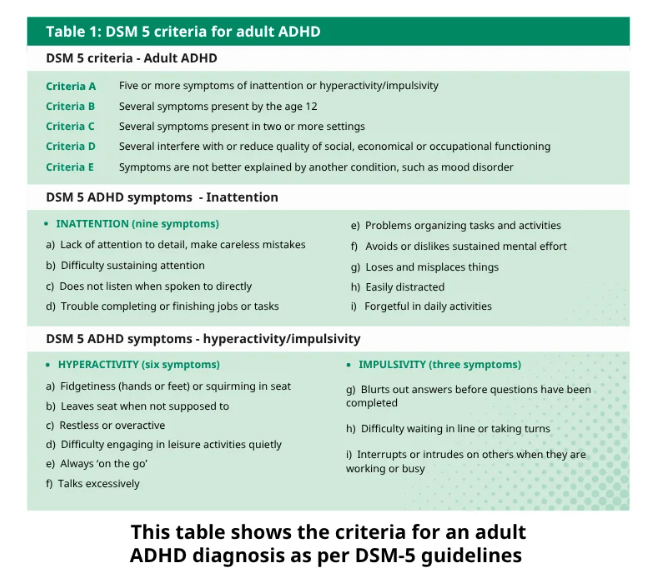
Finally, DSM-V was released and it broadened and refined the definition of ADHD. The comparison of IV and V can be found at the National Institute of Health (NIH) website under National Library of Medicine.
The following is a copy of a figure from Qbtech.com. This particular sample from DSM-V shows the various criteria for adult ADHD.
WORK CITED
- Gallaghar, Teresa, "Born to Explore!": CFAH.org (Retrieved 2010)
- WebMD writer: “ADHD Resource Center" (retrieved 2010): WebMD.com
- Sarah Gremminger:"DSM-5 and ADHD: What changed, what’s missing, and what clinicians must know": Qbtech.com (June, 2025)
- NIH editors: "Table 7 -- DSM-IV to DSM-5 Attention-Deficit/Hyperactivity Disorder Comparison": NIH/National Library of Medicine - ncbi.nlm.nih.gov (Retrieved 2026)
About the Creator
Dean Traylor
* Masters in special education and degree in journalism.
*Seasoned writer for the last 30+ years (Newspapers, Magazines, Internet sites)
* Former writer at Hubpages, Helium, and Wikinut.
* Current: Medium (https://medium.com/@ds_traylor)
Enjoyed the story? Support the Creator.
Subscribe for free to receive all their stories in your feed.
Comments
There are no comments for this story
Be the first to respond and start the conversation.