
Counting Sheep Is a Myth. The "Plosive" Theory Makes It Worse.
Three layers of error in a sleep remedy that traveled from English folk wisdom to Chinese internet advice.
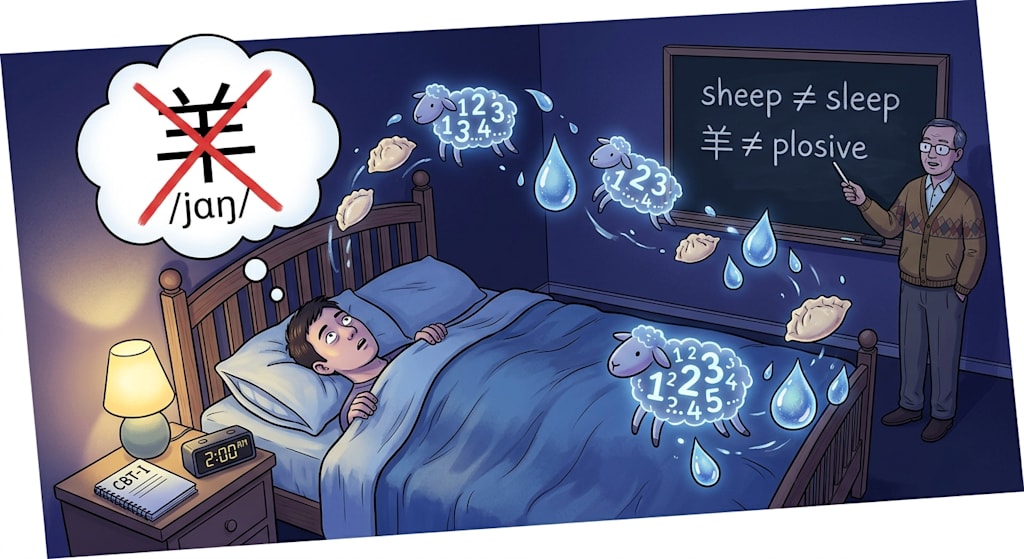
"If you can't sleep, count sheep" is widely repeated advice. Recently, an expert explained why Chinese people become more alert when they count sheep: the whole thing is a "translation accident." In English, "sheep" sounds close to "sleep," so the word supposedly hints at falling asleep. In Chinese, the word for sheep is a "plosive," so counting sheep makes Chinese people more awake. The expert proposed an alternative: before bed, repeat a word that sounds like the Chinese word for sleep, such as "water," and imagine dew dripping onto a lake. Some people joke that Chinese people should count dumplings instead.
This account has three layers of problems. Counting sheep has no reliable evidence behind it even in English-language contexts. The Chinese word for sheep is not a plosive. And repeating the word "water" is equally lacking in evidence that it reliably outperforms a control condition. Stacked together, these three problems produce a folk remedy that looks as if it has phonetics and psychology behind it but does not withstand verification.
In the English-speaking world, counting sheep is not a validated sleep technique
The claim that "sheep sounds like sleep, so it hints at falling asleep" is internet-style folk etymology. "Sheep" /ʃiːp/ and "sleep" /sliːp/ share a final rhyme, but turning a partial rhyme into a sleep mechanism has no experimental basis. English-language science communication mocks the ineffectiveness of counting sheep often enough.
In 2002, the Oxford University psychologist Allison Harvey and Suzanna Payne published a frequently cited study. The researchers divided people with insomnia into groups. One group imagined pleasant, relaxing scenes. Another performed a "general distraction" task; some participants chose to count sheep, while others chose meditation or recalling tunes. A third group received no special instruction. The group that imagined relaxing scenes fell asleep faster and had better emotional states. The "general distraction" group, including those who counted sheep, showed no measurable improvement compared with the no-instruction group. Harvey explained that counting sheep is "too monotonous to effectively drive away worries." This study was not a strict randomized controlled trial designed specifically to test counting sheep, so it cannot simply be said to prove that counting sheep does not work. But it shows that in people with insomnia, monotonous counting has not demonstrated a stable sleep-promoting advantage. The Sydney sleep psychologist Dianne Richards also pointed out that counting tasks may create stress for some people and make them more awake instead.
Counting sheep fails for a simpler reason: it is a monotonous, continuous task that requires mild cognitive effort. The word "sheep" has nothing to do with it.
The Chinese word for sheep is not a plosive
The expert said that the Chinese word for sheep is a "plosive." This is not valid in phonetics.
The Mandarin word for sheep is yáng, usually transcribed in the International Phonetic Alphabet as /jɑŋ/. The initial /j/ is an approximant, a semivowel. When it is produced, the airflow channel is not completely blocked, and there is no sudden burst. A plosive, also called a stop, is a consonant produced when the airflow channel is first completely blocked and then suddenly released. Examples include the b in bà, the t in tù, and the g in gē. In Mandarin, b, p, d, t, g, and k are typical plosives when they occur as syllable initials. The initial of yáng is not a plosive. Using "plosive" to explain why counting makes people more alert fails at the first step.
Even if the word for sheep were a plosive, it would not follow that counting sheep makes Chinese people more alert. The causal chain between articulation and falling asleep requires experimental evidence; association cannot fill it in.
Repeating the word "water": possible placebo, insufficient evidence
The expert suggested that before sleep, people repeat a neutral word that sounds similar to the Chinese word for sleep, such as "water." For some people, giving the brain a gentle, neutral focus may reduce pre-sleep rumination and the anxiety of "I must fall asleep." The problem is that no decent randomized controlled trial has shown that simply repeating a word reliably outperforms lying awake without instruction, relaxation training, or standard attention-distraction strategies.
"Water" sounds similar to "sleep," but "dumplings" and "sleep" differ only in tone, and "dumplings" is a food image that may trigger appetite or life associations; it is not necessarily more neutral than "water." Counting water drops or counting dumplings is essentially still a counting task. For people with performance anxiety about sleep, counting can become a timer for "why haven't I fallen asleep yet," which increases pressure. A placebo effect may exist, but a placebo effect is not the same as a generally effective sleep method.
What has preliminary evidence is cognitive shuffling, not monotonous repetition
If one wants to look for a relatively evidence-supported strategy in the direction of "giving the brain something to do," the approach that has attracted more attention is "cognitive shuffling," formally called "serial diverse imagining." Its core is rapid, incoherent switching among neutral mental images: starting from the letters of a word or a thought, one associates unrelated images, changing every few seconds, deliberately preventing the brain from building logical connections or sinking into worry.
The proposed mechanism is to occupy working memory with random, non-threatening mental content while inhibiting ruminative thinking in the default mode network. Preliminary randomized controlled studies suggest that cognitive shuffling helps reduce pre-sleep arousal and improve sleep quality. It also makes falling asleep feel less effortful. It is fundamentally different from simply repeating a word: the former emphasizes diversity and incoherence, while the latter is monotonous repetition. Confusing the two makes a technique with limited evidence appear more reliable than it is.
For chronic difficulty falling asleep, CBT-I is the first choice
For people who occasionally cannot sleep, counting sheep, counting water, or imagining a lake is at most a mild placebo. It is harmless to try, but it should not be given a scientific halo. For people with chronic difficulty falling asleep and daytime impairment, the non-pharmacological intervention with the strongest evidence is cognitive behavioral therapy for insomnia, or CBT-I. It includes stimulus control, sleep restriction, cognitive restructuring, and relaxation training. Its goal is to break the cycle of being awake in bed, then anxious, then even less able to sleep. It does not rely on a particular pronunciation or image to "hint" at sleep.
Sleep anxiety exists, and excessive expectations about sleep can also worsen insomnia. Addressing sleep anxiety means systematically adjusting sleep behavior and cognition. Swapping "sheep" for "water" does not accomplish that. Reducing a complex problem to "pronounce the right sound and you will sleep" looks easy to implement, but in practice it leads the public toward another untested folk remedy.
Conclusion
Counting sheep, counting water, and counting dumplings are harmless to try, but they should not be treated as evidence-based sleep switches. The idea that "sheep sounds like sleep, so it hints at falling asleep" is folk imagination. The claim that the Chinese word for sheep is a "plosive" is a phonetic error. Repeating the word "water" lacks evidence that it reliably outperforms a control condition. What has preliminary research support is a strategy such as cognitive shuffling, which rapidly switches among incoherent images. The first-line non-pharmacological intervention for chronic insomnia is CBT-I. Folk remedies can be harmless, but erroneous explanations should not be presented as science.
About the Creator
Jin
Writer of reamstories
https://reamstories.com/jin
Enjoyed the story? Support the Creator.
Subscribe for free to receive all their stories in your feed. You could also become a paid subscriber, letting them know you appreciate their work.
Comments
There are no comments for this story
Be the first to respond and start the conversation.