
Therapists Say a Relationship Going Downhill Can Be Saved. The Fix Comes Down to 4 Behaviors.
Couples therapy helps about 70 percent of couples. The difference between making it and breaking up often comes down to how you fight, listen, and repair.
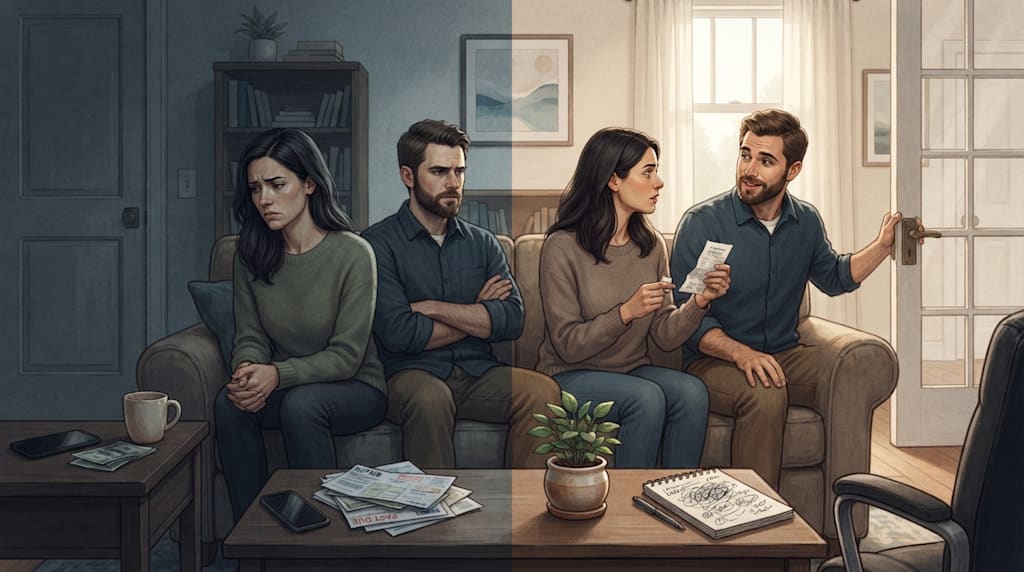
If you are unhappy in a relationship, the pain can settle in the body. Fights disturb sleep. Shoulders tighten. Headaches arrive. Children in the house absorb the noise. A good relationship supports health and can add years. A bad one wears health down and raises the risk of an early death. Researchers treat low-quality intimate relationships as a health risk on the order of smoking or inactivity. A relationship going downhill can be turned around. The work starts with how you handle conflict.
Why the same argument returns
Couples often argue about the same subjects for years. John Gottman and his team watched couples argue, then checked again four years later. Sixty-nine percent of the time, the couples were still fighting about the same type of problem. Therapists call these perpetual or gridlocked problems. Money. Parenting. Sex. Power. Tidiness. The topic can look small. The pattern is not. Money disagreements tend to be the longest and hottest. Uneven housework adds tension and raises the odds of divorce.
Conflict itself is not the enemy. Happy couples fight. Unhappy couples fight. The difference is how they treat each other during the fight and between fights.
Four behaviors that break a relationship
Carrie Cole, research director at the Gottman Institute in Seattle, points to four behaviors that predict trouble: criticism, contempt, defensiveness, and stonewalling. Stonewalling means refusing to engage, leaving the argument by going silent or walking out.
“These four behaviors destroy a relationship,” Cole says. “They can also be repaired if couples want to repair them.”
Money and chores can create friction. The behavior inside the conflict often decides the relationship’s direction. Criticism from a partner predicts earlier death. Fights with attack and hostility are destructive. They raise the risk of divorce.
Constructive conflict looks different. It runs on respect. It stays curious. It aims at solving a problem together. One element is responsiveness: the sense that your partner hears you, supports you, and understands you. Responsiveness links to higher marital satisfaction. It also buffers inflammatory responses and supports physical health and longevity.
Kindness and cooperation build goodwill over time. A 20-year study of married couples found that shared decisions and a fair split of housework went with higher marital happiness and less conflict. Conflict style can touch sleep. Destructive fights go with poor sleep. Constructive fights go with better sleep.
Couples therapy and the work of empathy
Turning bitter, hostile arguments into kind, supportive conversation can feel impossible. Research on couples therapy supports it. Couples therapy helps about 70 percent of couples who try it. It can improve relationship problems, raise satisfaction, prevent distress, and strengthen emotional intimacy. It can also help with individual emotional or physical health.
Jay Lebow, a clinical psychology professor at Northwestern University’s Family Institute and a couples therapist, says most couples who reach therapy arrive with empathy worn thin. He co-wrote a broad review that found couples therapy works. The challenge, he says, is: “How do we rebuild empathy?”
He looks for signs that therapy is working. One is better talking and listening. “That sounds simple,” Lebow says. “In a distressed relationship, listening becomes very hard.”
Another shift is the question couples bring. Can they step back and ask, “What is happening between us?” instead of “What is wrong with my partner?”
Two signs of hope
Cole watches for two specific signs in sessions. The first is when one partner says to the other, “I can understand why you feel that way.” For Cole, this shows the person is accepting influence. They can treat the partner’s view as valid even when it differs from their own.
The second sign is curiosity. “Do they still have curiosity about each other?” Cole asks. “If they do, there is hope.” Even when they disagree, they might say, “Tell me more. How did you come to see it that way?”
Lebow puts weight on motivation. If people are willing to work on their own part, “the evidence is strong that things can go well.”
The dream under the money fight
Gridlocked conflict often needs a shift in understanding. Cole describes a couple who came in fighting about money. Both had grown up poor. Poverty had shaped them in opposite directions. The wife wanted savings and careful budgets. She wanted safety and independence. The husband wanted to spend hard-earned money on good things. He wanted to enjoy belonging, to feel outside the isolation of poverty. Their arguments about purchases went in circles.
“They kept fighting about these things,” Cole says, “and never touched the reason they were fighting.”
In therapy, they heard each other’s stories about childhood poverty and how those years shaped their goals. They learned to compromise. They agreed on how much to save and how much each could spend freely.
“They did solve the problem,” Cole says. “But they first had to understand what mattered most to each other. Then they could open up to influence and move toward a compromise that held both dreams.”
Lebow adds another factor: client motivation. “You can have the best couples therapist in the world,” he says, “but if the clients have no motivation, the outcome is unlikely to be good. If the therapist is not the best but the clients are strongly motivated, you may still get through. That makes a large difference.”
A better breakup
Therapy can help couples who are separating. It can help them manage the split and the mental health strain that comes with it. It can lower hostility. If children are involved, it can help parents support their children’s mental health.
Divorce and separation can hurt. Lebow says these moments can also teach people about themselves. “This is when many people learn things about themselves that are valuable for the rest of their lives.”
Listening and empathy skills are not only for couples in trouble. “Even people who already have a good relationship can make it better,” Lebow says.
In a therapist’s office, a couple stands to leave. The wife reaches for her coat. The husband takes the parking receipt from his pocket and puts it in her bag. She looks at him.
“I saw it,” she says.
He nods. At the door, she asks, “Same time next week?”
He holds the door open. “Same time.”
About the Creator
Jin
Writer of reamstories
https://reamstories.com/jin
Enjoyed the story? Support the Creator.
Subscribe for free to receive all their stories in your feed. You could also become a paid subscriber, letting them know you appreciate their work.
Comments
There are no comments for this story
Be the first to respond and start the conversation.