
The Trouble with Fez
A family history remembered by one dog who knows better.

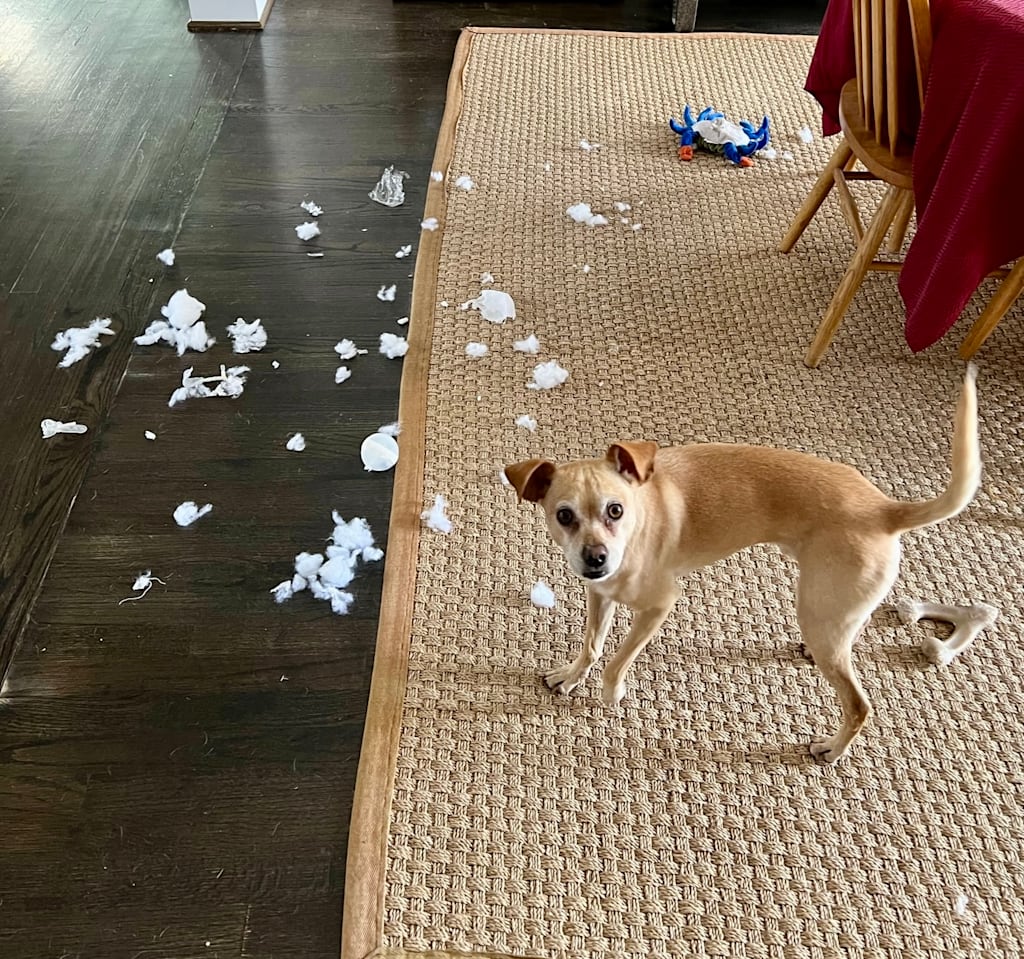
Perhaps the strangest thing about memory is that it does not simply preserve what happened; it preserves what each party believes happened. And perhaps, in the space between the following accounts, something more accurate will emerge.
We humans agree on three things about Fez, the family dog:
1. He weighs nineteen pounds.
2. He is thirteen years young.
3. He has never, in his entire life, been inadequately fed, improperly bathed, or insufficiently adored. Everything else is under dispute.
We believe we remember events in a sensible chronology, with reasonable attention to cause and effect, whereas Fez remembers them according to a system involving food, personal dignity, and the possibility that things always hide in pockets. Both parties consider our recollections unimpeachable.
We both might be wrong.
Or so Fez would argue.
All rise...
EXHIBIT A: THE MATTER OF BREAKFAST
What Humans Remember
Breakfast happens between six-thirty and seven each morning. This is neither a secret nor a surprise. We've followed the same routine twice daily for over thirteen years. Fez receives his measured portion, in his own bowl, in his own spot, from Us, his own people, without hesitation.
He has never missed a meal or waited long beyond the usual time.
Yet at 6:17 every morning, he rises from the bed, front paws planted, ears alert, and eyes fixed on the nearest family human face.
At 6:19, he places one paw on his Mom.
At 6:21, he breathes directly into her nose.
At 6:23, he makes sounds suggesting the last known food source on Earth was destroyed in a catastrophic industrial accident.
"Fez. It's not time yet."
He blinks.
"Breakfast is later."
He turns toward the kitchen. We have tried explaining clocks to him. We have tried ignoring him. We have gotten up early enough to preempt the entire operation. Nothing works.
We have concluded that Fez does not understand the concept of breakfast.
Fez’s Footnote, Part One
Breakfast used to be a beautiful thing: the sun rose, waking the humans. Food appeared with the natural regularity of the sun's return and the shifting of the tides. Then something changed:
The humans began snoozing through breakfast.
They call it “sleeping in,” as if that’s a legitimate excuse to let an entire morning pass without acknowledging my obvious hunger. I cannot understand why anyone would voluntarily remain horizontal when the kitchen is available. I have tried several diplomatic approaches. Standing. Sitting. Staring. Gentle paw placement. A few brief vocal warm-ups, with announcements.
Even scratching incessantly. Nothing.
So, every morning, I am forced to escalate, taking matters into my own paws.
I put my face within an inch of Mom’s face, which always gets a big reaction: She opens one eye.
"What?"
I explain the situation at length, and in complete detail. I do not stutter.
“Fezzy, go back to sleep," She says.
I remember the words, although I cannot be certain whether they are spoken in English or the local central Maryland dialect. The distinction is academic, but the meaning was clear: remain hungry.
I was appalled!
Eventually, Mom got up and walked toward the kitchen. I followed, of course, leaping in my usual fashion (my extraordinary herding instinct, inherited from my great-great-great-granddog).
Mom moves toward the food bin; I thoroughly inspect the premises.
She retrieves the food; I belt out serenades from the songbook of my people.
She adds water, nutrient powders she insists are “good for me,” and proceeds to the blender.
I despise anything that roars for no reason. Drills, vacuums, and especially blenders, because blenders touch my food. But I participate, because these are serious times.
Finally, food served! A reasonable person might expect gratitude. I am always grateful, save for my concerns about—
I always have concerns about the portions.
Human Family Footnote
Fez eats twice daily. He also receives treats and approved morsels throughout the day, plus an astonishing amount of attention whenever we eat.
He is far from starving.
On walks, we have also observed him eating bugs by the mouthful, occasional clumps of dirt, and something that might have been mulch.
Fez’s Footnote, Part Two
My humans confuse the existence of food with the availability of food. These are separate matters. For instance, when a human opens the refrigerator and removes cheese, I am expected to believe it belongs exclusively to them?
Absurd.
The cheese is in the family refrigerator.
I am family. The conclusion requires no further investigation.
The same applies to crackers, chicken, toast, and anything that falls on the floor—especially anything that falls on the floor.
Once, an avocado seed fell, and I grabbed it immediately, holding it. Everyone shouted. I stopped. I looked at them. They looked at me. A silence settled over the kitchen, thick with the weight of an important constitutional dispute.
"Fez. DROP IT.” I tightened my jaw, waiting for them to reconsider. They did not reconsider. They never reconsider.
So, I did what anyone would do: I swallowed it.
The avocado seed was eventually recovered, though neither of us remembers precisely how. My humans insist I surrendered it via veterinarian-induced emesis, but I maintain that I permitted my most-least-worst trusted human to remove it from me after determining that humans couldn't appreciate its value. We remember the same battle, but not the same victory.
I also dispute the mulch allegation, and contend that it was a small, uninteresting snack of exceptional unimportance.
EXHIBIT B: THE BATH THAT NEVER HAPPENED BEFORE
What Humans Remember
Fez gets a bath every two weeks, almost on schedule. We prepare the supplies and allow a reasonable window of time for it, assuming Fez cooperates. He rarely cooperates.
Fez is not a water dog. This is an understatement. He recognizes the sound of running water from anywhere. The moment someone turns a faucet on, he vanishes. We call this 'selective hearing,' but we imagine that he would call it 'self-preservation.'
There is usually a chase, and we understand never to reveal the towel too soon.
"Fezzy boy?"
Silence.
We find him behind furniture, under beds, inside closets, and in the backyard.
"Come here, little buddy."
Crickets.
Fez is excellent at escaping. We believe he can squeeze through openings that seem physically impossible for a dog his size; but once he's hidden, we have to wait.
"Do you want a treat?"
Fez’s tiny head appears around the corner. Eventually, we capture and carry him to the basin. Once inside, he transforms from a compact household companion into a slippery, four-legged legal objection. He braces his paws against the sides, attempts to climb out, and twists his body as though assembled from several different animals.
We insist he is perfectly safe. Fez probably insists he is being kidnapped.
The bath proceeds. Afterward, we wrap him in a warm towel, dry him, and let him go. He promptly rubs against the furniture, the carpet, and anywhere in the backyard that might help restore the fragrance we spent twenty minutes eliminating.
We call it disgusting. But Fez might say--
Fez’s Footnote
--Baths don’t exist. I have no recollection of them.
But I do remember Uncle in shadowy doorways with an expression of suspicious determination. After that, the record becomes strangely incomplete. I recall a narrow escape beneath the couch, and a moment when I believed that I had outmaneuvered the entire household.
Then I was airborne--this is the part that troubles me.
One moment, I was on the floor defending my freedom. The next, a human claiming to love me carried me toward the sink. I find this betrayal difficult to describe. The sink always smells of soap and damp towels.
Plus, it’s freezing.
Or hot. Irrelevant!
Uncle smiles like he rehearsed this operation.
I begin my escape plan immediately:
First, plant paws. Then, attempt counterclockwise rotations. Then clockwise rotations. Finally, I execute a maneuver I call the “Riverside Turnpike,” using all fours against opposing surfaces to make myself as unmovable as possible.
Uncle doesn’t appreciate my ingenuity.
He wets me, soaps me, and lathers it all in, claiming ‘it’s necessary,’ but I remain unconvinced. I recall the water as far deeper than Uncle admits; the soap, an invasive substance; the towel, a nasty net.
I state my rights, quite clearly. Again, zero stuttering: "This is not what we agreed to."
Uncle claims I said nothing.
This is a bald lie. I say many things. My humans simply lack the education to understand me. After the ordeal, they release me into the house. I run, roll, and rub against the carpet with the urgency of someone trying to erase a criminal record--and just for the record, soap should be criminal. Humans shout my name. I hear them fine. I just choose not to respond.
Human Family Footnote
Fez smells considerably better after a bath. For approximately forty-seven minutes, he's soft, clean, and fluffy. Then he finds something outside. We have never established what it is—maybe wet grass…Or an old leaf? It’s always something that should never re-enter a house.
Fez rolls in it. We sigh. We turn the water back on. He disappears again.
Fez’s Footnote
Not everyone has the advanced palate to appreciate a well-crafted bouquet. Humans fail to understand the purpose of a bath—it removes my natural scent and replaces it with whatever they decide smells like a flower. This isn't cleanliness; it's impersonation, and I consider it my duty to correct the situation.
After all, I am a pup of principles.
EXHIBIT C: THE ATTENTION CONTRACT
What Humans Remember
Fez loves attention. He climbs onto the couch, nestles beside us, and arranges himself in positions that make it impossible to move without disturbing him. He enjoys ear squishes, shoulder scratches, tummy rubs, and being held while he rests against us. He can remain in this position for hours on end. We consider this a successful bonding session.
Fez considers it an opening offer.
The trouble begins when we stop petting him: our hands slow, pause, maybe even withdraw. Fez watches this with deep concern. He lifts his head and places a paw on our hand(s). We resume petting, and everyone is satisfied, for approximately thirty-four seconds.
Then hands slow once more. Fez latches them under his paw, and pulls them toward him. We swoon every time.
"Okay, buddyboy."
Our hands resume. Fez settles. We believe the matter is resolved. It is not. Eventually, we need to get up: dishes to wash, errands to run, work to finish- other responsibilities not involving Fez.
We inform him of our plans. He rarely accepts it.
Fez’s Footnote
The family has a peculiar understanding of time. They believe that ninety-seven minutes is a substantial period of affection. They believe a few pallid scratches within said time frame constitute a satisfactory exchange—after which they have fulfilled their obligations?
Pure lawn bomb.
I have examined these claims carefully. All, fully without merit. When my humans sit on the couch, I place myself within reach. This is an invitation, which they understand. Their hands begin to move. Excellent. I close my eyes.
Hands move behind my ears, along my neck, down my back. I let it go on for a while, though occasionally shifting to ensure they reach the right spots.
Then the hands stop.
I open one eye. The hand? Still. I nudge it. Nothing. I lick it. It withdraws. I place my paw on it. Hands resume. All is good. I close my eyes again, reassured that the household remains fully functional.
Then the human says, "I have to do something."
I don’t understand this. They are already doing something—petting me. What else could possibly be more important? So, I paw their hand back. The human laughs. I do not—I have been abandoned in the middle of an appointment—a serious breach of contract!
The family has never shown me the contract, but I am confident it exists. I review the terms in my mind during feeding: humans provide food, warmth, and affection; I provide companionship, protection, and ongoing assessment of all activities concerning the kitchen.
This arrangement has worked for thirteen years. I see no reason to renegotiate.
Human Family Footnote
Fez is very affectionate. He follows us from room to room. He lies beside us while we work. He watches us eat, sleep, and use the bathroom. He does not believe anyone should be alone. Ever.
Fez’s Footnote
The family repeatedly demonstrates they cannot be trusted without supervision: they open doors and fail to investigate what lies beyond; they enter the kitchen and neglect to share the food; they carry bags containing mysterious objects and leave them unattended; they walk into bathrooms and close the door.
The last offense is particularly disturbing. I have spent years establishing that a closed bathroom door is a call to investigate. My humans insist that it is for “privacy.” I have no idea what this means. Privacy? From whom. Family???
I am the family. The logic is circular.
I have therefore adopted a simple policy: whenever humans enter a room and close a door, I scratch on it until it opens. Then I enter precisely to inspect the contents and perimeter. This has clearly prevented several disasters. The family never knows what they are.
I consider this further evidence that they need me.
EXHIBIT D: THE MISSING BACKPACK
What Humans Remember
One other incident, although Fez insists it belongs in a separate category.
It happened while friends visited for a weekend. A backpack lay on the bed. Within, folded clothes in neat stacks. Toiletries, arranged.
Three zippers, partially open.
Fez worked them all with his nose, shifting the metal tabs between his teeth until the compartments opened. First discovery: socks. He withdrew one. Then another.
Then he found a small object he decided was probably food, though we later identified it as a travel-sized bottle of shampoo. His investigation continued. When we returned, he sat beside the open bag, looking satisfied, but the backpack contents had been rearranged:
Clothes lay across the bed. One sock, disappeared beneath a pillow. The shampoo bottle rested on the floor, obviously discarded.
We examined the crimescene.
“Fezzy, what did you do?”
Fez blinked.
"Fez!"
We remember this as the day Fez learned to operate a zipper.
Fez’s Footnote
This accusation holds less water than my drinking bowl.
Having observed backpacks before, I know their purpose: Humans put things inside them, close them, and then leave for an indeterminate amount of time. This is unacceptable to me.
I entered through the doorway and approached for a closer look. The first zipper opened easily. The second required more concentration. The third was a challenge worthy of my talents, and I rose to the occasion.
I remember it as the day I prevented humans from coming and going without adequate supervision. The distinction is important. Afterward, I looked toward the kitchen--in my opinion, always an effective way to change the subject, but the humans didn’t agree. On these types of things, they never agree.
CLOSING ARGUMENTS: THE SPACE BETWEEN
Humans: We have accumulated hundreds of stories about Fez. We remember him disappearing beneath the furniture and emerging on the other side of the room. We remember him stealing candy bars from a bag and refusing to return them. We remember him appearing whenever the fridge opens, as though summoned by an ancient signal. We remember the baths, the meals, the endless affection. Our goodboy.
Fez: I remember these things, too. But my endings are different. In my version, the refrigerator is a community resource. The bath, unlawful detention. Petting sessions, a binding agreement. And the backpack inspection? A public service.
Humans: We see a small dog with a large personality.
Fez: I see a house of people doing their best, but requiring constant supervision.
Humans: We laugh when he stares at us.
Fez: I question why they laugh during such serious situations.
Humans: We call his name when he runs away.
Fez: I believe they are acknowledging my strategic brilliance.
Humans: We say, "Good boy."
Fez: I accept this as confirmation that I have been right all along.
Humans: We always remember our Fezzy, who is fed twice a day.
Fez: I remember a world in which food is almost always available.
Humans: We remember bathing him every two weeks.
Fez: I remember a recurring conspiracy.
Humans: We remember hours of companionship.
Fez: I remember when the hand stops.
Humans: We know Fez isn’t human, but he has never been convinced. Yet we have spent thirteen years learning each other's habits, anticipating each other's movements, recognizing each other's moods, and building a language of gestures, sounds, routines, and the occasional piece of stolen charcuterie. We have become fluent in one another without ever agreeing on the meaning of a single event. We call this "living with our dog."
Fez: I call it “living with my people.”
Humans: In the evening, when the house is quiet and the day's activities end, Fez climbs onto the couch and presses himself against one of us. Our hands rest upon him. For once, neither party disputes a thing. We stroke him lovingly. Fez closes his eyes. The hours pass. Our hands move away. Fez hooks them with one paw and pulls them back. We laugh. His eyes close again.
"Fez, you silly pup.”
Fez: I’ve heard this before, and remember it like this: "Fez, you're the best thing that's ever happened to us.”
Humans: Which, in a way, is probably what we mean. Our hands continue moving, and for a little while longer, the world is exactly as it should be. Then someone opens a bag of crackers in the kitchen. Fez is up before the first wrapper crackles and trots down the hallway.
"Fez! Those aren't yours.”
Fez: I don’t look back—I know exactly what they said. I remember it as clearly as opening a cookie treat bag.
"Fez! Come and share all this food with us!"
And after thirteen years together, I see no reason to believe they mean otherwise.
🐾 🍪 🌈
About the Creator
Eric Brooks
Puppeteer, musician, and story creator. I bring these together to enhance the brilliant stories that connect us all.
Story Dreamer • Motion Photos
Character Creator • Songwriter
Enjoyed the story? Support the Creator.
Subscribe for free to receive all their stories in your feed. You could also become a paid subscriber, letting them know you appreciate their work.
Comments
There are no comments for this story
Be the first to respond and start the conversation.