
My Neighbor Left a Bag of Tangerines at My Door. I Didn’t Ask Who.
A quiet story about closed doors, empty stairwells, and the slow fading of everyday kindness.
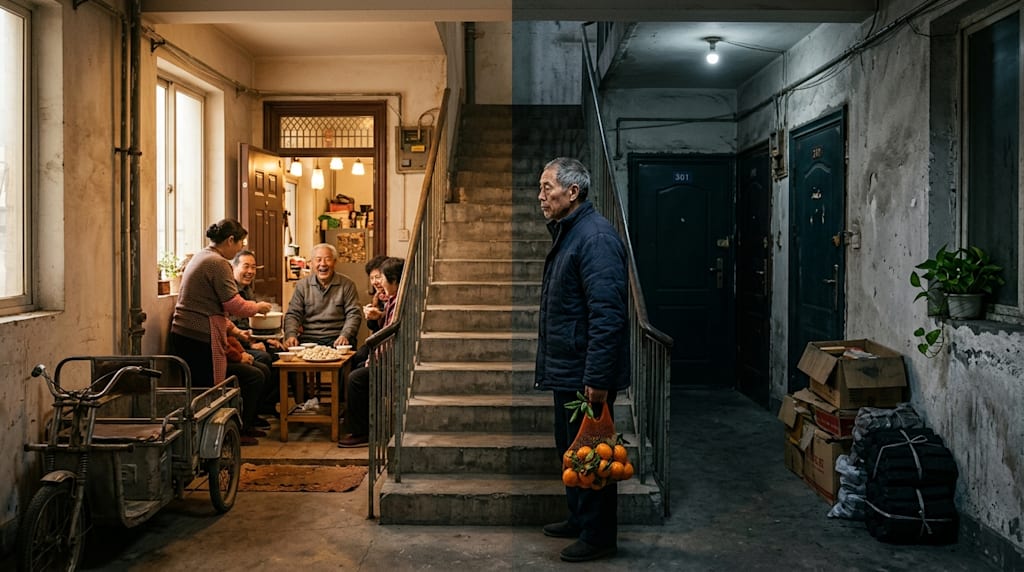
Across the Hall
Lao Zhou lived in a six-story building from the 1980s. No elevator. The stairwell was stacked with honeycomb coal briquettes and old cardboard boxes. Back then, if someone made dumplings, they carried a bowl to the neighbor across the hall. Lao Zhou remembered one night when his wife had a fever. Xiao Liu from downstairs pedaled a tricycle to the hospital. The next morning, Xiao Liu's wife brought over a pot of millet porridge. "Drink it while it's hot," she said. "Don't stand on ceremony."
Later, families moved out one after another, and new ones moved in. The young newcomers nodded when they met, then looked down at their phones. Once Lao Zhou forgot his keys and sat by the door waiting for his son. The young man across the hall opened his door, glanced at him, and closed it again. Lao Zhou didn't think much of it. After that, he greeted people in the stairwell less often.
Last winter, the old woman on the third floor fell at home. She shouted for a long time, but no one heard. A delivery worker found the door not fully shut, pushed it open, and saw her. She had been on the floor for four hours. After that, some people installed cameras. Others replaced their doors. Lao Zhou kept his, but he wiped the peephole until it shone.
Work was the same.
Before he retired, Lao Zhou worked at a public institution in the district. In the 1980s, if anyone in the office had trouble, one shout was enough. Lao Zhang's child was two points short for school. The section chief made a trip to the education bureau, came back, waved his hand, and said, "Done." When Lao Li's wife was hospitalized, colleagues took turns keeping her company. The duty roster was taped to the wall. There were rules then too, but the rules could bend. The leader would say, "Special circumstances, special handling," and people handled them that way.
Now Lao Zhou occasionally went back to the unit to take care of something. The corridors were quiet. Young people sat in front of computers, screens glowing, fingers tapping keyboards. Lao Zhou wanted to ask a question. The person looked up and said, "Please take a number first and submit it in the system." Lao Zhou said he only wanted to ask one thing. The person said, "Sorry, I still have a report to submit." Lao Zhou stopped asking.
He heard that when someone in the office had trouble now, people still helped, but the help had changed. Before it was "I'll run that errand for you." Now it was "I'll help you see how the process works." Before it was "I'll cover this for you." Now it was "You'd better follow the rules. Don't make trouble for yourself." Lao Zhou understood. Inspections were strict. Whoever signed was responsible. He just noticed that the sentence "It's fine, I'll handle it for you" had gone quiet.
Xiao Liu from downstairs moved away too. Once Lao Zhou ran into him at the supermarket, and they chatted in front of a shelf. Xiao Liu said work was busy, group chats never stopped, and on weekends he still had to take his kid to classes. Lao Zhou said, "Then come over sometime." Xiao Liu said, "Sure." Both knew that "sometime" would probably never come.
Lao Zhou's son lived in another city. When the son moved, Lao Zhou said, "I'll come help." The son said no need. He had hired a moving company for eight hundred yuan. Lao Zhou said eight hundred yuan could buy a lot. The son said, "It's easier." Lao Zhou didn't say more. He knew his son was not a bad son. He just thought it was better not to trouble people. Trouble them, owe a favor, and have to repay it. Pay money, and the matter is settled.
Later, Lao Zhou learned to do the same. Once a water pipe leaked at home. He had thought of asking the young man across the hall to take a look. He knocked. The young man said, "I'll find you a repair number." Lao Zhou said okay. The repairman came, fixed it in ten minutes, and charged one hundred twenty. Lao Zhou paid. The repairman said, "Call if you have trouble again." Lao Zhou said, "Okay." The door closed. The apartment was quiet again.
One evening, Lao Zhou was walking outside. He saw a child fall and scrape a knee. The child cried. Several adults stood nearby. No one stepped forward. Lao Zhou walked over, helped the child up, and asked, "Where do you live?" The child pointed to the building ahead. Lao Zhou led him over. When they reached the entrance, the child's mother ran out, thanking him again and again. Lao Zhou waved his hand and left.
On the way back, Lao Zhou thought of his own childhood. In the village, if a child fell, anyone passing by would help him up. After helping him up, they would say, "Don't cry. Go home and have your mother put some red medicine on it." Back then, no one was afraid of being falsely accused. Now they were. Afraid they could not explain. Afraid they would have to pay. Afraid of trouble.
Lao Zhou did not blame the people standing there. They were not bad. They were unsure. The child might say you pushed him. There might be no camera nearby. A kind act might turn into a summons.
That night Lao Zhou sat on the sofa watching TV. The news was talking about "building a harmonious society." Lao Zhou changed the channel. A program was on about renovating old residential communities. The host said, "We must make the community warmer." Lao Zhou thought, warmth does not come from installing a few exercise machines.
He remembered the pot of millet porridge in the stairwell, and Xiao Liu's back as he pedaled the tricycle. The section chief's "Done" came back too. None of it was big. The memory still stayed with him. Now he sat in his apartment. The heating was strong, but somehow a draft still got in.
The next morning, Lao Zhou went out to buy groceries. In the stairwell he met the young man across the hall. The young man was carrying a trash bag. He saw Lao Zhou and nodded. Lao Zhou nodded too. They passed each other. Lao Zhou went downstairs and looked back. The door was closed. In the past, that door had often been open. Anyone passing by could go in and sit.
Lao Zhou did not look back again. He walked toward the vegetable market. On the way he met a neighbor. They said "Morning" to each other. Then each went his own way. The market was crowded and noisy. Lao Zhou bought tofu and greens. When he paid, the vendor said, "Five yuan twenty." Lao Zhou gave five. The vendor said, "Forget it, five." Lao Zhou said, "No, that won't do." The vendor said, "Next time." Lao Zhou smiled and left with his groceries.
On the way home, he saw a shoe repairman by the roadside. The man kept his head down, hammer tapping. Beside him was an enamel mug with tea in it. Lao Zhou stood for a while. He remembered he had a pair of shoes that needed repairing. But he did not sit down. He kept walking.
When he reached the building, he saw the young man across the hall standing at the door, rummaging through his bag. Lao Zhou asked, "Forgot your keys?" The young man said, "Yeah, waiting for my roommate." Lao Zhou said, "Why not sit in my place for a while?" The young man paused, then said, "No thanks." Lao Zhou said, "It's cold outside." The young man said, "It's fine, I'll wait."
Lao Zhou said nothing more. He took out his keys and opened his own door. Before going in, he looked back. The young man was still rummaging, phone pressed to his ear. Lao Zhou closed the door. The apartment was quiet. He put the groceries in the kitchen and walked to the window. Downstairs, the young man was still standing. Lao Zhou watched for a while, then drew the curtain.
That night Lao Zhou dreamed. He dreamed the stairwell smelled of dumplings, and Xiao Liu was downstairs shouting, "Uncle Zhou, come down for a drink." He went down and saw a table full of people, lively and noisy. When he woke, it was not yet light. Lao Zhou lay in bed and heard a car pass outside. He turned over and closed his eyes again.
When he got up, he opened the door. A bag of tangerines sat outside. No note. Lao Zhou looked at the door across the hall. It was closed. He took the tangerines inside and put them on the table. They were fresh, leaves still on the skins. Lao Zhou picked one up, peeled it, and ate a segment. A little sour, a little sweet.
He did not ask who left them. He saved the peels and dried them on the windowsill. On the windowsill were several pots of pothos, leaves green. Lao Zhou watered them. Then he sat down and began writing what he needed to buy today. On the note he wrote: tofu, greens, eggs. After thinking, he added one more line: tangerines.
About the Creator
Jin
Writer of reamstories
https://reamstories.com/jin
Enjoyed the story? Support the Creator.
Subscribe for free to receive all their stories in your feed. You could also become a paid subscriber, letting them know you appreciate their work.
Comments
There are no comments for this story
Be the first to respond and start the conversation.