
If you don’t know what to say to a cancer patient, say nothing
A cancer researcher and crash survivor explains why “stay positive” can hurt, and what actually helps.
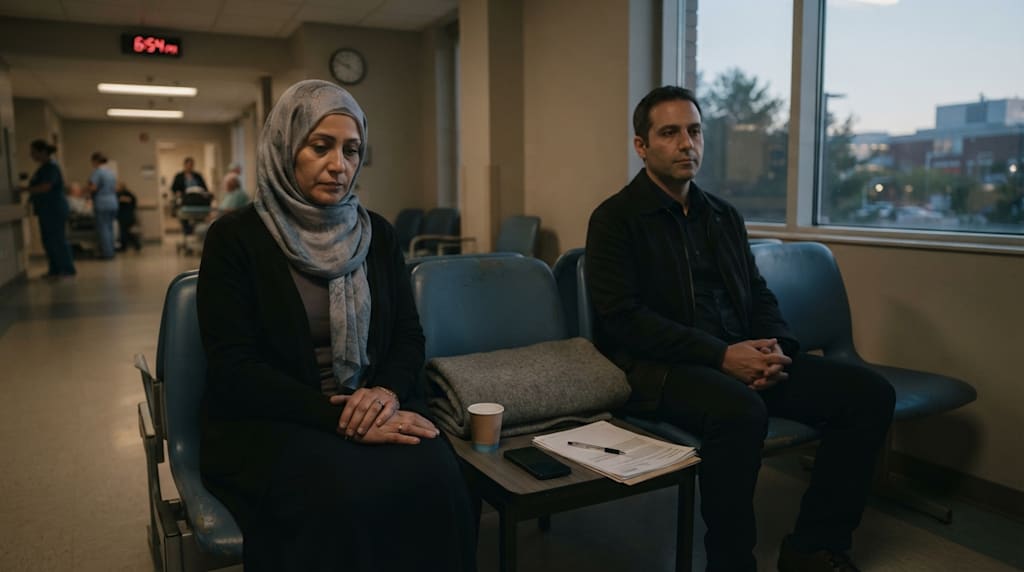
If you don’t know what to say to a cancer patient, say nothing
A cancer researcher and crash survivor explains why “stay positive” can hurt, and what actually helps.
I
A scar over 30 centimeters long. Nearly a thousand stitches.
Li Zhizhong smiles as he tells the story. He was leaving a charity event and getting into a taxi. One second he was in the car. The next, he woke up in a hospital and learned he had been unconscious for two days.
I asked him, “When you woke up, did you ask for a mirror?”
He said, “I didn’t dare look. Everything was wrapped in gauze. I only knew it was serious. My first thought was: I’m still alive.”
At four o’clock, he was wheeled into plastic surgery. The doctor looked at him and told his family not to wait for dinner. The operation lasted eight hours. Li chatted with the doctor the whole time. “I’m an internet celebrity, you know,” he said. “Sew me up well, and I’ll advertise for you later.”
That is the Sichuan sense of humor, born and bred.
The crash changed three things. He understood doctors better. Trust them. Most of them want the best for the patient. He understood patients better. Do not force the words “relax, it will pass.” He also understood why patients he had helped for years could be so “strong.” This is their life.
One more thing: he is starting a podcast, because he might be disfigured.
II
Under the word cancer, Li has three identities.
He is a family member of a cancer patient. His mother was diagnosed with breast cancer when he was a junior in college. She is now a proud “more than twenty-year breast cancer survivor.”
He is a PhD in cancer biology from Duke University. He worked at a pharmaceutical company for years. That identity puts him on the side of the people doing the treating.
He has been explaining cancer to the public for 13 years. He wrote the Cancer: The Truth books. He founded Sunflower Children, a nonprofit for children with cancer. That identity makes him a communicator.
Because he has worn all these hats, he can put himself in almost anyone’s shoes.
That is why his advice carries weight. When he says “do not force the words ‘relax, it will pass,’” it is not a pretty line. It comes from four places: family member, researcher, communicator, and patient.
We talk too much when other people are suffering. Silence feels cold. Not encouraging feels unkind. Not offering hope feels negative. But often, the words are for us, not for them. They ease our helplessness.
Facing a cancer patient, the cruelest response is often not silence. It is the light, correct-sounding line.
“Come on, you have to be strong.”
“Relax, it will pass.”
“I’m sure it’s nothing. Don’t overthink.”
“I understand how you feel.”
“You have to beat it.”
“Look at so-and-so. They got better.”
These lines are not malicious. Many come from love. But they ask a person in pain to take care of the speaker’s feelings.
He has to nod. He has to smile. He has to show “I will be strong.” He has to accept the hope you hand him. If he does not, he seems weak, negative, or uncooperative.
Cancer is not a battle won by slogans. Patients are not characters in an inspirational story.
III
Why do we rush to speak?
Because silence is hard.
Silence means admitting: I cannot help. I cannot change the outcome. I do not know what to do. Silence means there is no ready-made line between us and the other person’s pain. Silence means facing the fact that illness, loss, and death are not far from anyone.
So we talk. We fill the air with comfort. We cover fear with advice. We cover “I don’t know if it will be okay” with “it will be okay.”
Mature companionship is the ability to hold back.
After the crash, Li understood patients better. He lay on that bed. He knew what “I’m still alive” felt like. He knew what it was like not to dare look in a mirror. He knew what it was like to be wrapped in gauze and only know it was serious. At that moment, what good did “you have to be optimistic” do?
None.
What helped was someone there. Someone who remembered the doctor’s words. Someone who poured a glass of water. Someone who did not press, judge, or force him to perform strength.
IV
Patients and families face a flood of information and choices. Learning is how they fight anxiety. But when family members use nonprofessional judgment to question doctors, they may not get the best result.
Cancer treatment often has no single best answer. How do you build trust with doctors, get the most honest information, and make the best choice?
Li’s answer has trust and boundaries. Trusting doctors means acknowledging that medicine is complicated and that most doctors want the best plan for the patient. At the same time, patients and families should learn, ask questions, and join the decision. But joining the decision does not mean putting doctors on trial with fragments from the internet.
There is a narrow path. Do not surrender yourself. Do not treat doctors as enemies.
Language matters on that path. Not “you must cure him.” Not “the internet says this drug is better.” Try: “Let’s look at the other options.” “What are the benefits and risks?” “If we try another approach, what happens?”
Comfort works the same way. There is no perfect script.
One rule holds: do not cover the other person’s feelings with your fear.
V
AI is here. Can it help us manage our health and give us more ammunition for conversations with doctors?
Li gives a surprising answer. AI will make variance larger. People who cannot find information will drown in it.
That sounds cold. It is also true.
Tools do not spread ability evenly. People who can search, judge, ask questions, and cross-check will use AI to get closer to the truth. People who cannot will be dragged into deeper anxiety by massive information, answers that are hard to judge, and emotional content.
For cancer patients and families, AI is a tool. It can organize your questions. It can explain terms. It can help you prepare for a doctor’s visit. It cannot be your doctor, your verdict, or a search engine that makes you collapse at three in the morning.
It cannot bear your fear. It cannot make the decision with no perfect answer.
In the end, trust between people still matters most.
VI
Li is a delightful person to talk to. Every tangled, difficult question I prepared, he took apart. He accepts all outcomes. Every current choice is the best choice.
That may be what lets him move lightly.
He developed cancer drugs at an American pharmaceutical company. His goal was modest: get one cancer drug into clinical trials. If one or two people benefited, that was enough. He worked nearly 10 years. He left without reaching that goal.
He is not bitter. “Ninety-nine percent of scientists in companies may be cannon fodder,” he said. “But because of us cannon fodder, that molecule exists.”
He quit his job in America and returned to China to run a public welfare foundation. The decision took one week. I did not understand. Li said he felt no negative emotion. He did something he had wanted to do but had never had the courage to do. He explored a profession he had never tried. It helped people. That felt fulfilling.
He did stand-up comedy. It brought fame and a flood of criticism. Many attacks seemed unfair to me. I imagined he must struggle with the vanity of fame and the price it carries.
He was detached. “It’s fun,” he said. “Doing stand-up about cancer.”
Even with a packed schedule, he sets himself one “useless” goal each year. This year: a Mandarin proficiency test. Northerners keep mocking his Sichuan accent.
Put the details together. He is not playing an “anti-cancer hero.” He is living. He is humorous when humor fits. He works when work fits. He accepts what he cannot change. The scar is real. The surgery is real. The coma is real. The possible disfigurement is real. “I’m still alive” is also real.
This is their life.
VII
So, facing a cancer patient, if you do not know what to say, say nothing.
But saying nothing does not mean walking away, turning cold, or cutting contact.
Saying nothing gives the stage back to the other person. It refuses to block his mouth with platitudes. It refuses to force optimism. It refuses to turn “I care about you” into “you need to reassure me.”
After saying nothing, you can still do many things.
You can go to the hospital and take notes on what the doctor says.
You can bring a meal. Do not ask what he wants. Bring several light dishes.
You can pick up his child or handle one concrete problem.
You can say, “I’m here. Talk if you want. It’s okay if you don’t.”
You can say, “We don’t have to talk about the illness today.”
You can say, “Do you want me to look something up? I’ll send it when I’m done. I won’t bother you.”
You can say, “I don’t know what to say, but I don’t want you to be alone.”
Useful responses are often actions. Say “I’m with you.” Ask “What do you want to eat today?” Offer “I’ll help you think it through.”
Facing a cancer patient, the best communication is not finding the perfect words. You will not find them. No one can.
The best communication is admitting you do not know what to say, and staying anyway.
If you cannot stay, at least do not block the other person’s mouth with “relax.”
Many times, saying nothing can make space.
Companionship often means being present without talking.
About the Creator
Jin
Writer of reamstories
https://reamstories.com/jin
Enjoyed the story? Support the Creator.
Subscribe for free to receive all their stories in your feed. You could also become a paid subscriber, letting them know you appreciate their work.
Comments
There are no comments for this story
Be the first to respond and start the conversation.