
I Watched BlizzCon 2026 Until 4 A.M. Here’s Why It Felt Like a Campfire That’s Slowly Going Out
Diablo 5, StarCraft 2030, a Heroes of the Storm miracle, and a Warcraft 3 campaign you can play today. Blizzard’s nostalgia play worked on me, but the cracks are getting harder to ignore.
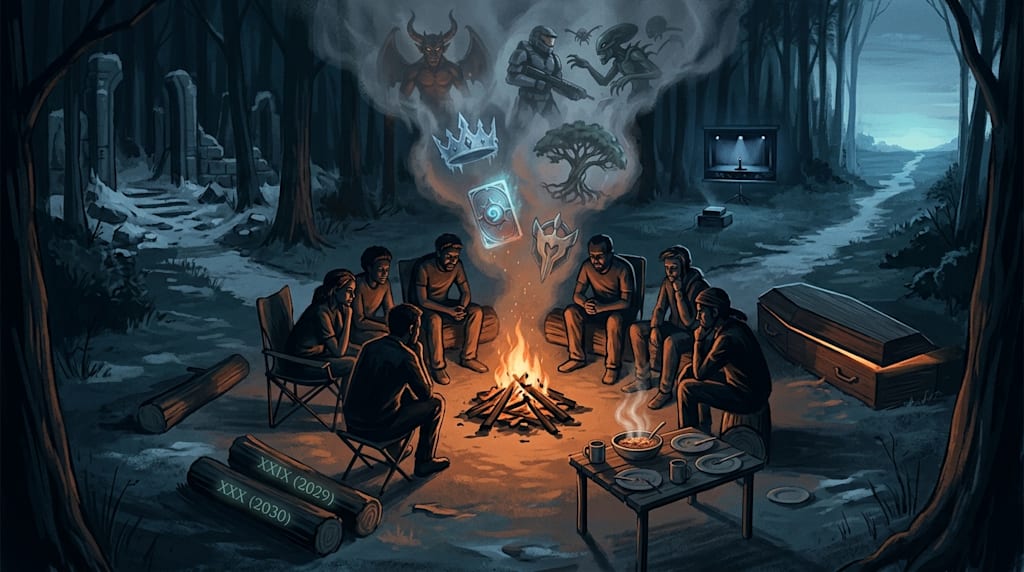
BlizzCon 2026: After the campfire burns out
In the early hours of September 13, 2026, the BlizzCon opening ceremony ended. When the livestream cut back to the studio, the person in front of the screen rubbed their eyes. Outside, it was still dark. The first comments on social media were almost identical: “So dumb. But I watched it all.” That sentence captures the contradiction. You know some of it is vaporware. You know some dates are so far off they sound like a joke. But when those familiar names appear on screen one by one, you still drag the progress bar to the end.
The showcase was built for people who have been around for a decade or more. It felt like a campfire gathering. Everyone seated around it has known each other for years, and the stories are old. The fire warms your hands. Outside the circle, no one looks in.
1. A new log thrown into a fire that hasn’t even caught yet
Diablo V took the most watched slot of the opening ceremony. A thirtieth-anniversary tribute. A proper sequel. Set in a world after Sanctuary has fallen and the three Prime Evils have won. Scheduled for spring 2029. Development logs will continue from 2027. The gear system will copy Diablo II’s classic design. Runewords are confirmed to return.
Every item hits an old player’s memory anchor. The three Prime Evils, Diablo II-style gear, the thirtieth anniversary. The list reads like a promise to old players.
But Diablo IV is still being patched up. The pace of seasonal updates and bug fixes has not satisfied core players, and Blizzard has already thrown a new log into the same fire. One player wrote on a forum: “New Folder 2.0.” Before you could review the last folder, a new one was on the desktop.
There is also the Diablo animated series with Netflix, and plans to expand into Warcraft and Overwatch universes later. Film and television adaptation is an ambition Blizzard has shelved for years. Grafting it onto Netflix with Microsoft’s resources is not a bad direction. But the crack in trust around the games themselves has not been repaired. How much expectation an adaptation can catch is another question.
2. Six years later, the coffin lid cracks open a sliver
If one moment in the showcase made everyone stop scrolling, it was Heroes of the Storm.
New hero Xal’atath, launching September 28. This is the game’s first new hero since Hogger in 2020. Six years.
When the news appeared on screen, the community went silent, then exploded. “So the official team still remembers the login password.” Behind that joke is a game Blizzard had effectively shelved for years. Starting in 2022, the Heroes of the Storm development team shifted to other projects. Content updates nearly stopped. Only server maintenance and sporadic balance adjustments remained. Players asked on forums whether Heroes of the Storm was already dead. The official side never answered directly.
Xal’atath’s arrival matters more as a signal than as content. It says one thing: this game has not been completely forgotten. Blizzard president Johanna Faries mentioned what Heroes of the Storm means to its community during the opening ceremony. For a player base used to silence, being seen is itself a reward. The official side also said the hero roster may expand later. The wording was cautious, but at least a door was left unlocked.
One hero every six years says enough. Heroes of the Storm does not need one corpse twitch. It needs regular updates over time. Otherwise, this revival is likely a PR gesture. Once the heat passes, the coffin lid will close again.
3. Meat that isn’t cooked yet, served first
Next to the surprise of Heroes of the Storm, two pieces of meat were clearly not cooked.
The new StarCraft was announced as an open-world shooter, slated for 2030. It is simply called StarCraft, led by former Far Cry producer Dan Hay. The story is set 70 years after Legacy of the Void. Players take the role of an ordinary soldier fighting a reborn swarm. In an interview with IGN, Dan Hay said 2030 is a definite target, and that giving the team a clear date keeps everyone honest.
The line is fine for PR. For players, it caused backlash almost immediately. From StarCraft II: Wings of Liberty to 2030 is twenty years. For an IP that has waited twenty years, the first full new entry offers a release date four years away and a CG trailer with no gameplay. One player wrote: “A year and a half is the upper limit of vaporware I can accept. Beyond that, you might as well not say anything.”
The deeper problem is the transformation itself. Blizzard is trying to redefine StarCraft with an open-world shooter. It moves from commanding a war from a god’s-eye view to a first-person experience inside the battlefield. Dan Hay mentioned the pressure of a ten-foot hydralisk lunging at the player. He argued that a close-up view can make combat carry more weight. The idea has logic. The risk is right there. StarCraft’s appeal lies in RTS tactical depth and faction rivalry. Turning it into an open-world shooter means using a different genre to carry an IP with very high expectations. Done well, it is a God of War-style rebirth. Done badly, it is another forgotten adaptation.
Diablo V and StarCraft share the same problem. Both use far-off dates to support a story that says, “We are still doing big things.” 2029 and 2030 are anchors. They are signals Blizzard sends to investors and its core community. Whether players will still be there when the signals are redeemed is another story.
4. The only dish served at the table
Among everything at this BlizzCon, the new Warcraft III: Reforged campaign, The Kingdom of the Forsaken, was the only dish served the moment you ordered it.
It went live the same day as the opening ceremony. Over 30 hours of single-player story. A prologue plus three main chapters. The story covers Lordaeron’s fall and the Forsaken’s rise. Players advance through two perspectives, Arthas and Sylvanas. They establish the Undercity in the main story and confront the Scarlet Crusade and the Scourge. A free 3.0 update pushed at the same time overhauled the base game. It added a new “Definitive Edition” graphics mode, remade building and unit models, a revamped inventory system, and a rewritten World Editor.
This is Warcraft III’s first all-new campaign since The Frozen Throne in 2003. Twenty-three years. IGN’s early review called it “a surprisingly good single-player campaign that keeps the spirit of classic Warcraft III while folding in many new ideas.” PCGamer put it more directly: Blizzard is trying to recover from the reputation Warcraft III: Reforged earned back then.
Thirty hours of single-player campaign plus a free major base-game update made this the highest-value item in the entire BlizzCon content lineup. No vaporware. No far-off date. You open Battle.net and download it. For old players who have been here since Reign of Chaos, returning to the ruins of Lordaeron and retelling that frozen history from Sylvanas’s perspective carries enough emotional weight on its own. The problem is that its audience boundary is clear. It serves people who still care about Warcraft III’s narrative. There are fewer of them every year.
5. World of Warcraft’s two legs: one forward, one backward
World of Warcraft pushed two lines at this BlizzCon.
The forward line is The Last Titan, the final chapter expansion of the Worldsoul Saga, teased for 2027. The teaser showed snow-covered Northrend, a massive dark figure striding toward Wyrmrest Temple, then firing a giant laser. Game director Ion Hazzikostas said the final patch of the current expansion, Midnight, titled Critical Etching, will lead to a major reveal. That reveal will set up the climax of World of Warcraft’s twenty-year story.
The backward line is World of Warcraft: Eternal, the “Classic Plus” the community has requested for years. A third World of Warcraft running parallel to modern and Classic servers. The level cap is locked at 60. It adds three new zones, over 1,000 new quests, nine new dungeons, two raids, and a new playable race, Skyborne. The beta begins September 17. Launch is set for November 4.
The logic of this two-line layout is clear. Retail keeps current players. Classic+ recalls lapsed ones. But resource allocation follows. Some players pointed out on forums that the showcase’s resources clearly tilted toward Eternal, while retail 13.0 The Last Titan had very little substance. For an MMO that has run for more than twenty years, Blizzard chose to recall lapsed players over serving existing ones. That may not be the wrong decision, but it shows a judgment: the return from old players is higher than the return from current ones.
6. The quietly updated corner
Under the volume of several heavyweight IPs, the updates for Overwatch and Hearthstone were not small. Their discussion heat was low.
Overwatch announced Doctrine, a vampire-styled support hero. Her core mechanic is Infuse. It enhances the next skill and uses drones to heal teammates and give attack-speed bonuses. Sombra moves from damage to support. Roadhog gets a mechanics rework. Season 5 launches October 6. The new map is Iceland-themed Grímsvötn.
Hero reworks are good. “Sombra to support” caused controversy. A character built around hacking, placed into a support role, needs a fundamental rebuild of her gameplay logic. One player joked that the game might as well be renamed Overwatch: Rework.
Hearthstone announced the new expansion, Rule of the Dark Empire, launching October 20. It centers on the Old Gods and is set tens of thousands of years ago in the era of the Dark Empire. It also announced the first new class in four years, Monk, expected in March 2027, plus a new 2v2 mode.
The addition of 2v2 is Hearthstone’s biggest gameplay experiment in years. If it works, it could bring a new social and competitive dimension to the card game. But Monk has to wait until 2027. Players will rely on expansions alone to stay fresh for the next year and a half.
The updates for these two IPs share one trait. Enough content, little story. They are not as tense as StarCraft’s transformation. They are not as emotional as Heroes of the Storm’s revival. They are just doing their jobs. And doing the job normally, in today’s Blizzard, has become notable.
7. Beyond the campfire
Back to the metaphor.
BlizzCon 2026 was a group of people sitting around a campfire, telling stories they have told for twenty years. Some were told well. Warcraft III’s new campaign had warmth. Heroes of the Storm’s revival had emotion. Classic+’s landing had weight.
But campfire light does not reach far. When Blizzard set StarCraft’s release date in 2030 and Diablo V in 2029, it was saying: please wait a few more years, we are still here.
For StarCraft players who have waited twenty years, that sentence is either comfort or irony. It depends on which side of the campfire you stand on.
Strategically, this BlizzCon exposed Blizzard’s main problem. It owns some of the most valuable game franchises. Most of them are in the middle or late stage of their life cycles. Using new entries to wake up old IPs is the only path. The development cycles are long enough to exhaust players’ patience. StarCraft’s open-world shooter, Diablo V’s return-to-roots theme, Classic+’s parallel world. They all answer the same question: how do you make a twenty-year-old IP still matter in 2026?
Blizzard’s answer: keep old players here first, then think about the next step.
That answer is not pretty. After Microsoft completed its acquisition and the company went through internal restructuring, Blizzard needs something not pretty but stabilizing. BlizzCon 2026 played defense. It held the core player base. It used the same-day Warcraft III campaign and the unexpected Heroes of the Storm update to prove it is still working. It used long-term projects to tell investors and players that the pipeline is still there.
StarCraft’s 2030 and Diablo V’s 2029 work as anchors. Blizzard needs these anchors to prove it is still developing large projects. Players need to sit by the campfire long enough. Long enough that those anchors are no longer a year on a screen, but a game they can download.
One Zhihu user wrote: “After holding it in for years, they dropped a big one. The screen is full of remakes, vaporware, and New Folder. It is all propped up by inherited IP and nostalgia.”
But he still watched the entire livestream.
Every complainer watched the entire livestream.
That is the magic of a campfire. You know it is burning old wood. You know the firelight will eventually dim. But you still cannot help reaching your hands over to warm them.
About the Creator
Jin
Writer of reamstories
https://reamstories.com/jin
Enjoyed the story? Support the Creator.
Subscribe for free to receive all their stories in your feed. You could also become a paid subscriber, letting them know you appreciate their work.
Comments
There are no comments for this story
Be the first to respond and start the conversation.