
I Spent 20 Years Chasing Love. Then I Realised It Was Never the Point.
Four serious relationships, one ring I never gave, and the moment I finally understood that being loved and being happy aren’t the same equation.
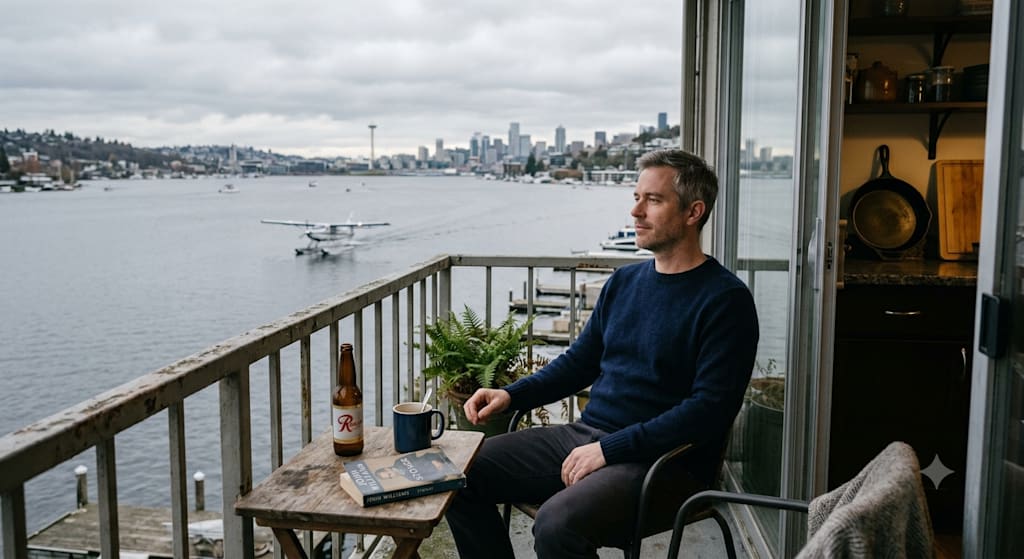
Michael was forty-two that summer when he mailed off the last box of his ex-girlfriend’s things from an apartment in Seattle with a view of the docks. Inside the box: a cashmere scarf, half a bottle of gin, and a copy of Stoner she’d only read halfway through. Standing in line at the post office, he watched a young man in front of him argue into his phone in a low, strained voice, saying over and over, “Do you love me or not?”
Michael looked at the back of that young man’s neck and remembered himself at twenty-something.
The first time he really thought hard about being loved wasn’t in some girlfriend’s bed. It was at the Thanksgiving table in his hometown of Milwaukee. His mother had roasted the turkey. His father, well into the bourbon by the time he carved the meat, suddenly slapped the table and said, “Everything I’ve done my whole life has been for you kids.” Then he slid across a home-repair bill and said the basement pipes needed replacing, the three brothers could split it.
His father loved him. Michael never doubted that. But that night, sitting in his childhood bedroom, listening to the radiator tick and knock, he arrived at a thought: his father’s love was real, and so were the belittling and the control. Both things could be true at the same time, like two numbers printed on the same bill.
Being loved and being happy might not even belong on the same line.
Later, he had four serious relationships. Sarah loved him deeply. Sarah would take a cab across the entire city to bring him soup when he worked late. She wrote him three-page letters by hand on his birthdays. But Sarah also, during the months he was laid off, kept saying, “I believe in you, you’ll find something better,” her voice gentle, her eyes on her phone. It wasn’t that she didn’t love him. She just couldn’t bear a man who was temporarily failing. That was a fear sunk into her bones, and it had nothing to do with whether she loved him or not.
When they broke up, Sarah cried for a long time. She said, “I really love you.” He said, “I know.”
That night he slept on the living room sofa. He woke at three in the morning and noticed the pothos in the corner had gone unwatered for a long time, its leaves yellowing and curled at the edges. He filled a glass of water, crouched down, and poured it slowly into the pot. He wasn’t thinking about Sarah. He was thinking about when he had become someone who needed to be loved by another person just to confirm he existed.
Sarah had given him love. But the honesty inside a relationship, the willingness to shoulder weight, the ability to stand firm when things got hard—those weren’t decided by love. Those were the shape a person had been pressed into by everything they’d lived through: how they treated a waiter when no one was watching, how they faced their own failures, how they treated a life weaker than their own. The word for those things was character, and it didn’t share a root with love.
He’d known women of extraordinary character; being with them wasn’t always passionate. He’d also been loved by women who loved hysterically, a love as thick and undiluted as a shot of espresso, and it gave him a stomachache.
At thirty-five, he almost got engaged. Her name was Claire. She had a crooked canine tooth when she smiled and cooked bacon in a cast-iron skillet on weekend mornings, grease splattered across the stovetop that she never wiped up. He loved her. She loved him. But Claire had a habit: every time they fought, she would disappear for two days. No messages, no calls, then she’d walk back in as if nothing had happened, as if those two blank days were just a printing error on the calendar. She wasn’t unfaithful. She was terrified of conflict itself. And Michael was terrified of being left.
Both of them carried their own cracks. They loved each other hard, but the cracks didn’t line up.
Their last fight was about something small—maybe the dishwasher, or how to tie a garbage bag. Claire put on her coat and left. Michael sat on the kitchen floor. The tiles were cold. He realized he felt no impulse to go after her, only a vast exhaustion. A thought flickered through his head: We love each other. But we can’t live together.
There was no contradiction between those two sentences. Like a math equation where both sides balanced but produced no graphable function.
Later, on a rainy Tuesday night, packing moving boxes, a ring rolled out of an old wallet. Silver, no diamond. The style he’d picked for proposing. He crouched there a long time looking at it, then placed it into the box he was sending to Claire. No note.
After that, he lived alone for three years.
The hardest part of the first six months wasn’t the loneliness. It was the withdrawal from being loved. Like cutting sugar. The body craves that sweetness, knowing full well it’s bad for the metabolism, and still you open an ex’s Instagram late at night. He made himself a rule: every time he wanted to text someone “how have you been,” he went to the gym and did a set of deadlifts. Three months later he could pull twice his body weight, and the drafts folder on his phone was empty.
Then he started noticing things he’d overlooked before.
Health. His physical at forty: blood pressure normal, cholesterol slightly high, the doctor telling him to cut back on red meat. He ran three mornings a week along Lake Union, watching seaplanes take off and land. The steadiness of the body was concrete—heart rate in the aerobic zone, knees not hurting, a thin layer of sweat after a run, stepping into the shower feeling like the day could actually begin. That kind of groundedness didn’t need anyone else to confirm it.
Finances. He worked in supply-chain management at Amazon. Not rich, but the number in his account was enough to quit and rest for six months if he ever needed to. That security wasn’t something being loved could give him. Claire had loved him fully, but she’d never once helped him pay off a credit card.
The interior life. He started reading novels again—not fragmented news on a phone screen, but sitting in a leather armchair and finishing the whole of Stoner. When he reached the passage near Stoner’s death, he closed the book and looked out at the rain and thought that being understood by a book is sometimes more accurate than being understood by a person. A book doesn’t leave. It doesn’t vanish for two days of silence and then come back pretending everything is normal.
His thirty-two-year-old cousin flew in from Austin to see him. They sat on the balcony drinking beer, and the cousin suddenly asked, “Don’t you ever get lonely?”
Michael said, “Sometimes. But you know what’s worse than loneliness? Being with someone and still feeling alone.”
His cousin said nothing. Out on the lake, a seaplane was coming in to land.
Michael pointed at it and said, “Look. When it lands, it doesn’t need the lake to love it. It just needs the water to be calm enough.”
His cousin laughed. “When did you get so old and wise?”
“From the moment I realized being happy and being loved are two different things,” Michael said.
He knew his cousin might not get it. Some understandings have to be walked through personally before they can be carved into the bone. Just like at twenty you don’t believe staying up late damages your liver, and at forty you find out it damages everything. Being loved is sweet. But sweetness isn’t nutrition. What actually holds a person’s life up are things with no emotional volatility: a six-thirty alarm clock, an emergency fund in the bank, a back that doesn’t betray you, and a partner you can trust to fix the dishwasher herself when it breaks instead of disappearing for two days.
He hadn’t given up on love. He had just stopped placing being loved on an altar.
Last autumn he met Elena. A divorce attorney. She smoked a mint-flavored vape and spent weekends volunteering at a food bank. She didn’t often say she loved him, but when he talked about his mother being ill, she muted the television. When they argued, she would say, “I need to cool down. I’ll be back in half an hour,” and then actually came back in half an hour.
Once they had a bad fight. He later forgot what started it. Elena put on her coat and walked to the door. He thought she was leaving, but she stopped in the entryway and turned around. “I’m really angry right now,” she said, “but I need you to know, I’m not leaving. I just need to go downstairs and get some air.”
She went downstairs. Fifteen minutes later she came back holding two cups of hot chocolate.
That was when he understood. Not because Elena loved him—she did love him, but Claire had loved him too. The difference was that Elena knew how to handle anger. She knew how to drop anchor in a storm. That had nothing to do with love. It was about who she, as a person, had been shaped by life to become.
Now he is forty-two, sitting in his Seattle apartment, gray sky and glinting lake outside the window. On the coffee table, a cup of cold coffee and a copy of Stoner open to the middle. He’s heading to the gym this afternoon. Elena is coming over tonight. They’re going to try out that new cast-iron skillet.
He no longer chases the feeling of being loved. What he chases is waking up each morning with a body that doesn’t hurt, a mind that isn’t rattled, and the person beside him—if there is one—being someone he can trust.
Love comes. Love goes. Love changes. Love becomes the past tense. But a person who knows how to keep their own life in order, standing shoulder to shoulder with another solid person; that, to him, is closer to happiness than love itself ever was.
He didn’t tell his cousin any of this. He just finished his beer, clapped his cousin on the shoulder, and said, “Don’t rush to find answers. Go for a run first.”
On the balcony, two empty beer bottles remained, and a whole afternoon of lake light.
About the Creator
Jin
Writer of reamstories
https://reamstories.com/jin
Enjoyed the story? Support the Creator.
Subscribe for free to receive all their stories in your feed. You could also become a paid subscriber, letting them know you appreciate their work.
Comments
There are no comments for this story
Be the first to respond and start the conversation.