
THE ORIGIN OF LIFE ON EARTH
The evolution of life on Earth is one of the most fascinating stories in science

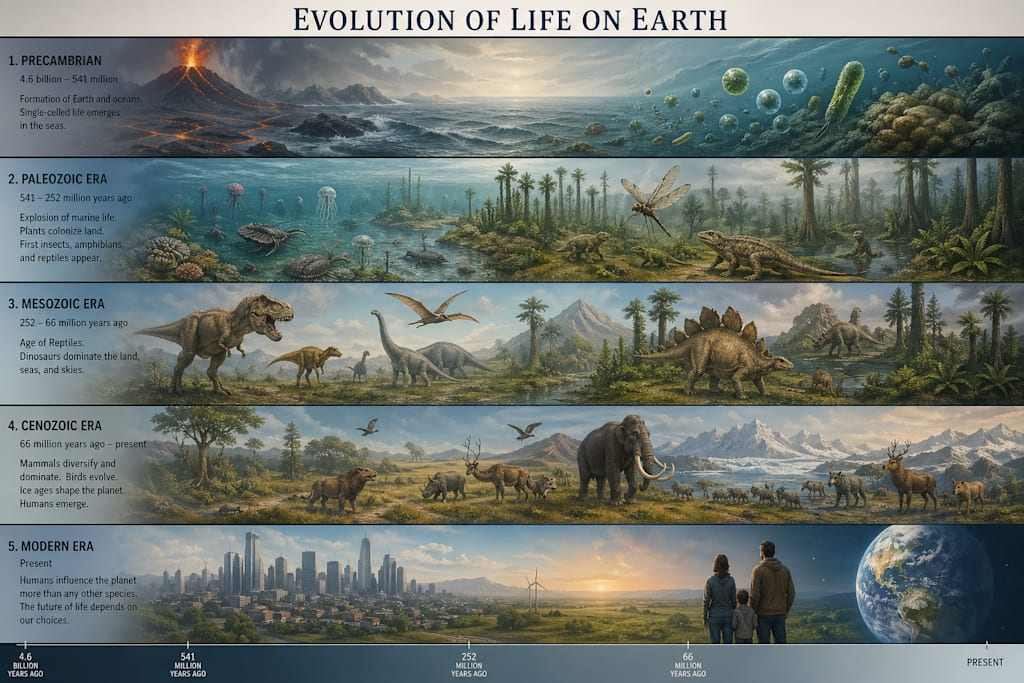
The origin of life on Earth stands as one of the great mysteries of science. Various answers have been proposed, all of which remain unverified. To find out if we are alone in the galaxy, we will need to better understand what geochemical conditions nurtured the first life forms. What water, chemistry and temperature cycles fostered the chemical reactions that allowed life to emerge on our planet? Because life arose in the largely unknown surface conditions of Earth’s early history, answering these and other questions remains a challenge.
Several seminal experiments in this topic have been conducted at the University of Chicago, including the Miller-Urey experiment that suggested how the building blocks of life could form in a primordial soup.
When did life on Earth begin?
Earth is about 4.5 billion years old. Scientists think that by 4.3 billion years ago, Earth may have developed conditions suitable to support life. The oldest known fossils, however, are only 3.7 billion years old. During that 600 million-year window, it's possible that life may have emerged repeatedly, only to be snuffed out by catastrophic collisions with asteroids and comets.
The details of those early events are not well preserved in Earth’s oldest rocks. Some hints come from the oldest zircons, highly durable minerals that formed in magma. Scientists have found traces of a form of carbon—an important element in living organisms—in one such 4.1 billion-year-old zircon. However, it does not provide enough evidence to prove life’s existence at that early date.
Where did life on Earth begin?
The early days on Earth looked very different from today—it was extremely hot, volcanically active, and bathed in brutal ultraviolet radiation. Since we don’t have fossils from this time, scientists can look at life forms that still exist today in similar conditions. From these, they have suggested possibilities where life first began.Organic molecules may also have formed in certain types of clay minerals that could have offered favorable conditions for protection and preservation. This could have happened on Earth during its early history, or on comets and asteroids that later brought them to Earth in collisions. (If the latter is true, this would suggest that the same process could have seeded life on planets elsewhere in the universe.)
What are the ingredients of life on Earth?
The recipe consists of a steady energy source, organic compounds and water.
Sunlight provides the energy source at the surface, which drives photosynthesis. On the ocean floor, geothermal energy supplies the chemical nutrients that organisms need to live.
Also crucial are the elements important to life. For us, these are carbon, hydrogen, oxygen, nitrogen, and phosphorus. But there are several scientific mysteries about how these elements wound up together on Earth. For example, scientists would not expect a planet that formed so close to the sun to naturally incorporate carbon and nitrogen. These elements become solid only under very cold temperatures, such as exist in the outer solar system, not nearer to the sun where Earth is. Also, carbon, like gold, is rare at the Earth’s surface. That’s because carbon chemically bonds more often with iron than rock. Gold also bonds more often with metal, so most of it ends up in the Earth’s core. So, how did the small amounts found at the surface get there? Could a similar process also have unfolded on other planets?
The last ingredient is water.
Water now covers about 70% of Earth’s surface, but how much sat on the surface 4 billion years ago? Like carbon and nitrogen, water is much more likely to become a part of solid objects that formed at a greater distance from the sun. To explain its presence on Earth, one theory proposes that a class of meteorites called carbonaceous chondrites formed far enough from the sun to have served as a water-delivery system.
Some microorganisms thrive in the scalding, highly acidic hot springs environments like those found today in Iceland, Norway and Yellowstone National Park. The same goes for deep-sea hydrothermal vents. These chimney-like vents form where seawater comes into contact with magma on the ocean floor, resulting in streams of superheated plumes. The microorganisms that live near such plumes have led some scientists to suggest them as the birthplaces of Earth’s first life forms.
Life emerged from a primordial soup. As a University of Chicago graduate student in 1952, Stanley Miller performed a famous experiment with Harold Urey, a Nobel laureate in chemistry. Their results explored the idea that life formed in a primordial soup.
Miller and Urey injected ammonia, methane and water vapor into an enclosed glass container to simulate what were then believed to be the conditions of Earth’s early atmosphere. Then they passed electrical sparks through the container to simulate lightning. Amino acids, the building blocks of proteins, soon formed. Miller and Urey realized that this process could have paved the way for the molecules needed to produce life.
Scientists now believe that Earth’s early atmosphere had a different chemical makeup from Miller and Urey’s recipe. Even so, the experiment gave rise to a new scientific field called prebiotic or abiotic chemistry, the chemistry that preceded the origin of life. This is the opposite of biogenesis, the idea that only a living organism can beget another living organism.
The Rise of Oxygen
A major turning point in Earth’s history occurred when some bacteria developed photosynthesis. These organisms, known as cyanobacteria, used sunlight to produce energy and released oxygen as a byproduct. Over millions of years, oxygen accumulated in the atmosphere during an event called the Great Oxygenation Event.
This oxygen changed Earth forever. It allowed the development of more complex cells, called eukaryotes, which later gave rise to plants, fungi, and animals.
The Explosion of Life
Around 541 million years ago, a dramatic increase in biodiversity took place during the Cambrian Explosion. Many new forms of life appeared in the oceans, including early fish, worms, and arthropods. This period marked the beginning of rapid evolution.
Soon, plants began to colonize land, followed by insects and amphibians. Forests spread across continents, creating new habitats and increasing oxygen levels even further.
Age of Reptiles and Dinosaurs
About 252 million years ago, the Mesozoic Era began, often called the Age of Reptiles. Dinosaurs became the dominant land animals, while flying reptiles ruled the skies and marine reptiles lived in the seas.
During this era, the first mammals and birds also evolved. Mammals were small and lived in the shadow of dinosaurs for millions of years.
Mass Extinction and Mammals
Approximately 66 million years ago, a massive asteroid struck Earth near present-day Mexico. This event caused widespread destruction and led to the extinction of the dinosaurs and many other species.
With dinosaurs gone, mammals rapidly diversified. They evolved into many forms, including whales, bats, horses, and primates.
Human Evolution
The earliest human ancestors appeared in Africa around 6 to 7 million years ago. Over time, species such as Australopithecus and Homo habilis evolved. Later, Homo erectus developed larger brains and used tools.
Modern humans, Homo sapiens, emerged around 300,000 years ago. Humans spread across the globe, developing language, agriculture, civilizations, and advanced technology.
Evolution Continues
Evolution is not a process of the past—it continues today. Animals adapt to changing climates, bacteria evolve resistance to antibiotics, and species respond to environmental pressures.
The story of life on Earth shows the power of adaptation, survival, and change. From tiny microbes in ancient oceans to modern humans exploring space, evolution remains one of nature’s greatest wonders.
About the Creator
Ibrahim Shah
I am an Assistant Professor with a strong commitment to teaching,and academic service. My work focuses on fostering critical thinking, encouraging interdisciplinary learning, and supporting student development.
Enjoyed the story? Support the Creator.
Subscribe for free to receive all their stories in your feed.
Comments
There are no comments for this story
Be the first to respond and start the conversation.