
The Man Behind the Thread: The Secret History of Cato
Americana at its finest...

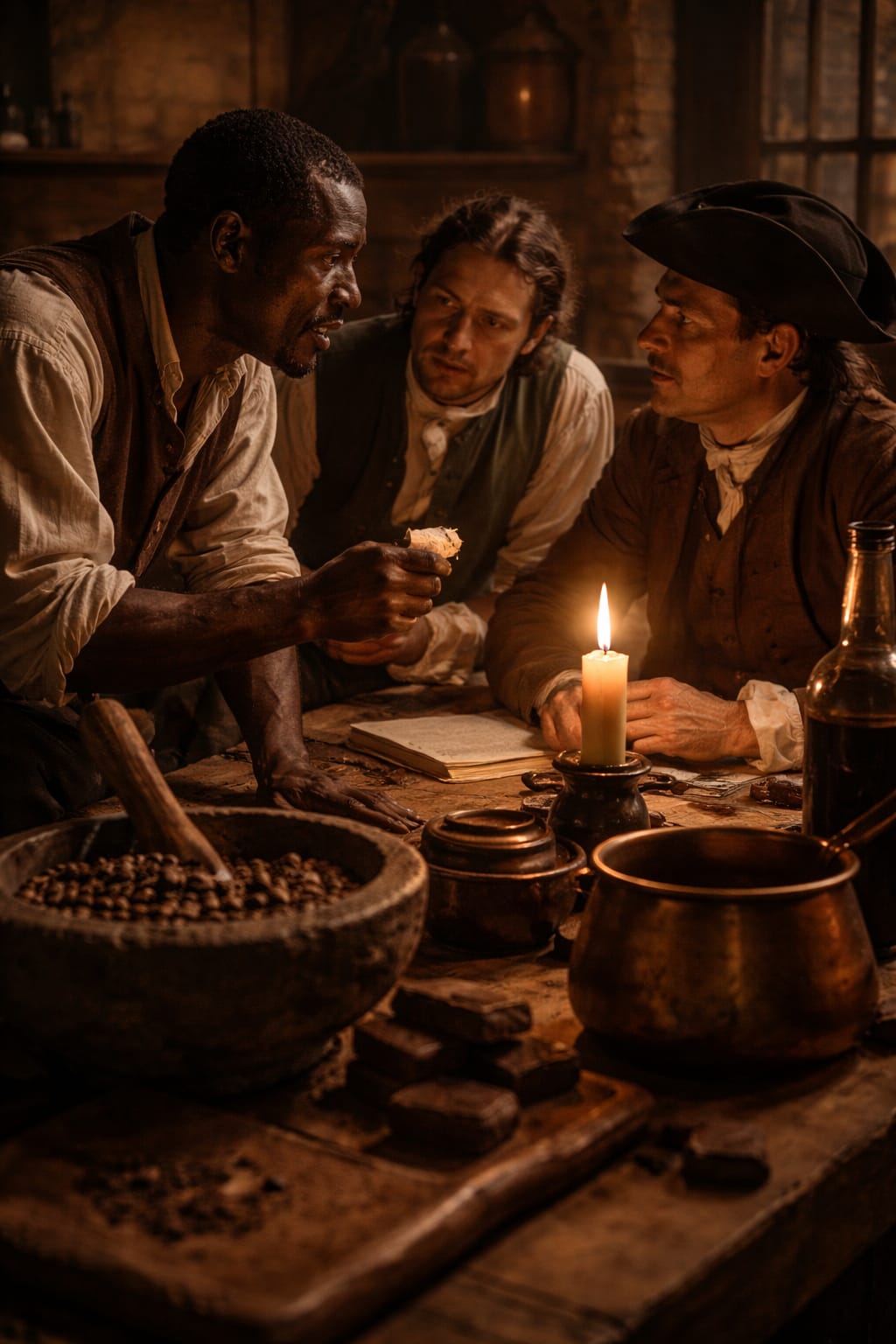
There are moments in history that hinge on a single decision, a single warning, a single whispered piece of information passed from one person to another at exactly the right time. We tend to imagine those moments as grand, dramatic scenes, generals hunched over maps, soldiers riding through the night, leaders making impossible choices beneath the weight of destiny. But more often than not, history turns quietly. It moves through ordinary rooms, across worn wooden floors, through conversations that barely rise above a murmur. And sometimes, the fate of a nation passes not through the hands of the powerful, but through someone history almost forgot.
In the years leading up to the American Revolution, New York City was a place of tension and divided loyalties, a city where British officers moved freely through its streets while whispers of rebellion traveled just as quickly beneath the surface. Shops, taverns, and homes became more than places of business or rest; they became nodes in a growing, invisible network of information. Among these was a tailor shop run by a man who would later become known as one of the most daring spies of the Revolution... Hercules Mulligan. To British officers, Mulligan was simply a skilled craftsman, a man who took their measurements, fitted their coats, and listened politely as they spoke. But behind that polite demeanor was a patriot who understood that loose talk could be as valuable as any weapon.
The story that has come down through time tells us that Mulligan used his position well, gathering intelligence from British officers who spoke freely in his presence, believing themselves among allies. It is said that he passed along information that helped warn George Washington of potential danger, including at least one rumored assassination plot. It is a story of cunning and courage, and for years it has stood largely on its own, a neat and compelling narrative of espionage in the birth of a nation.
But history, like those quiet rooms where it unfolds, is rarely so simple. Because Mulligan was not alone. Working alongside him, living within his household, moving through the same spaces, hearing the same conversations, was an enslaved man named Cato. And while his name appears only faintly in the historical record, recent research and reexamination of the era suggest that Cato may have played a far more significant role than previously understood. Not as a bystander. Not as a footnote. But as a critical link in the chain of information that helped shape events far beyond his control.
To understand how this could be, you have to picture the rhythm of daily life in colonial New York. Mulligan’s shop was not just a place where clothes were made. It was a place where British officers lingered, where conversations stretched beyond business, where assumptions were made. They spoke freely because they believed they were among friends. They spoke freely because they believed certain people were not listening.
But Cato was always there. He moved through the shop and the household in ways that made him both visible and invisible. He carried fabrics, delivered finished garments, and ran errands through the streets of a city alive with tension. He was present in the margins of conversations, in the pauses between words, in the spaces where information often slips through unnoticed. And unlike Mulligan, whose role required a degree of subtlety, Cato’s position allowed him to move more freely, to travel without drawing the same level of suspicion.
This is where the story begins to shift. Because intelligence gathering is only part of espionage. Information must also move. It must travel from one place to another, often quickly, often quietly, often without attracting attention. And in a city watched closely by British forces, that kind of movement was dangerous. Messages could not always be written down. Couriers could not always be trusted. Every step carried a risk.
But a man like Cato could move through the city in ways others could not. He could pass through checkpoints with less scrutiny. He could carry messages hidden in plain sight. He could act as the connective tissue between Mulligan’s shop and the broader network of patriots working to undermine British control. In this light, the story of Mulligan as a lone operator begins to feel incomplete. It becomes something larger, more complex, a partnership operating under the constraints and realities of a deeply unequal world.
Some accounts suggest that when Mulligan learned of a potential threat to Washington, the urgency of the moment required immediate action. There was no time for elaborate planning, no time for hesitation. The warning had to reach its destination. And in that moment, the question becomes not just who knew, but who could act.
If Cato was the one who carried that warning, if he moved through the streets of New York with information that could alter the course of the Revolution, then his role was not secondary. It was essential.
And yet, history is not always kind to those who operate in the shadows. Mulligan’s name endured. Washington’s legacy became foundational to the nation itself. But Cato’s story faded, reduced to fragments, overshadowed by the larger figures around him. This is not unusual. History has a way of preserving certain voices while allowing others to slip into silence, especially when those voices belonged to people who were never granted full agency in their own time.
But silence does not mean absence. It means we have to listen differently. It means we have to look at the spaces between the recorded events and ask who else was there, who else was involved, who else made those moments possible. It means acknowledging that the story of the American Revolution, like the story of any nation, is not just the story of its leaders, but of the countless individuals whose contributions were never fully documented.
Cato’s story, as it is being rediscovered, offers something rare and powerful. It challenges the simplicity of familiar narratives. It asks us to reconsider what we think we know. It reminds us that history is not fixed, that it can expand and evolve as new perspectives come to light.
And perhaps most importantly, it invites us to recognize the humanity at the center of it all. Because behind the speculation, behind the research, behind the effort to reconstruct a life from limited evidence, there is a man who lived in a world not of his choosing. A man who navigated that world with awareness, with intelligence, and possibly with a quiet determination to influence events in whatever way he could. A man who may have carried information that helped protect the life of someone who would go on to shape the future of a nation.
There is something profoundly moving about that possibility. Not because it fits neatly into a heroic narrative, but because it doesn’t. It is complicated. It is imperfect. It exists in the gray spaces where most real lives unfold. And that is what makes it worth telling.
The story of Cato does not replace the story of Hercules Mulligan. It deepens it. It adds dimension to it. It transforms it from a tale of individual bravery into something more collaborative, more human, more reflective of the world in which it took place.
It also serves as a reminder that history is not just what we inherit. It is what we choose to remember. And sometimes, remembering means going back, looking again, and seeing what was there all along but never fully acknowledged.
In the end, the American Revolution was not won by a single act, a single battle, or a single figure. It was the result of countless decisions, countless risks, countless moments where individuals stepped into uncertainty and did what they believed was necessary.
Some of those individuals became legends. Others became shadows. But shadows, as any lighthouse keeper will tell you, are only visible because of the light. And sometimes, if you look closely enough, you can see the shape of something that was there all along... waiting, quietly, to be recognized.
About the Creator
The Iron Lighthouse
Where folklore meets freeway. A guide to the strange heart of the American backroads...
Enjoyed the story? Support the Creator.
Subscribe for free to receive all their stories in your feed.
Comments
There are no comments for this story
Be the first to respond and start the conversation.