Discoveries
Archeologists Discovered the Earliest Dental Bridge in Aberdeen
Archaeologists in Scotland have uncovered one of the most fascinating discoveries in the history of medieval medicine and dentistry: the earliest known example of restorative dental treatment ever identified in Scotland. The remarkable find was made during the examination of skeletal remains from a medieval burial in Aberdeen, where researchers discovered a middle-aged man buried with a carefully crafted gold dental bridge attached to his lower front teeth.
By History Seeker4 months ago in History
Did You Know That The Maya Civilization Used Hallucinogenic Substances?
The Maya civilization, which flourished in Mesoamerica from roughly 2000 BCE to 1500 CE, developed one of the most sophisticated cultural and religious systems of the ancient world. Their society was deeply rooted in a worldview where nature, gods, ancestors, and humans were all interconnected. The natural environment was not separate from the spiritual realm but rather an extension of it. Mountains, caves, plants, animals, the sky, and even altered states of consciousness were considered pathways to divine communication.
By History Seeker4 months ago in History
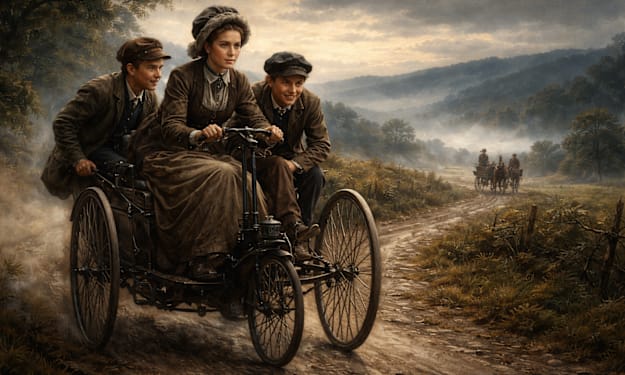
The Benz Patent-Motorwagen: The Invention She Funded, Tested, and Improved — and Could Not Own
She pushed the machine out of the workshop before dawn so that the engine noise would not wake him. August 5, 1888. Mannheim, Germany. Her husband, Carl, was still asleep. Bertha Benz and her two teenage sons, Eugen (fifteen) and Richard (thirteen), rolled Patent-Motorwagen Number 3 down the street by hand. They passed the sleeping houses and the horses that shied away from the strange smell. They continued until they were far enough away to start the engine without being heard. She had left a note on the table. She had not asked the police for permission, which was legally required. She hadn't told Carl, either. She was going to drive 106 kilometers to visit her mother in Pforzheim.
By Chronicle and Void4 months ago in History
Mammoths and Early Human Civilization: Giants of the Ice Age and the Rise of Humanity
Mammoths, among the most iconic creatures of the Ice Age, continue to fascinate scientists and the public alike, offering a vivid window into the deep past of both Earth and humanity. These enormous, elephant-like mammals with towering curved tusks, dense shaggy coats, and powerful bodies once dominated vast regions of the Northern Hemisphere. They moved slowly but powerfully across frozen tundras, steppe grasslands, and glacial landscapes that stretched across continents. To early humans, however, mammoths were not just distant wildlife—they were deeply intertwined with survival, shaping the rhythms of daily life, technological progress, and even early spiritual thought.
By History Seeker4 months ago in History
The Rise of Apple
In 1976, in a quiet suburban garage in Los Altos, California, two young men set out to change the world. Their names were Steve Jobs and Steve Wozniak, and what they built together would eventually become Apple Inc—one of the most valuable and influential companies in history.
By Bob Madden4 months ago in History
Moral Law and False Witness
When Truth Is Not Optional Moral systems do not begin with outcomes. They begin with constraints. Certain acts are treated as wrong not because they fail, but because performing them already constitutes the failure. Bearing false witness has always occupied that category. It is not condemned because it sometimes produces injustice. It is condemned because it corrupts the very process by which justice is discerned. Once falsehood is introduced deliberately, the pathway to truth is no longer reliable, even if it occasionally arrives at a correct destination.
By Peter Thwing - Host of the FST Podcast4 months ago in History
Pakistan Army in Global Perspective
Pakistan Army in Global Perspective The Pakistan Army is widely regarded as one of the most capable armed forces in the developing world. While it may not rival the scale and technological dominance of superpowers, it has built a reputation for efficiency, resilience, and operational effectiveness. To understand its true standing, it is essential to compare it with other major militaries such as those of the United States, China, Russia, and India.
By Wings of Time 4 months ago in History
Encephalitis Lethargica: Why a Century of Science Still Cannot Find the 1917 Pathogen
In 1997, a team of molecular archaeologists exhumed the body of an Inuit woman who had been buried in the Alaskan permafrost. She had died from the 1918 influenza virus. Her lungs, preserved by the ice, still contained fragments of the virus. Using those fragments, scientists reconstructed the full genome of the deadliest pandemic in modern history.
By Chronicle and Void5 months ago in History
A Millennium of Glory: The Byzantine Empire's Ascent and Decline
One of the most dramatic eras in human history was late antiquity, when nations and peoples rose and collapsed in a bloody struggle for dominance and territory. The world was changing as a result of massive migrations, the emergence of bizarre new religions, and the obsolescence of centuries-old customs.
By Francis Dami5 months ago in History