
The Winter That Nearly Broke the Revolution
The Oneida Allies of Valley Forge

There are certain moments in history that become so iconic they begin to feel almost mythological. The winter at Valley Forge encampment is one of them.
Most Americans recognize the imagery immediately: barefoot soldiers crossing frozen ground, smoke rising from crude log huts, ragged Continental troops huddled against the brutal Pennsylvania winter while George Washington struggles to hold together an army and a revolution that seemed perpetually on the verge of collapse.
It is remembered as a story of endurance. Of sacrifice. Of the birth pains of a nation. But buried beneath the familiar mythology is another story, one often reduced to a historical footnote despite the fact that it may have helped save the Continental Army itself. It is the story of the Oneida Nation. And the long journey they made through the winter, carrying food to starving soldiers who might otherwise never have survived to continue the war.
By the winter of 1777, the American Revolution was in serious trouble. The British had captured Philadelphia, forcing Washington’s army into retreat. The Continental Army limped toward Valley Forge exhausted, undersupplied, and dangerously demoralized. Of the roughly 12,000 soldiers who entered the encampment that December, many lacked proper coats, boots, blankets, or even functional weapons. Food shortages became catastrophic almost immediately.
Supply systems were disorganized and often corrupt. Roads turned to mud or ice. Livestock failed to arrive. Flour shipments disappeared. Soldiers routinely went days with little or nothing to eat. Some reportedly survived on thin mixtures of flour and water baked into crude cakes over open fires. Others simply starved.
Disease spread rapidly through the camp. Typhus, dysentery, pneumonia, and influenza tore through the exhausted ranks. Men slept in overcrowded huts with inadequate heat while freezing winds swept through the encampment. The smell of sickness, smoke, sweat, and death lingered constantly in the air.
By February, the army was nearing collapse. And Washington knew it. The image of Valley Forge has often been framed as a purely American struggle, isolated and self-contained. But the Revolutionary War was never that simple. It was not merely a conflict between colonists and the British Crown. It was also a tangled web of alliances involving European powers, enslaved people seeking freedom, frontier settlers, and Indigenous nations forced to navigate a war unfolding directly across their lands.
Among the nations confronting this impossible choice were the Haudenosaunee, often known to Europeans as the Iroquois Confederacy. For generations, the Haudenosaunee Confederacy had maintained a delicate political balance among its member nations, including the Mohawk, Seneca, Cayuga, Onondaga, Tuscarora, and Oneida. But the American Revolution fractured that unity. Different nations chose different paths depending on political alliances, trade relationships, geography, and survival.
The Oneida chose to support the revolutionaries. It was not a decision without enormous risk. The alliance between the Oneida and the Continental forces developed gradually through diplomacy, trade, and missionary influence. Oneida leaders had established relationships with colonial figures for years before the war, and some believed British expansion posed a greater long-term threat to their autonomy.
Others hoped cooperation might secure protection for their lands and people after the conflict ended. Whatever the reasons, the Oneida became one of the few Indigenous nations to openly aid the American cause. And during the winter at Valley Forge, that alliance became critically important.
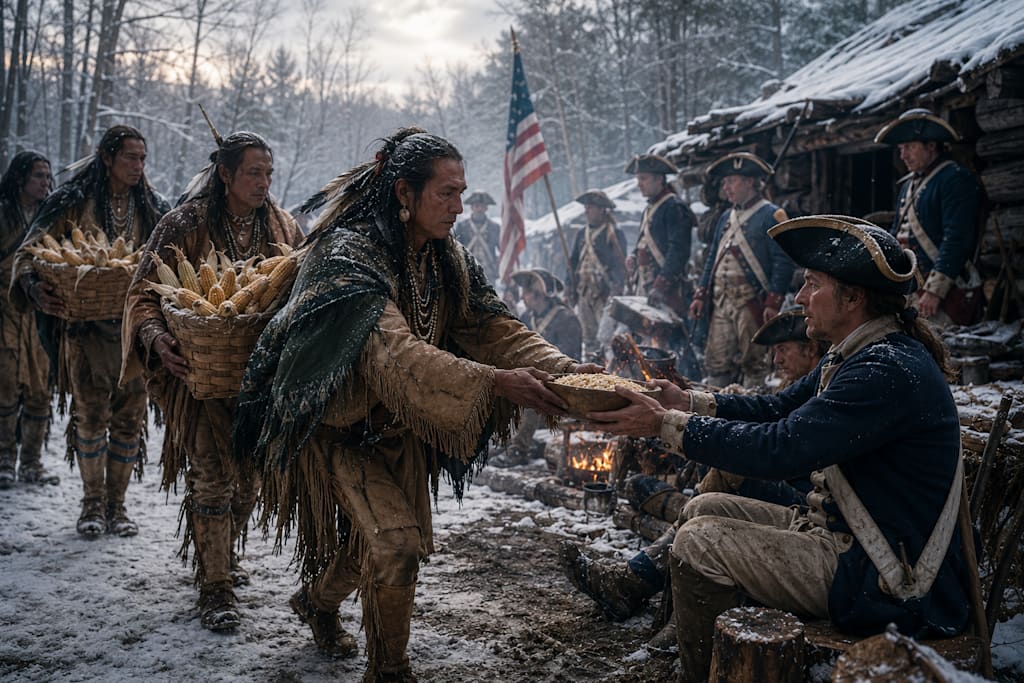
As the Continental Army’s food crisis worsened, Oneida communities gathered supplies of white corn and began transporting it to Washington’s starving soldiers. The distances involved were staggering.
Travel during winter in the late eighteenth century was already dangerous under normal conditions. Snow, ice, and freezing temperatures transformed roads and wilderness trails into punishing terrain. Yet Oneida men and women reportedly carried heavy loads of corn for hundreds of miles through these brutal conditions to reach the encampment.
Not with wagons filled by industrial supply systems. Not with military caravans. On their backs. The image is difficult to shake once imagined clearly. Small groups moving through frozen forests. Snow crunching beneath moccasins. Breath hanging in the air. Bushels of white corn carried mile after mile toward an army they knew was starving. The white corn itself was more than simple food. It was survival knowledge.
Oneida members taught Continental soldiers how to prepare and use the corn properly, grinding and boiling it into nourishing meals that could sustain weakened troops through the winter months. Some accounts describe a preparation similar to a porridge or soup, dense enough to provide desperately needed calories and nutrition.
To starving men at Valley Forge, it may as well have been salvation. Because food in wartime is never merely food. Food is morale. Food is endurance. Food is time. And at Valley Forge, time was exactly what the revolution desperately needed. It is difficult to overstate how fragile Washington’s army truly was during that winter.
Historians often speak of Valley Forge as a turning point because the army emerged more disciplined and unified by spring, thanks in part to the training efforts of Baron Friedrich von Steuben. But that later transformation can obscure just how close the encampment came to disaster beforehand.
Thousands died during the winter. Desertion remained a constant threat. Had conditions deteriorated further, the army might have disintegrated entirely. And if Washington’s army collapsed, the revolution itself may have collapsed with it.
That is what makes the Oneida contribution so significant. Their aid was not symbolic. It was practical and immediate. Life-preserving. And yet, for generations, their role remained largely absent from mainstream accounts of the Revolutionary War.
Part of this omission reflects a broader pattern in American historical memory. National myths often simplify complicated events into cleaner narratives with familiar heroes and easily recognizable symbols. Stories that do not fit neatly into those narratives frequently fade into the margins, no matter how important they were.
The Revolution became remembered primarily as a struggle between colonial patriots and British forces, leaving less room for the many groups whose contributions complicated that image. But the Oneida story complicates it in necessary ways.
Because it reminds us that the survival of the United States was not achieved alone. There is also a deeper irony woven into the story.
Despite their alliance and sacrifices, the Oneida, like many Indigenous nations, would later face displacement, broken treaties, land loss, and political marginalization as the United States expanded westward after independence. The same revolution they helped sustain ultimately became part of the machinery that transformed Indigenous life across the continent.
That reality does not erase the significance of their actions at Valley Forge. If anything, it makes them more poignant. Because the aid they provided was given during a moment of profound uncertainty, without any guarantee that the future would reward their loyalty.
Every Iron Lighthouse story eventually arrives at the place where history stops feeling distant and suddenly becomes deeply human. Here, that moment may be found not in the politics of war, but in a quieter image.
A starving soldier receives a bowl of corn. Hands are trembling from the cold. Smoke rising through the winter air. The realization that someone came through the snow carrying food because they understood what hunger looked like.
History often celebrates victories won in battle. But survival itself is sometimes the greater victory. And survival usually depends on people whose names rarely appear in textbooks.
Today, visitors to Valley Forge encampment walk through reconstructed huts and frozen fields while hearing stories of Washington’s endurance and the army’s perseverance. Those stories matter. But so does this one.
The story of the Oneida who crossed winter landscapes carrying white corn to starving soldiers. The story of an alliance built in uncertainty. The story of a contribution so vital that without it, the American Revolution itself might have taken a very different path. Because nations are rarely built by the people history remembers most loudly.
More often, they are carried forward by quieter acts of courage. A shared fire. A long journey. A burden carried through the snow.
And food was placed into the hands of strangers who needed it desperately enough to survive another day...
About the Creator
The Iron Lighthouse
Where folklore meets freeway. A guide to the strange heart of the American backroads...
Enjoyed the story? Support the Creator.
Subscribe for free to receive all their stories in your feed.
Comments
There are no comments for this story
Be the first to respond and start the conversation.