
The City They Built: The Rise and Fall of America’s Black Wall Street
An Iron Lighthouse Special Edition

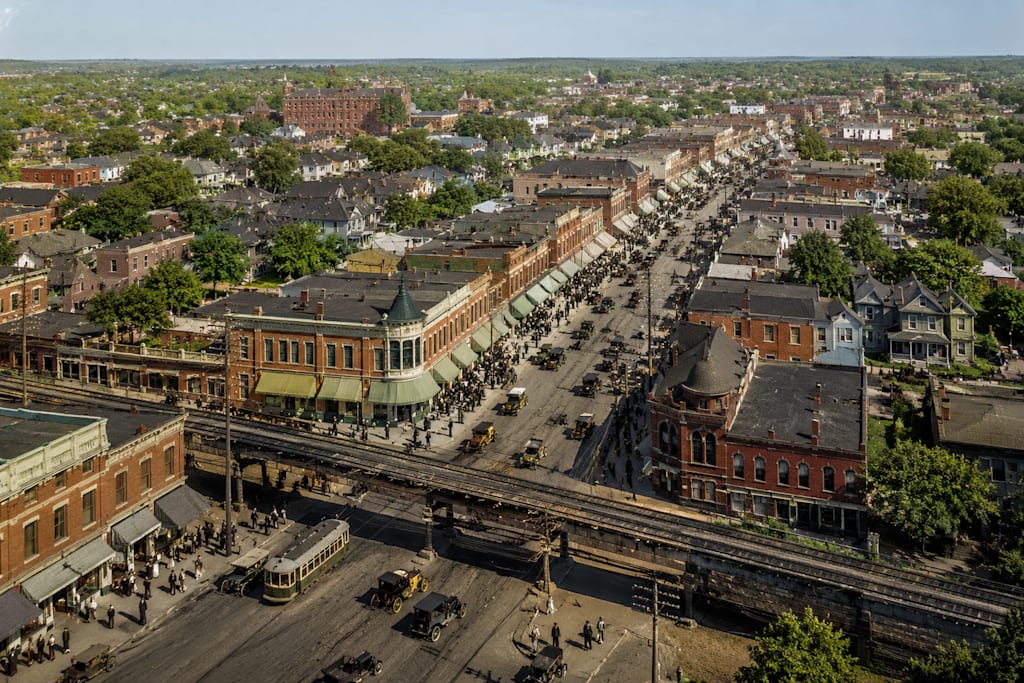
There are places in history that become symbols. Some symbolize triumph, others symbolize tragedy. And a rare few somehow become both at the same time. The Greenwood District of Tulsa is one of those places.
Today, many Americans know Greenwood primarily through the lens of the devastating events of 1921, when one of the worst acts of racial violence in American history destroyed much of the district. Yet focusing solely on the tragedy risks overlooking something equally important.
Before it was attacked, Greenwood was extraordinary. It was a thriving center of Black entrepreneurship, innovation, and prosperity, unlike anything else in the United States.
Known throughout the country as "Black Wall Street," Greenwood stood as living proof that determination, vision, and community could build something remarkable even in an era defined by segregation and discrimination.
Its story is not merely one of destruction. It is the story of what was built. To understand Greenwood, one must first understand the America in which it emerged. The early twentieth century was not an easy time for African Americans. Across much of the nation, Jim Crow laws restricted opportunities, enforced segregation, and limited economic advancement. In many communities, Black citizens faced obstacles at nearly every turn, from education and employment to housing and political participation.
Yet history often reveals an unexpected truth. When doors close, people find windows. And in the growing city of Tulsa, those windows opened wider than anyone could have imagined. The foundation for Greenwood's success was laid by a remarkable man named O. W. Gurley.
Born shortly after the Civil War, Gurley arrived in Oklahoma during a period of tremendous growth. Recognizing opportunity where others saw uncertainty, he purchased forty acres of land north of the Frisco railroad tracks and began selling parcels specifically to African Americans.
His vision was simple but powerful. Create a community where Black families could own property, build businesses, and shape their own future. That vision would change history. As Tulsa expanded, Greenwood flourished. New businesses appeared almost constantly.
A grocery store opened. Then a pharmacy. Then a restaurant. Then another and another! Soon, doctors established practices. Lawyers opened offices. Dentists welcomed patients. Tailors crafted suits. Barbershops buzzed with conversation. Newspapers circulated local news. Hotels accommodated travelers. Real estate firms helped families purchase homes.
The district became a hive of activity. Money circulated within the community, creating a powerful economic engine. Residents shopped locally, hired locally, invested locally, and built wealth that remained within Greenwood's borders. The result was remarkable.
By the late 1910s, Greenwood had become one of the most prosperous African-American communities in the nation. Visitors often struggled to believe what they were seeing.
Along Greenwood Avenue stood elegant brick buildings housing thriving businesses. The streets bustled with customers. Well-dressed professionals moved between offices and storefronts. Luxury automobiles appeared throughout the district.
At a time when much of America questioned whether African Americans could achieve economic independence, Greenwood offered a clear and undeniable answer. They already had.
Some residents owned multiple businesses. Others invested in commercial real estate. Teachers, physicians, entrepreneurs, and skilled tradespeople formed a growing middle and upper class.
The community became so successful that Booker T. Washington reportedly referred to it as "Negro Wall Street," a phrase that eventually evolved into the more widely known "Black Wall Street."
The nickname stuck because it fit. Greenwood wasn't merely prosperous. It was thriving on a scale that attracted national attention. The district's achievements extended far beyond business. Greenwood developed its own cultural identity.
Churches became centers of community life. Schools educated future generations. Theaters screened films to enthusiastic audiences. Music drifted through dance halls and gathering places. Families built beautiful homes. Children played in neighborhoods filled with optimism. People dreamed and made those dreams a reality.
That may sound simple and obvious, but dreams are powerful things. Especially when they begin to take shape. Perhaps most impressive was the sheer self-sufficiency of the community.
Segregation had created countless barriers, but Greenwood responded by building its own institutions. Need medical care? There were Black doctors. Need legal representation? There were Black attorneys. Need a hotel? There were Black-owned luxury accommodations. Need financing? There were Black-owned financial institutions.
Greenwood became a model of economic circulation, with wealth remaining within the district and helping generate further prosperity. In many ways, it represented one of the most successful examples of community-based economic development in American history. And it accomplished this despite enormous social and political obstacles.
By 1921, Greenwood's success had become impossible to ignore. The district contained hundreds of businesses. Its population had grown substantially. Property values continued rising. Many residents enjoyed standards of living that rivaled or exceeded those of neighboring communities.
The future seemed bright. But history often reminds us that prosperity alone does not guarantee security. And in Greenwood's case, success itself became part of the problem.
On May 31 and June 1, 1921, following allegations involving a young Black man and a white woman, tensions exploded into violence. What followed became known as the Tulsa Race Massacre. Armed white mobs descended upon Greenwood. Buildings were looted. Homes were burned. Businesses were destroyed. Entire blocks disappeared beneath smoke and flames.
Witnesses described scenes resembling a war zone. By the time the violence ended, much of Greenwood had been reduced to ashes. Thousands were left homeless. Countless livelihoods vanished overnight. The human toll was devastating. The scale of destruction is difficult to comprehend. More than thirty city blocks were damaged or destroyed.
Hundreds of businesses disappeared. Schools, churches, hotels, homes, and offices vanished. Generations of accumulated wealth were wiped away in a matter of hours.
Imagine building a community for decades. Imagine creating something extraordinary against tremendous odds. Imagine watching it burn. That was Greenwood's reality. And yet, even amid the devastation, another remarkable chapter began. The survivors rebuilt. Against all logic and expectation, many residents refused to abandon Greenwood. They cleared rubble. They reopened businesses. They reconstructed homes. They started again.
The recovery was neither quick nor easy, but it demonstrated the same resilience that had built the district in the first place. For years afterward, Greenwood continued functioning as a center of Black business and culture despite the enormous losses it had suffered. The spirit that created Black Wall Street proved harder to destroy than its buildings.
One of the most striking aspects of the story is how long it remained absent from public discussion. For decades, many Americans knew little or nothing about Greenwood. The massacre received limited attention in textbooks.
Survivor accounts often remained confined to families and local communities. Entire generations grew up unaware that one of America's most successful Black economic centers had ever existed. In some cases, people learned about the destruction before they learned about the achievement. But the achievement is the heart of the story. Because Greenwood was never important simply because it was attacked. Greenwood was important because of what it became.
Every Iron Lighthouse story eventually arrives at a deeper truth hidden beneath the historical details. Here, that truth shines brightly. Greenwood reminds us that history is not only about what was lost. It is also about what was possible.
The district represented vision transformed into reality. It demonstrated what determination, entrepreneurship, education, and community support could accomplish under extraordinarily difficult circumstances.
Its success challenged assumptions. Its existence proved a point... that proof mattered.
Today, Greenwood remains a powerful symbol. Not because it was perfect. Not because it was untouched by hardship. But it showed what people could build when given opportunity and purpose. The true American spirit in living color.
The buildings may have been destroyed. The streets may have changed. But the story endures. A story of entrepreneurs opening businesses when others expected failure. A story of families building wealth when others predicted dependence. A story of a community that refused to be defined by limitations imposed from outside. And ultimately, a story of resilience powerful enough to survive even tragedy.
Because some lights shine so brightly that even history's darkest moments cannot fully extinguish them. Greenwood was one of those lights. And more than a century later, its glow still reaches us, if we just look for it!
About the Creator
The Iron Lighthouse
Where folklore meets freeway. A guide to the strange heart of the American backroads...
Enjoyed the story? Support the Creator.
Subscribe for free to receive all their stories in your feed.
Comments
There are no comments for this story
Be the first to respond and start the conversation.