
Why Ships Have a Circle with a Line on the Hull — and What It Has to Do with Human Lives
How one simple mark on a ship’s hull became a life-and-death rule against overloading in the merchant fleet.
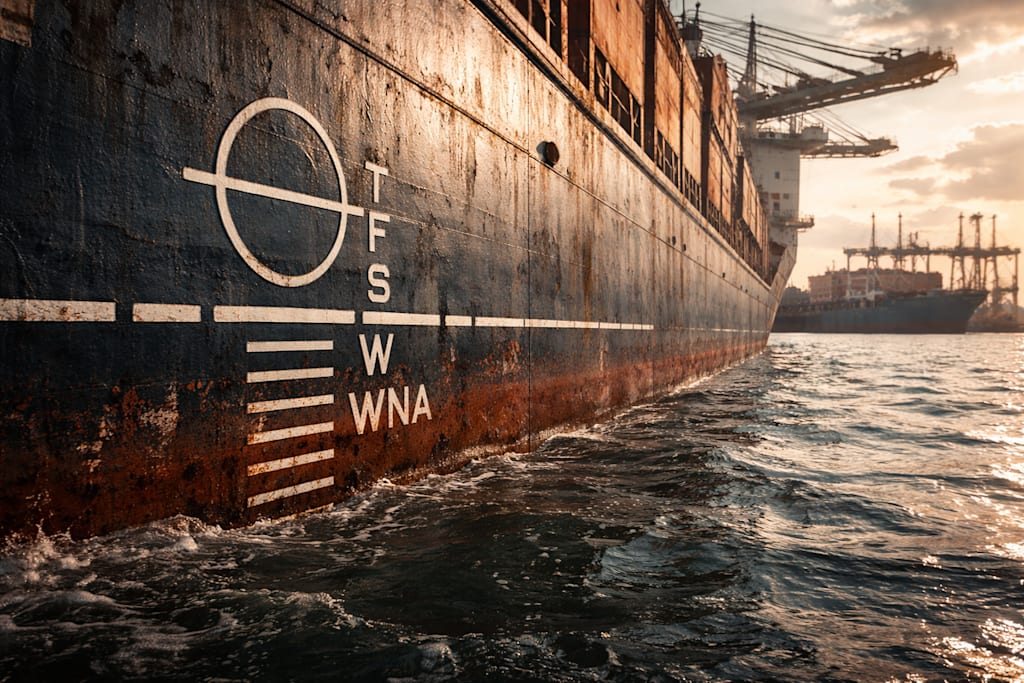
If you look at a cargo ship in port, you may notice a mark on the hull: a circle with a horizontal line through it, and beside it several short lines with letters. To someone outside the maritime world, it looks like an ordinary technical marking. In reality, it is one of the most useful things ever invented for the merchant fleet. It is called the Plimsoll line, or the load line.
What the Plimsoll line shows
Its meaning is simple: it shows the ship’s safe draught. In other words, how deeply the hull may sit in the water after loading. If the water is below the proper mark, everything is normal. If the line has gone under water, the ship is overloaded.
Why does that matter? Because an overloaded ship has too little freeboard left — the distance from the water to the deck. The smaller that distance, the easier it is for waves to sweep across the deck. Such a ship handles worse, responds more slowly to the helm, drives its bow more heavily into waves, and in a storm loses its margin of stability more quickly.
In calm water, overloading may not look disastrous. But in bad weather, the difference between “acceptable” and “too deep” becomes a question of survival.
In the nineteenth century, this was especially critical. There were no proper forecasts and no modern control systems. That is why a simple mark on the side worked better than any complicated explanation: one glance, and it was immediately clear whether the ship was safely loaded or not.
Who Plimsoll was

Samuel Plimsoll was not a sailor and not an engineer. He was a British politician who, before entering Parliament, had been involved in the coal trade.
It was through trade that he saw how maritime cargo transport really worked. Shipowners often saved money on repairs, kept old hulls in service, and loaded ships to the limit. The logic was simple: more cargo meant more profit. The risk to the crew was treated as something secondary. Plimsoll began campaigning to ensure that overloading at least stopped being normal practice. He spoke in Parliament, gathered data on lost ships, wrote about how the business operated, and demanded the introduction of a mandatory mark on the hull below which loading would no longer be allowed.
“Coffin ships”
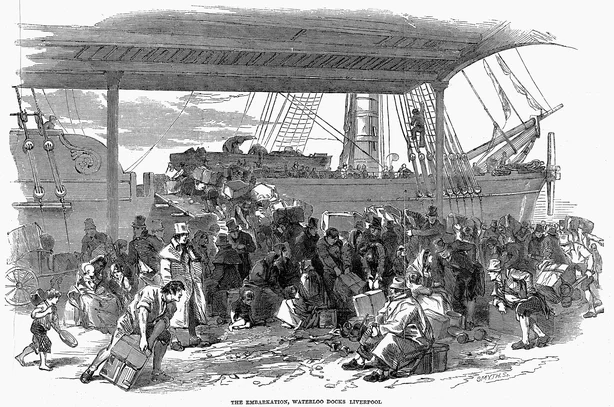
In Britain at that time there was even a phrase for them: coffin ships. That was the name given to ships that were dangerous from the outset — old, badly repaired, overloaded, and sometimes heavily over-insured as well.
The problem was not only bad weather. Sometimes it was almost more profitable for the owner to lose the ship than to operate it properly: the insurance payment covered more than the real value of the vessel.
One of the best-known cases was the loss of the steamship SS London in 1870. She sailed in winter, was caught in a storm in the Bay of Biscay, and sank. Out of 240 people on board, only 19 survived. It later emerged that the vessel had been overloaded and that her technical condition had raised serious questions. Stories like this became Plimsoll’s strongest argument: the sea is dangerous by itself, but very often it was not the storm that killed people, but ordinary greed.
Why the law was not passed at once
Today the idea seems obvious: if a ship must not be overloaded, then there must be a clear loading limit. But at the time, shipowners and their allies in Parliament strongly resisted it.
Their arguments were roughly these: — the owner knows the capabilities of his ship better than anyone else; — one rule cannot be set for all vessels; — if the weather is good, then extra cargo is not a problem.
In reality, everything came down to money. Any restriction meant that less cargo could be carried per voyage. And that meant less profit.
Plimsoll pressed the issue for years. In 1875, the dispute in Parliament led to a major scandal. When an attempt was made to stall the bill, he lost his temper and openly accused his opponents of protecting people who were sending sailors to their deaths. Formally, he was forced to apologize, but after that the story reached the newspapers and stopped being an internal quarrel among politicians. It became a public scandal.
The law of 1876
In 1876, Britain passed a new Merchant Shipping Act. It made the load line compulsory for British ships. The law did not create one universal mark for all vessels. Owners still calculated it according to the rules for a particular ship. Enforcement, too, was not yet as strict as it later became. But the essential change had taken place: overloading ceased to be “normal practice” and became a violation. That was the first real step. From then on, the load line came to be known as the Plimsoll line, and the name remained.
Why there are several marks, not just one
Later it became clear that one line was not enough for every situation.
A ship sits deeper in fresh water than in salt water. Winter in the North Atlantic is far more severe than summer in warm seas. That means the permissible load has to change as well.
That is why several marks are placed beside the main symbol: S — summer, the standard for seawater; W — winter; WNA — winter North Atlantic, the strictest standard; T — tropical; F — fresh water; TF — tropical fresh water.
The captain looks at where the ship will sail and under what conditions, and then loads it to the proper mark. If the relevant line goes under water, that is already overloading.
How it became an international rule
The British law applied to British ships. But in international trade, that was not enough. The same port would receive vessels under many different flags, and all of them followed different rules.
That is why, in 1930, the first international Load Line Convention was adopted in London. It entered into force in 1933. From that point on, the rules began to apply not only inside a single country, but across international shipping.
Later, in 1966, a new convention was adopted. It remains in force today, though it has been amended since then. By that stage, the issue was no longer just a line on the hull, but more precise calculations, hull strength, stability, and other parameters as well.
But the basic idea stayed the same: a ship must not be loaded any way people please.
About the Creator
Enjoyed the story? Support the Creator.
Subscribe for free to receive all their stories in your feed.
Comments
There are no comments for this story
Be the first to respond and start the conversation.