
The Day Boston Drowned in Molasses
America’s Strangest Industrial Disaster

There are disasters that become etched into history through fire, smoke, and spectacle. Earthquakes split cities apart. Floods swallow entire towns. Explosions leave craters where buildings once stood. And then there are disasters so bizarre that they almost resist belief entirely.
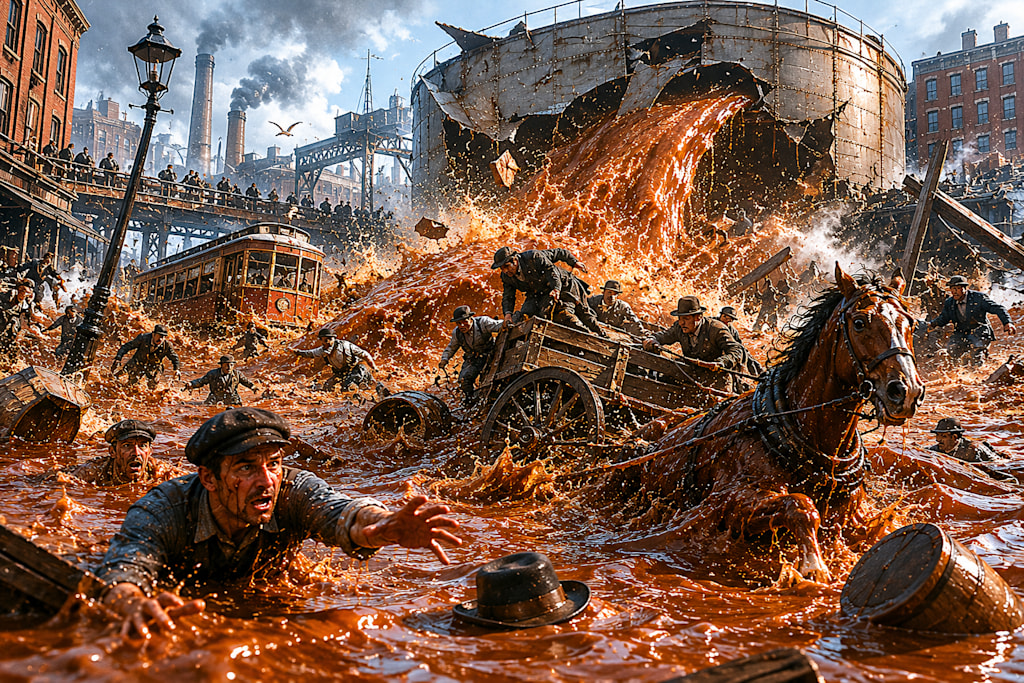
On January 15, 1919, the people of Boston experienced one of the strangest catastrophes in American history when a massive storage tank suddenly burst open, unleashing a deadly wave of molasses through the streets of the city’s North End. Not water. Not oil... Molasses.
A towering brown wall, roughly 25 feet high, surged through the neighborhood at an estimated 35 miles per hour, ripping buildings from their foundations, crushing wagons, trapping horses, and sweeping human beings into a suffocating tidal wave of sticky industrial syrup.
Twenty-one people died and more than 150 were injured. And for decades afterward, locals swore that on especially hot summer days, the faint smell of molasses still lingered in the streets. It sounds absurd. Until you realize how horrifying it truly was.
By 1919, the North End of Boston was alive with industry, immigration, and constant motion. Crowded streets wound between brick buildings while laborers, dockworkers, and families filled the tightly packed neighborhood near the harbor.
Towering above part of the district stood an enormous steel tank owned by the United States Industrial Alcohol Company. The structure held roughly 2.3 million gallons of molasses, a thick syrup imported primarily from the Caribbean.
Molasses was not merely a sweetener in those days. It was industrial fuel for alcohol production. And alcohol production mattered enormously in 1919.
The First World War had recently ended, but industrial demand remained high. Alcohol was essential for munitions, manufacturing, and commercial products. At the same time, the United States stood on the edge of Prohibition, which would officially begin the following year. Rumors circulated that companies were racing to produce as much industrial alcohol as possible before new regulations complicated the market.
Speed mattered. And when speed matters too much, corners often get cut. From the beginning, residents near the tank reportedly suspected something was wrong. The structure leaked constantly.
Children sometimes collected dripping molasses in cans from cracks along the sides. Workers and neighbors described strange groaning noises coming from the tank, especially when it was full. Some accounts claim the company painted the tank brown partly to disguise the leaks from public view.
Whether entirely true or somewhat embellished over time, one fact is undeniable: The tank was dangerously flawed. It had reportedly never been properly tested after construction. Rivets were insufficient. Steel thickness varied. Engineers later concluded that the structure was fundamentally inadequate to withstand the immense pressure exerted by millions of gallons of molasses.
And on a cold January afternoon, all of those failures converged at once. Witnesses described a sound like machine-gun fire as rivets blasted free from the tank walls. Then came the rupture.
The massive steel container exploded outward with catastrophic force, sending an enormous wave of molasses roaring into the surrounding streets. The syrup moved with terrifying momentum, carrying debris, steel fragments, and shattered pieces of the tank itself through the neighborhood. People barely had time to react.
Buildings collapsed almost instantly beneath the pressure. A nearby firehouse was lifted from its foundation and crushed. Elevated railway supports twisted and buckled. Wagons vanished beneath the wave while horses struggled helplessly against the rapidly thickening syrup.
Some victims were swept away immediately. Others became trapped. And that was where the true horror began. Molasses behaves strangely in large quantities. Freshly released from the tank, it moved with shocking speed, especially under pressure. But as the cold Boston air rapidly cooled the liquid, it began thickening almost immediately. What had started as a fast-moving wave soon became something closer to quicksand.
Rescue workers arriving on the scene found entire streets coated in knee-deep syrup. Victims struggled desperately to free themselves while others suffocated under the sheer density of the molasses. Horses panicked and became immobilized. Debris stuck to everything.
Even movement became exhausting. One rescuer later described the scene as though the entire neighborhood had been dipped in glue.
The sounds reportedly haunted witnesses for years afterward. People screaming for help. Steel groaning. Horses thrashing. Buildings collapsing. And beneath it all, the bizarre sloshing roar of molasses flowing through city streets.
The surreal nature of the disaster made it difficult even for newspapers to describe accurately. Early reports struggled to balance the absurdity of the material involved with the staggering violence of what had actually occurred. Because on paper, a “molasses flood” sounds almost comedic. In reality, it was devastating.
The cleanup effort became a nightmare of its own. Firefighters, police officers, sailors, and volunteers worked for days trying to recover bodies and clear the streets. Saltwater was pumped onto roads and buildings in desperate attempts to wash away the syrup, but the molasses spread everywhere. Onto brick walls. Into basements. Across harbor piers. Inside homes.
Workers tracked it throughout the city on boots and equipment. Residents later joked that Boston remained sticky for months, though beneath the humor lingered genuine trauma. The harbor itself reportedly turned brown from the runoff. And still the smell remained. Sweet. Heavy. Almost sickening.
As investigators began examining the disaster, the story shifted from bizarre accident to industrial scandal.
The United States Industrial Alcohol Company initially attempted to deflect blame, suggesting anarchists may have sabotaged the tank. The claim reflected the paranoia of the era, when fears of radical bombings and labor unrest ran high across America.
But the evidence increasingly pointed elsewhere. Engineering failures. Negligent construction. Ignored warnings. Corporate haste. The tank had not been adequately designed to withstand the stress it was subjected to. Some experts later concluded the steel itself contained dangerously high levels of manganese, making it brittle and prone to fracture.
Most damning of all, the company appeared to have ignored repeated warning signs. Leaks. Strange noises. Structural instability. All were dismissed or minimized until the structure finally failed.
The legal aftermath became one of the longest and most significant court battles in the history of early twentieth-century Boston. Families of victims sued the company, leading to years of hearings involving engineers, metallurgists, witnesses, and industrial experts. Eventually, the company was found responsible for the disaster and forced to pay substantial settlements.
The case helped establish important precedents regarding corporate accountability and engineering oversight. In many ways, the Great Molasses Flood became part of a broader shift in how Americans viewed industrial safety during the modern age.
Because by 1919, industry had grown so rapidly that regulation often lagged behind innovation. Massive machines, factories, and storage systems transformed cities faster than safety standards could keep pace.
And when those systems failed, the consequences could be catastrophic. Even when the catastrophe involved molasses. What makes the Great Molasses Flood endure in public imagination is not merely the bizarre material involved. It is the tension between absurdity and tragedy.
At first glance, the story almost sounds humorous. A giant wave of molasses racing through Boston feels closer to cartoon logic than historical reality. But the deeper you look, the darker it becomes. People died terrified and trapped. Entire families were devastated.
A neighborhood was physically shattered because corners had been cut in pursuit of profit and speed. And perhaps that contrast is precisely why the story remains unforgettable. Because history is often stranger than fiction precisely because reality does not care about tone.
Real disasters do not arrive neatly packaged in ways that feel emotionally appropriate. Sometimes, catastrophe comes wrapped in smoke and fire. And sometimes it arrives sweet-smelling and brown.
Every Iron Lighthouse story eventually reaches a point where the strange surface gives way to something deeper beneath. Here, that deeper truth feels painfully modern. The Great Molasses Flood was not truly about molasses. It was about negligence.
About warnings ignored because addressing them would have cost money. About industrial ambition moving faster than responsibility. And about ordinary people paying the price when systems built for profit fail catastrophically. The wave itself lasted only moments, but the consequences lasted years.
Today, there is little visible evidence of the disaster remaining in modern Boston. The North End bustles with restaurants, apartments, and city life. Tourists walk the streets where a deadly tidal wave once surged, unaware of what happened there more than a century ago. But the story lingers. Passed between generations. Repeated in documentaries, history books, and whispered bits of Boston folklore. And always accompanied by that final detail, the one that feels almost ghostly.
That even decades later, on especially hot summer days, some residents claimed they could still smell molasses in the air. A faint sweetness rising from the city itself. As though history had soaked so deeply into the streets that it never completely washed away...
About the Creator
The Iron Lighthouse
Where folklore meets freeway. A guide to the strange heart of the American backroads...
Enjoyed the story? Support the Creator.
Subscribe for free to receive all their stories in your feed.
Comments
There are no comments for this story
Be the first to respond and start the conversation.